Itaki Mariya, Endo Masayuki, Asakura Hiroyuki, Nagashima Mami, Somura Yoshiko, Takahashi Aki, Kayebeta Aya, Takahashi Ikumi, Yahata Yuichiro
Department of Health, Shinjuku City Office, Tokyo, Japan.
Department of Microbiology, Tokyo Metropolitan Institute of Public Health, Tokyo, Japan.
Western Pac Surveill Response J. 2025 Feb 25;16(1):1-10. doi: 10.5365/wpsar.2025.16.1.1088. eCollection 2025 Jan-Mar.
In 2018, the Shinjuku City Department of Health detected excess cases of hepatitis A virus (HAV) infection. The objectives of this investigation were to characterize the outbreak, identify transmission routes among inpatient cases and make recommendations to control and prevent HAV infection among men who have sex with men.
Information about cases of HAV infection was collected from the National Epidemiological Surveillance for Infectious Diseases system and inpatient interviews conducted by public health nurses in 2018.
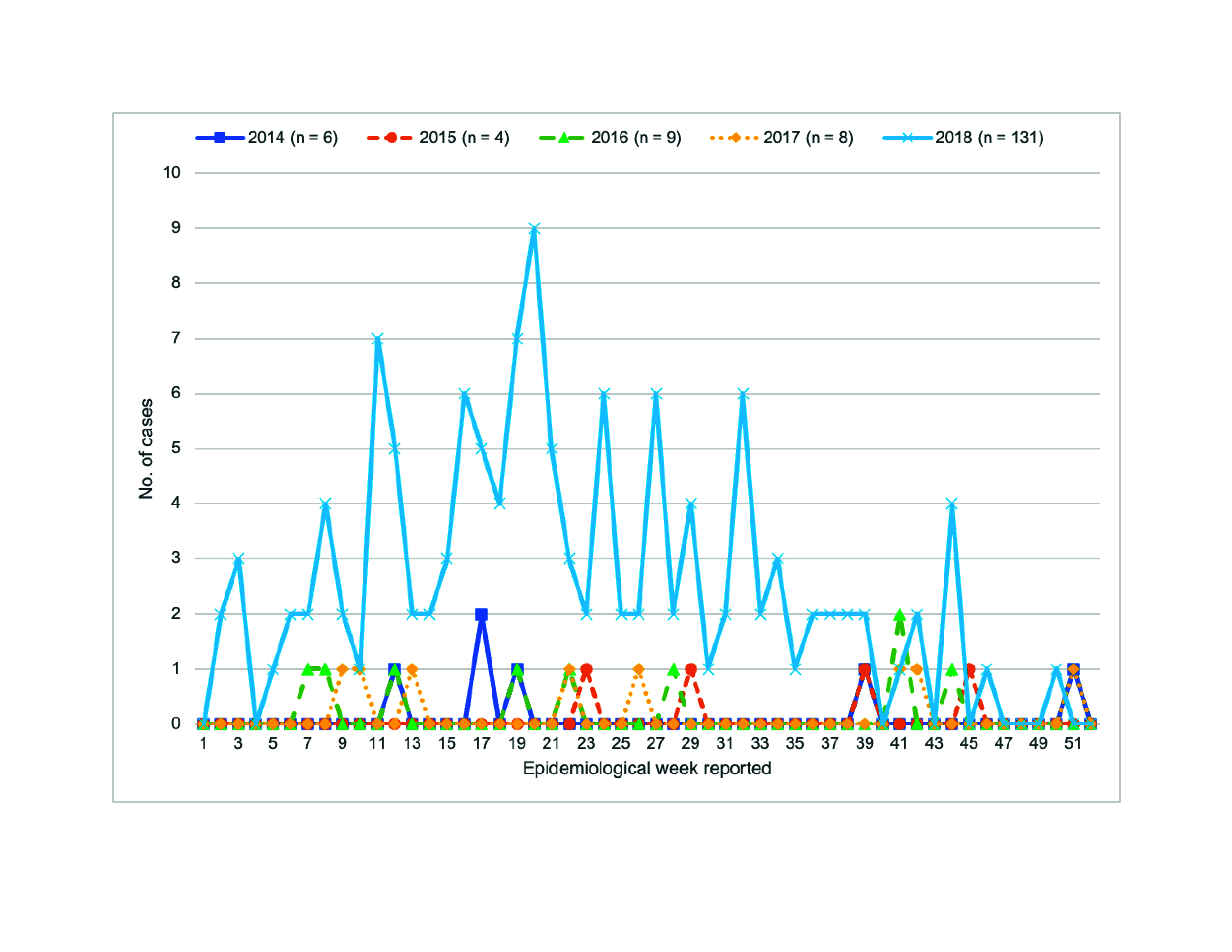
There were 131 HAV cases in 2018. Of these, 98% (129/131) were male, of whom 81% (105/129) were men who have sex with men. Hospitalization was required for 40 cases (31%). The age groups with the highest proportion of cases were 30-39 and 40-49 years (each 34%; 44/131). Two cases (2%) had received the second dose of the HAV vaccine, but only 10 days before symptom onset; all others had received no doses. The sequence type subgroup 13, an RIVM-HAV-16-090-like strain, was seen in 51 cases (39%). Of the 40 hospitalized cases, 21 (53%) participated in an interview conducted using a semistructured questionnaire. Altogether, of 21 cases, 12 (57%) had coinfection with HIV, 13 (62%) had casual sexual contact within the preceding 2 months and 10 (48%) had used social networking services (SNS) to find a sexual partner.
In Shinjuku, this outbreak almost exclusively affected the population of men who have sex with men. The detected outbreak strain has previously been reported in outbreaks among men who have sex with men in China, Taiwan (China) and Europe. For HAV prevention, the most important measures are raising awareness of the risk of HAV as a sexually transmitted infection via SNS and promoting immunization at the appropriate time.
2018年,新宿市卫生部门检测到甲型肝炎病毒(HAV)感染病例数超出正常水平。本次调查的目的是对此次疫情进行特征描述,确定住院病例之间的传播途径,并提出控制和预防男男性行为者感染HAV的建议。
从国家传染病流行病学监测系统以及2018年公共卫生护士进行的住院患者访谈中收集HAV感染病例的信息。
2018年共有131例HAV病例。其中,98%(129/131)为男性,其中81%(105/129)是男男性行为者。40例(31%)需要住院治疗。病例比例最高的年龄组为30 - 39岁和40 - 49岁(各占34%;44/131)。2例(2%)接种过第二剂HAV疫苗,但仅在症状出现前10天接种;其他所有人均未接种过疫苗。51例(39%)病例的序列类型亚组13为RIVM - HAV - 16 - 090样毒株。在40例住院病例中,21例(53%)参与了使用半结构化问卷进行的访谈。在这21例病例中,共有12例(57%)合并感染HIV,13例(62%)在之前2个月内有过偶然性行为接触,10例(48%)曾使用社交网络服务(SNS)寻找性伴侣。
在新宿,此次疫情几乎只影响了男男性行为者群体。检测到的疫情毒株此前在中国、中国台湾地区和欧洲的男男性行为者疫情中也曾有过报告。对于预防HAV,最重要的措施是提高对HAV作为通过SNS传播的性传播感染风险的认识,并在适当时间推广免疫接种。