Rodriguez Lucía Ines Lopez, Amadio Roberto, Piperno Giulia Maria, Benvenuti Federica
Cellular Immunology, International Centre for Genetic Engineering and Biotechnology, Trieste, Italy.
Department of Life Sciences (DSV), University of Trieste, Trieste, Italy.
J Immunother Cancer. 2025 Mar 25;13(3):e010547. doi: 10.1136/jitc-2024-010547.
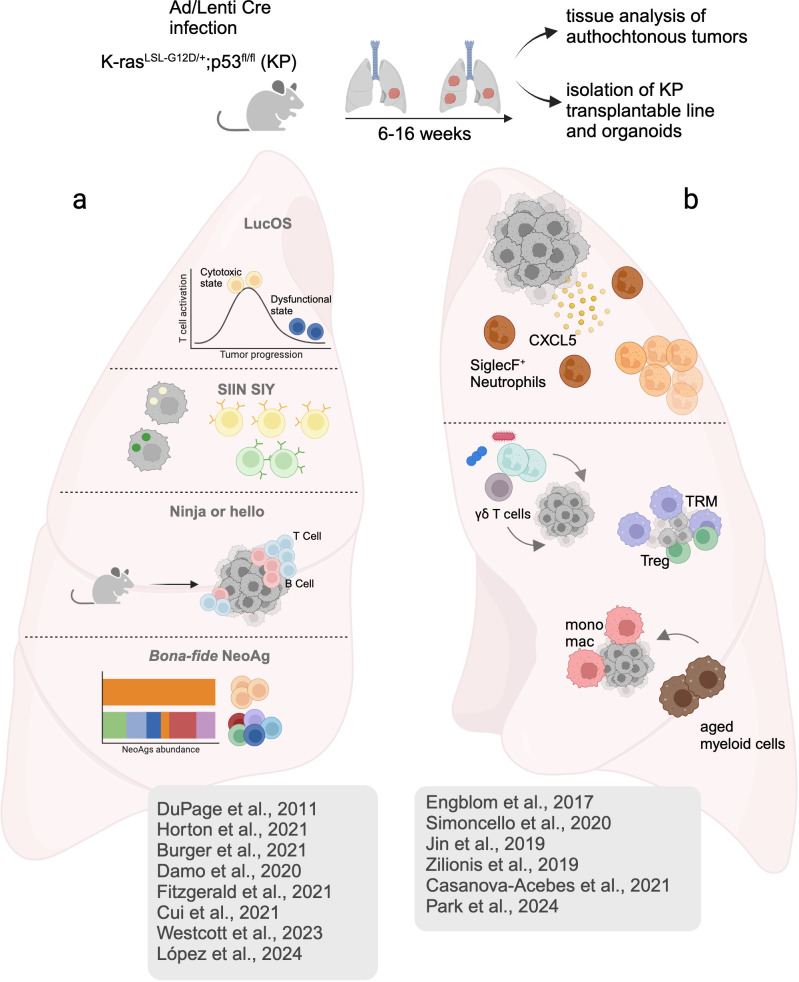
Checkpoint inhibitors have led to remarkable benefits in non-small cell lung cancer (NSCLC), yet response rates remain below expectations. High-dimensional analysis and mechanistic experiments in clinical samples and relevant NSCLC models uncovered the immune composition of lung cancer tissues, providing invaluable insights into the functional properties of tumor-infiltrating T cells and myeloid cells. Among myeloid cells, type 1 conventional dendritic cells (cDC1s) stand out for their unique ability to induce effector CD8 T cells against neoantigens and coordinate antitumoral immunity. Notably, lung resident cDC1 are particularly abundant and long-lived and express a unique tissue-specific gene program, underscoring their central role in lung immunity. Here, we discuss recent insights on the induction and regulation of antitumoral T cell responses in lung cancer, separating it from the tissue-agnostic knowledge generated from heterogeneous tumor models. We focus on the most recent studies dissecting functional states and spatial distribution of lung cDC1 across tumor stages and their impact on T cell responses to neoantigens. Finally, we highlight relevant gaps and emerging strategies to harness lung cDC1 immunostimulatory potential.
检查点抑制剂已在非小细胞肺癌(NSCLC)中带来了显著益处,但缓解率仍低于预期。对临床样本和相关NSCLC模型进行的高维分析及机制实验揭示了肺癌组织的免疫组成,为肿瘤浸润性T细胞和髓样细胞的功能特性提供了宝贵见解。在髓样细胞中,1型常规树突状细胞(cDC1)因其独特能力脱颖而出,即诱导效应性CD8 T细胞针对新抗原并协调抗肿瘤免疫。值得注意的是,肺驻留cDC1特别丰富且寿命长,并表达独特的组织特异性基因程序,突出了它们在肺免疫中的核心作用。在此,我们讨论了近期关于肺癌中抗肿瘤T细胞反应诱导和调节的见解,将其与从异质性肿瘤模型中产生的与组织无关的知识区分开来。我们重点关注剖析肿瘤各阶段肺cDC1功能状态和空间分布及其对T细胞针对新抗原反应影响的最新研究。最后,我们强调了相关差距以及利用肺cDC1免疫刺激潜力的新兴策略。