Sion Guy, D'Amore Domenic C
Department of Science, The David Yellin Academic College of Education, Jerusalem 9103501, Israel.
Gulbali Institute, Charles Sturt University, Boorooma Street, Locked Bag 588, Wagga Wagga, NSW 2678, Australia.
J Dev Biol. 2025 Mar 10;13(1):9. doi: 10.3390/jdb13010009.
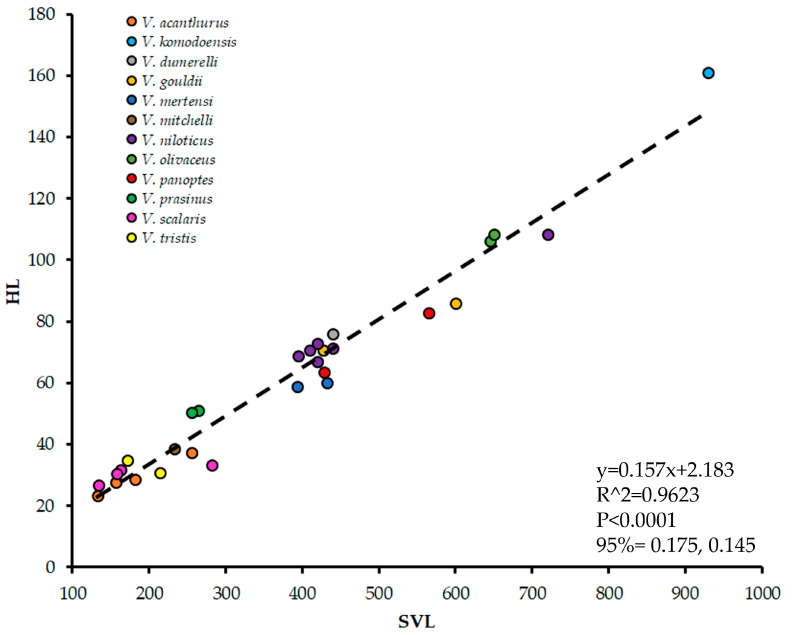
Stressors such as injuries, embryonic instability during development, and higher levels of stress hormones such as testosterone can result in increases in fluctuating asymmetry in reptiles and other vertebrates. Digit asymmetry, digit ratio variability, and skull trait asymmetry such as eye and jaw size have been correlated with stress level in both snakes and lizards. Teeth asymmetry has also been used as a biomarker for stress and brain laterality. Body size is correlated with many potential stressors, yet there has been little research on how body size in reptiles relates to asymmetry. We investigate teeth asymmetry within the lizard family Varanidae, a clade with a diverse range of sizes consisting of the largest living lizard, . Using a landmark/semi-landmark analysis, we derived Centroid Size for 671 pairs of teeth from 13 varanid species, and asymmetry was derived for each pair. Right-biased asymmetry was significantly greater in the upper tooth row, but breaking up tooth positions into further sections did not yield a significant difference. We found a significant positive linear correlation between body size and right-biased teeth directional asymmetry within , but only when excluding . This significant correlation may result from fewer potential predators and more potential food items, thus resulting in less overall stress. When analyzed separately, individuals with <180 mm head length demonstrated a positive, yet non-significant, trend along a similar trajectory to their congenerics with a high goodness of fit. On the other hand, individuals > 180 mm showed a high degree of scatter, with several specimens having pronounced left-biased asymmetry. We suspect that this dramatic change was due to a combination of ontogenetic niche shift, bigger home ranges, a greater susceptibility to negative anthropogenic influences, and/or a male bias in the bigger specimens sampled, but a larger sample size is required to determine if there is statistical significance in these intra-specific trends. Body asymmetry can reflect brain laterality, which may be a potential driver for the teeth asymmetry seen here.
诸如受伤、发育过程中的胚胎不稳定以及睾酮等应激激素水平升高等应激源,会导致爬行动物和其他脊椎动物的波动不对称性增加。指不对称性、指比变异性以及头骨特征不对称性(如眼睛和颌骨大小)已被证明与蛇和蜥蜴的应激水平相关。牙齿不对称性也被用作应激和大脑偏侧性的生物标志物。身体大小与许多潜在应激源相关,但关于爬行动物的身体大小与不对称性之间的关系,研究甚少。我们研究了巨蜥科蜥蜴的牙齿不对称性,该科包含各种体型的物种,其中包括现存最大的蜥蜴。通过地标/半地标分析,我们从13种巨蜥物种的671对牙齿中得出了质心大小,并计算了每对牙齿的不对称性。上牙列中右偏不对称性显著更大,但将牙齿位置进一步细分并没有产生显著差异。我们发现身体大小与 内右偏牙齿方向不对称性之间存在显著的正线性相关,但仅在排除 时如此。这种显著的相关性可能是由于潜在捕食者较少和潜在食物较多,从而导致总体应激较小。单独分析时,头长小于180毫米的个体呈现出与同属较大个体相似的正向但不显著的趋势,拟合优度较高。另一方面,头长大于180毫米的个体呈现出高度离散,有几个标本表现出明显的左偏不对称性。我们怀疑这种显著变化是由于个体发育生态位转移、更大的活动范围、对负面人为影响的更大易感性和/或所采样的较大标本中雄性占比偏高等多种因素共同作用,但需要更大的样本量来确定这些种内趋势是否具有统计学意义。身体不对称性可以反映大脑偏侧性,这可能是此处所见牙齿不对称性的一个潜在驱动因素。