Cavanagh Megan, Amabebe Emmanuel, Kulkarni Neha S, Papageorgiou Maria D, Walker Heather, Wyles Matthew D, Anumba Dilly O
Division of Clinical Medicine, University of Sheffield, Sheffield, UK.
School of Biosciences, University of Sheffield, Sheffield, UK.
NPJ Biofilms Microbiomes. 2025 Mar 26;11(1):52. doi: 10.1038/s41522-025-00671-4.
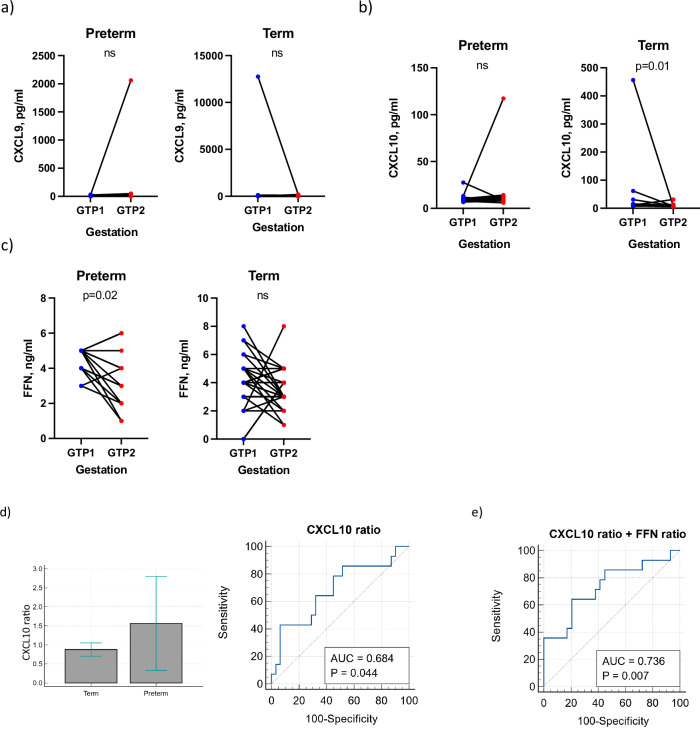
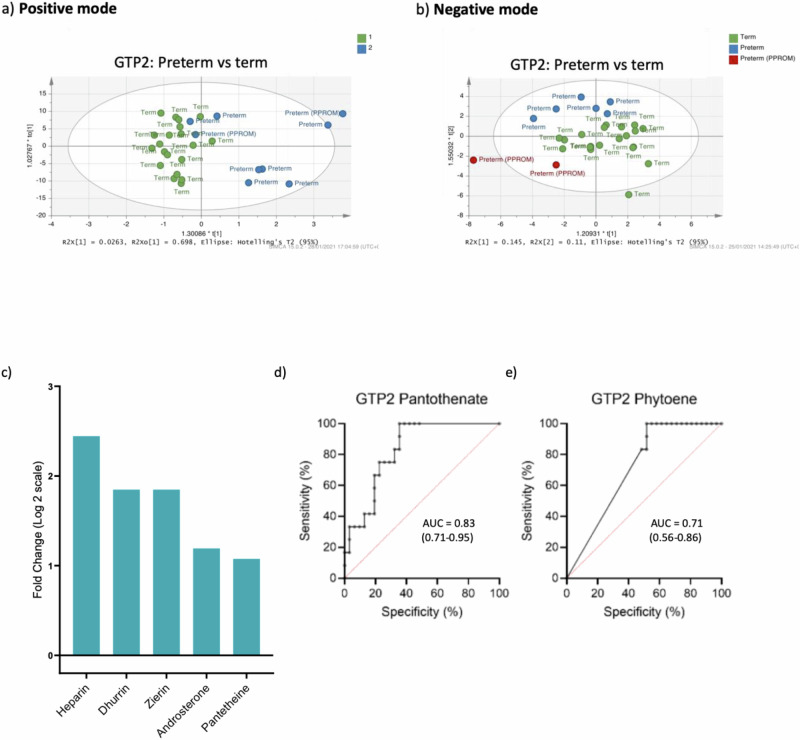
In order to improve spontaneous preterm birth (sPTB) risk stratification in a predominantly white cohort of non-labouring pregnant women, we analysed their vaginal microbiota, metabolite, cytokine and foetal fibronectin (FFN) concentrations at two gestational time points (GTPs): GTP1 (20-22 weeks, preterm = 17; term = 32); and GTP2 (26-28 weeks, preterm = 14; term = 31). At GTP1, the preterm-delivered women showed abundant G. vaginalis (AUC = 0.77) over L. crispatus and L. iners, and upregulation of 10 metabolites. At GTP2, the same women had more lactobacilli- and mixed anaerobes-dominated microbiota, upregulation of five metabolites, and decreased TNFR1, distinguishing them from their term counterparts (AUC = 0.88). From GTP1 to GTP2, sPTB was associated with increased microbiota α-diversity, and upregulation of pantothenate and urate. CXCL10 declined in the term-delivered women by ~3-fold, but increased in the preterm-delivered women (AUC = 0.68), enhanced by FFN (AUC = 0.74). Characterising the complex dynamic interactions between cervicovaginal microbial metabolites and host immune responses could enhance sPTB risk stratification.
为了改善以白人为主的未临产孕妇队列中自发性早产(sPTB)的风险分层,我们分析了她们在两个妊娠时间点(GTP)的阴道微生物群、代谢物、细胞因子和胎儿纤连蛋白(FFN)浓度:GTP1(20 - 22周,早产 = 17例;足月产 = 32例);以及GTP2(26 - 28周,早产 = 14例;足月产 = 31例)。在GTP1时,早产分娩的女性阴道加德纳菌(AUC = 0.77)比卷曲乳酸杆菌和惰性乳酸杆菌丰富,并且有10种代谢物上调。在GTP2时,同样这些女性的微生物群以乳酸杆菌和混合厌氧菌为主,5种代谢物上调,并且肿瘤坏死因子受体1(TNFR1)降低,这使她们与足月产的女性区分开来(AUC = 0.88)。从GTP1到GTP2,sPTB与微生物群α多样性增加以及泛酸盐和尿酸上调有关。CXCL在足月产女性中下降了约3倍,但在早产分娩的女性中升高(AUC = 0.68),胎儿纤连蛋白使其增强(AUC = 0.74)。表征宫颈阴道微生物代谢物与宿主免疫反应之间复杂的动态相互作用可以增强sPTB风险分层。