Mariadas Heidi, Chen Jie-Hong, Chen Kuo-Hu
Department of Obstetrics and Gynecology, Taipei Tzu-Chi Hospital, The Buddhist Tzu-Chi Medical Foundation, New Taipei City 23142, Taiwan.
Department of Medicine, MacKay Medical College, New Taipei City 25245, Taiwan.
Int J Mol Sci. 2025 Mar 10;26(6):2458. doi: 10.3390/ijms26062458.
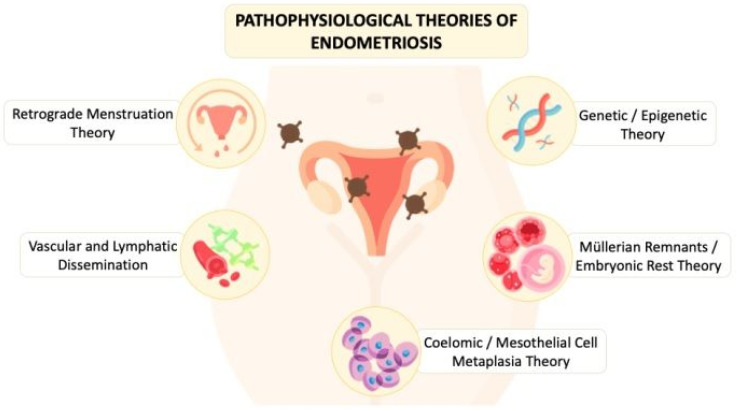
Endometriosis is a complex gynecological disorder characterized by endometrial-like tissue growing outside the uterus, leading to chronic pain, infertility, and reduced quality of life. Its pathophysiology involves genetic, epigenetic, immune, and molecular factors. Theories such as retrograde menstruation, coelomic metaplasia, and stem cell involvement explain lesion formation. Endometrial mesenchymal stem cells (eMSCs) and epithelial progenitors (eEPs) contribute to lesion establishment by adhering to peritoneal surfaces, proliferating, and differentiating into ectopic tissue. Aberrant adhesion molecules, inflammatory cytokines, and molecular pathways like PI3K/Akt and Wnt/β-catenin drive proliferation, angiogenesis, and resistance to apoptosis. Elevated estrogen levels and progesterone resistance further promote lesion growth and immune evasion. Immune dysfunction, including altered macrophage activity and reduced natural killer (NK) cell function, contributes to inflammation and lesion persistence. Pain is linked to prostaglandin E2 (PGE2) and nerve infiltration, emphasizing the need for targeted pain management. Current therapies, such as GnRH agonists, suppress ovarian hormone production but face limitations in long-term efficacy and side effects. Integrating molecular insights into clinical practice may advance diagnostics and treatment, with emerging approaches focusing on molecular pathways, immune modulation, and hormonal regulation for more effective, personalized therapies. Future research should unravel the complex mechanisms driving endometriosis to improve patient outcomes.
子宫内膜异位症是一种复杂的妇科疾病,其特征是子宫内膜样组织在子宫外生长,导致慢性疼痛、不孕和生活质量下降。其病理生理学涉及遗传、表观遗传、免疫和分子因素。诸如经血逆流、体腔化生和干细胞参与等理论解释了病变的形成。子宫内膜间充质干细胞(eMSCs)和上皮祖细胞(eEPs)通过粘附于腹膜表面、增殖并分化为异位组织,从而促成病变的形成。异常的粘附分子、炎性细胞因子以及PI3K/Akt和Wnt/β-连环蛋白等分子途径驱动增殖、血管生成和抗凋亡作用。雌激素水平升高和孕激素抵抗进一步促进病变生长和免疫逃逸。免疫功能障碍,包括巨噬细胞活性改变和自然杀伤(NK)细胞功能降低,会导致炎症和病变持续存在。疼痛与前列腺素E2(PGE2)和神经浸润有关,这凸显了针对性疼痛管理的必要性。目前的治疗方法,如促性腺激素释放激素(GnRH)激动剂,可抑制卵巢激素的产生,但在长期疗效和副作用方面存在局限性。将分子见解整合到临床实践中可能会推动诊断和治疗的发展,新出现的方法侧重于分子途径、免疫调节和激素调节,以实现更有效、个性化的治疗。未来的研究应阐明驱动子宫内膜异位症的复杂机制,以改善患者的治疗效果。