Khowdiary Manal M, Khan Shoaib, Iqbal Tayyiaba, Rehman Wajid, Khan Muhammad Bilal, Rehman Mujaddad Ur, Fiaz Zanib
Department of Chemistry, Faculty of Applied Science, University College-Al Leith, University of Umm Al-Qura, Makkah 21955, Saudi Arabia.
Department of Chemistry, Abbottabad University of Science and Technology, Abbottabad 22500, Pakistan.
Pharmaceuticals (Basel). 2025 Mar 15;18(3):415. doi: 10.3390/ph18030415.
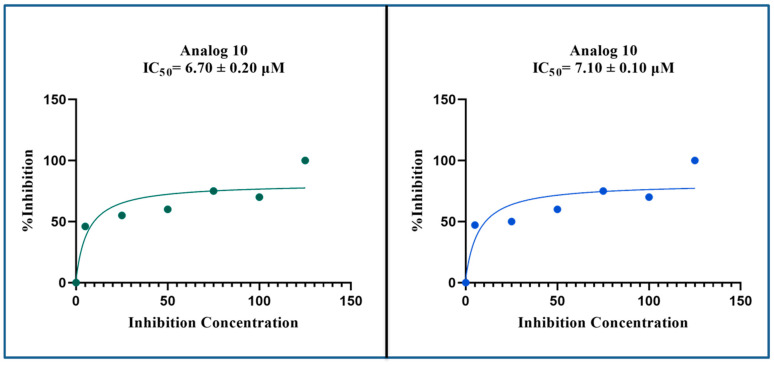
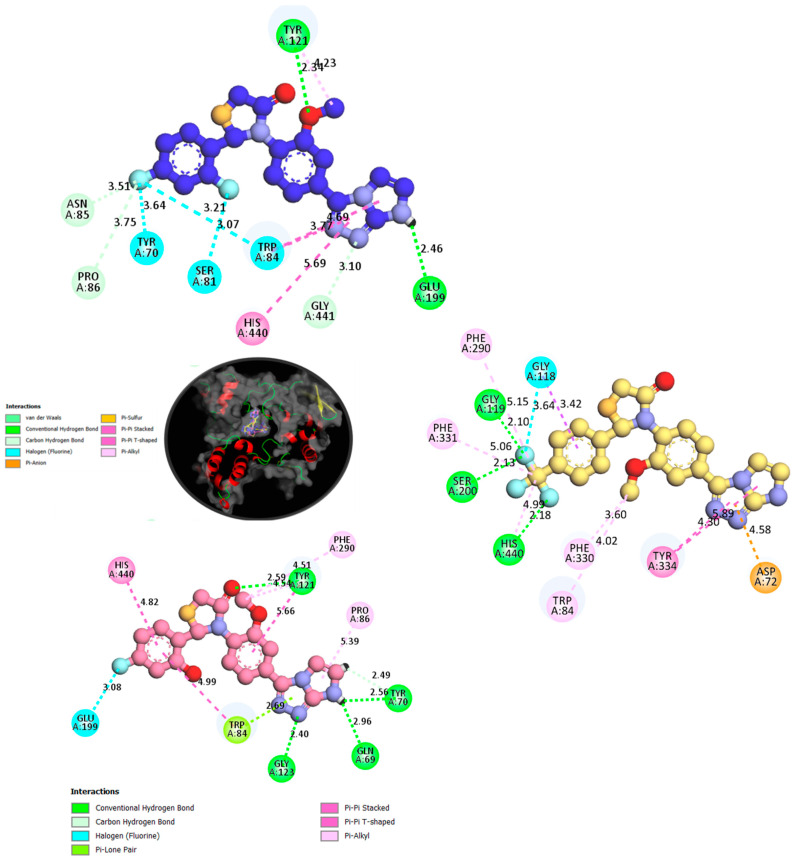
Alzheimer's disease is a complex and multifactorial brain disorder characterized by gradual memory impairment, cognitive disturbance, and severe dementia, and, ultimately, its progression leads to patient death. This research work presents the design, synthesis, and characterization of novel imidazotriazole-based thiazolidinone derivatives (-), displaying promising anti-Alzheimer's activity. These derivatives were synthesized by using 1-imidazole-2-thiol as a starting reagent. Structural characterization was accomplished by C-NMR and H-NMR, while the molecular weight was confirmed by HREI-MS. These compounds were investigated for their anti-Alzheimer's potential under an in vitro analysis. These compounds showed a significant to moderate biological potential against AChE and BChE in comparison to donepezil (IC = 8.50 µM and 8.90 µM against AChE and BuChE), used as a reference drug. Among these compounds, analog with IC values of 6.70 µM and 7.10 µM against AChE and BuChE emerged as the lead compound of the series with promising biological efficacy against targeted enzymes. Molecular docking revealed the interactive nature of active ligands against target enzymes. These compounds were also assessed under dynamic conditions to examine the structural deviation and conformational changes in a protein complex structure. DFT calculations provided the relative stability and reactivity of the lead compounds. An ADMET analysis showed that these compounds have no toxicological profile. This research study paves the way for the further development and optimization of novel and selective imidazotriazole-based thiazolidinone inhibitors as potent anti-Alzheimer's agents.
阿尔茨海默病是一种复杂的多因素脑部疾病,其特征为逐渐出现的记忆障碍、认知紊乱和严重痴呆,最终病情进展会导致患者死亡。本研究工作介绍了新型咪唑并三唑基噻唑烷酮衍生物(-)的设计、合成与表征,这些衍生物展现出有前景的抗阿尔茨海默病活性。这些衍生物是以1-咪唑-2-硫醇作为起始试剂合成的。通过碳核磁共振(C-NMR)和氢核磁共振(H-NMR)完成结构表征,同时通过高分辨电子轰击电离质谱(HREI-MS)确定分子量。在体外分析中研究了这些化合物的抗阿尔茨海默病潜力。与用作参比药物的多奈哌齐(对乙酰胆碱酯酶(AChE)和丁酰胆碱酯酶(BuChE)的抑制常数(IC)分别为8.50 μM和8.90 μM)相比,这些化合物对AChE和BChE显示出显著至中等的生物学潜力。在这些化合物中,对AChE和BuChE的IC值分别为6.70 μM和7.10 μM的类似物成为该系列的先导化合物,对靶向酶具有有前景的生物学功效。分子对接揭示了活性配体与靶向酶的相互作用性质。还在动态条件下评估了这些化合物,以检查蛋白质复合物结构中的结构偏差和构象变化。密度泛函理论(DFT)计算提供了先导化合物的相对稳定性和反应活性。一项药物代谢动力学/药物毒性预测(ADMET)分析表明这些化合物没有毒理学特征。本研究为进一步开发和优化新型、选择性的咪唑并三唑基噻唑烷酮抑制剂作为有效的抗阿尔茨海默病药物铺平了道路。