
基于身体活动奖励的数字应用程序使用对心脏代谢和心血管疾病发病率的现实世界影响。
Real-world impact of physical activity reward-driven digital app use on cardiometabolic and cardiovascular disease incidence.
作者信息
Berliner Senderey Adi, Mushkat Tom, Hadass Ofer, Carmeli Daphna, Hayek Samah, Charpingnon Marie-Laura, Jacobson Eyal, Balicer Ran D
机构信息
Clalit Research Institute, Innovation Division, Clalit Health Services, Ramat Gan, Israel.
Department of Biomedical Informatics, Harvard Medical School, Boston, MA, USA.
出版信息
Commun Med (Lond). 2025 Mar 27;5(1):94. doi: 10.1038/s43856-025-00792-z.
BACKGROUND
The lack of effective tools available to health providers for enhancing patient physical activity prompts this study to examine the real-world impact of a physical activity reward-driven app on health outcomes, utilizing Electronic Health Records (EHR) data from Israel's largest healthcare organization.
METHODS
Conducting a retrospective cohort study, we matched app-users to non-users based on demographic and clinical characteristics.
RESULTS
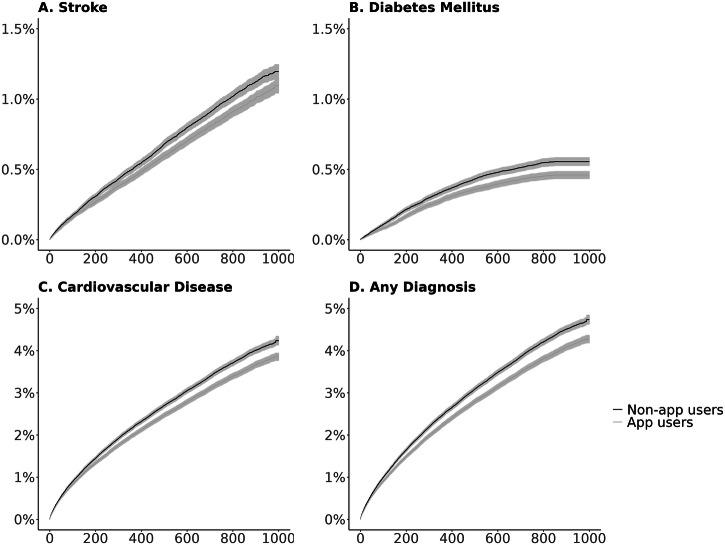
App-users have a significantly lower risk of cardiovascular disease (HR 0.95), stroke (HR 0.91), and type 2 diabetes (HR 0.82) compared to non-app users. Higher levels of physical activity among app users further reduce the incidence of cardiovascular disease (HR 0.87), stroke (HR 0.84), and type 2 diabetes (HR 0.75) compared with non-app user. However, engagement in mild physical activity, as measured by step count, does not differ from non- users in the incidence of these conditions.
CONCLUSIONS
These findings highlight the potential of app-based interventions to promote higher levels of physical activity and mitigate major vascular and metabolic illnesses.
背景
医疗服务提供者缺乏有效的工具来提高患者的身体活动水平,促使本研究利用以色列最大医疗保健机构的电子健康记录(EHR)数据,考察一款基于身体活动奖励的应用程序对健康结果的实际影响。
方法
我们进行了一项回顾性队列研究,根据人口统计学和临床特征将应用程序用户与非用户进行匹配。
结果
与非应用程序用户相比,应用程序用户患心血管疾病(风险比0.95)、中风(风险比0.91)和2型糖尿病(风险比0.82)的风险显著更低。与非应用程序用户相比,应用程序用户更高水平的身体活动进一步降低了心血管疾病(风险比0.87)、中风(风险比0.84)和2型糖尿病(风险比0.75)的发病率。然而,通过步数衡量的轻度身体活动参与度在这些疾病的发病率方面与非用户并无差异。
结论
这些发现凸显了基于应用程序的干预措施在促进更高水平身体活动以及减轻主要血管和代谢疾病方面的潜力。



 Zotero 插件