Szinay Dorothy, Jones Andy, Chadborn Tim, Brown Jamie, Naughton Felix
School of Health Sciences, University of East Anglia, Norwich, United Kingdom.
Norwich Medical School, University of East Anglia, Norwich, United Kingdom.
J Med Internet Res. 2020 May 29;22(5):e17572. doi: 10.2196/17572.
The public health impact of health and well-being digital interventions is dependent upon sufficient real-world uptake and engagement. Uptake is currently largely dependent on popularity indicators (eg, ranking and user ratings on app stores), which may not correspond with effectiveness, and rapid disengagement is common. Therefore, there is an urgent need to identify factors that influence uptake and engagement with health and well-being apps to inform new approaches that promote the effective use of such tools.
This review aimed to understand what is known about influences on the uptake of and engagement with health and well-being smartphone apps among adults.
We conducted a systematic review of quantitative, qualitative, and mixed methods studies. Studies conducted on adults were included if they focused on health and well-being smartphone apps reporting on uptake and engagement behavior. Studies identified through a systematic search in Medical Literature Analysis and Retrieval System Online, or MEDLARS Online (MEDLINE), EMBASE, Cumulative Index to Nursing and Allied Health Literature (CINAHL), PsychINFO, Scopus, Cochrane library databases, DataBase systems and Logic Programming (DBLP), and Association for Computing Machinery (ACM) Digital library were screened, with a proportion screened independently by 2 authors. Data synthesis and interpretation were undertaken using a deductive iterative process. External validity checking was undertaken by an independent researcher. A narrative synthesis of the findings was structured around the components of the capability, opportunity, motivation, behavior change model and the theoretical domains framework (TDF).
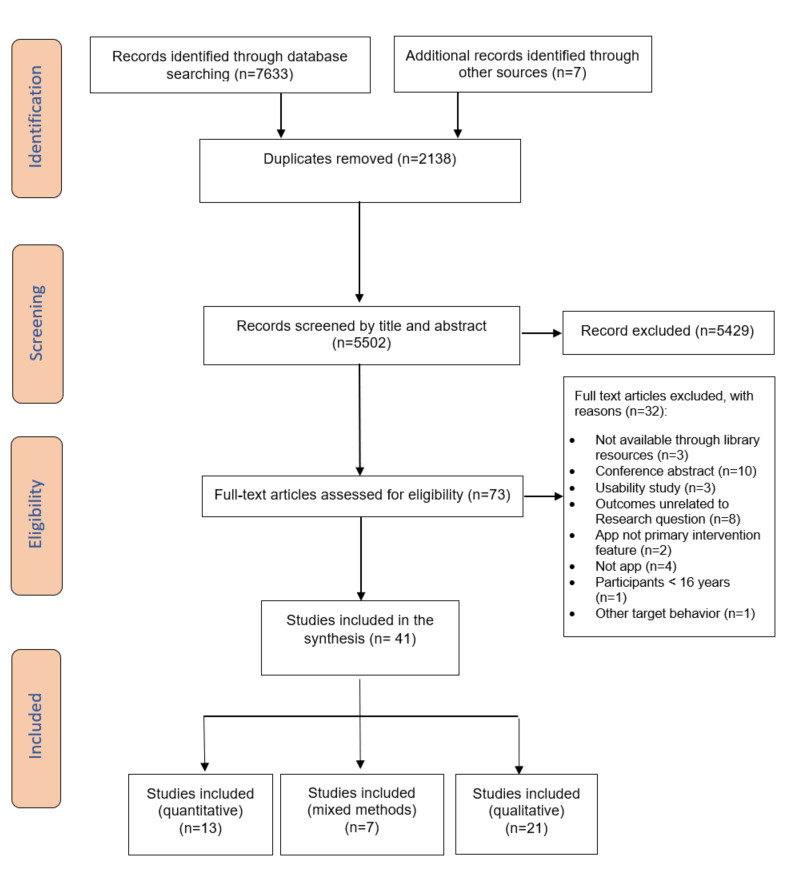
Of the 7640 identified studies, 41 were included in the review. Factors related to uptake (U), engagement (E), or both (B) were identified. Under capability, the main factors identified were app literacy skills (B), app awareness (U), available user guidance (B), health information (E), statistical information on progress (E), well-designed reminders (E), features to reduce cognitive load (E), and self-monitoring features (E). Availability at low cost (U), positive tone, and personalization (E) were identified as physical opportunity factors, whereas recommendations for health and well-being apps (U), embedded health professional support (E), and social networking (E) possibilities were social opportunity factors. Finally, the motivation factors included positive feedback (E), available rewards (E), goal setting (E), and the perceived utility of the app (E).
Across a wide range of populations and behaviors, 26 factors relating to capability, opportunity, and motivation appear to influence the uptake of and engagement with health and well-being smartphone apps. Our recommendations may help app developers, health app portal developers, and policy makers in the optimization of health and well-being apps.
健康与幸福数字干预措施对公众健康的影响取决于在现实世界中的充分采用和参与度。目前,采用情况在很大程度上依赖于人气指标(例如应用商店中的排名和用户评分),而这些指标可能与有效性不相符,而且迅速不再参与的情况很常见。因此,迫切需要确定影响健康与幸福类应用程序采用和参与度的因素,以便为促进有效使用此类工具的新方法提供信息。
本综述旨在了解关于成年人对健康与幸福类智能手机应用程序的采用和参与度的影响因素的已知情况。
我们对定量、定性和混合方法研究进行了系统综述。纳入的针对成年人的研究需聚焦于报告采用和参与行为的健康与幸福类智能手机应用程序。通过在医学文献分析与检索系统在线平台(即MEDLARS在线平台,MEDLINE)、EMBASE、护理及相关健康文献累积索引数据库(CINAHL)、心理学文摘数据库(PsychINFO)、Scopus数据库、考克兰图书馆数据库、数据库系统与逻辑编程数据库(DBLP)以及美国计算机协会(ACM)数字图书馆中进行系统检索所识别出的研究进行筛选,由两位作者独立筛选一定比例的研究。采用演绎迭代过程进行数据综合与解读。由一名独立研究人员进行外部效度核查。研究结果的叙述性综合围绕能力、机会、动机、行为改变模型以及理论领域框架(TDF)的组成部分展开。
在识别出的7640项研究中,41项被纳入本综述。确定了与采用(U)、参与度(E)或两者(B)相关的因素。在能力方面,确定的主要因素包括应用程序读写技能(B)、应用程序知晓度(U)、可用的用户指南(B)、健康信息(E)、进展的统计信息(E)、精心设计的提醒(E)、减少认知负荷的功能(E)以及自我监测功能(E)。低成本可用性(U)、积极的语气和个性化(E)被确定为物质机会因素,而健康与幸福类应用程序的推荐(U)、嵌入式健康专业支持(E)以及社交网络(E)可能性则是社会机会因素。最后,动机因素包括积极反馈(E)、可用奖励(E)、目标设定(E)以及应用程序的感知效用(E)。
在广泛的人群和行为中,与能力、机会和动机相关的26个因素似乎会影响成年人对健康与幸福类智能手机应用程序的采用和参与度。我们的建议可能有助于应用程序开发者、健康应用程序门户开发者以及政策制定者优化健康与幸福类应用程序。
