Marchetti Luca, Rebucci Raffaella, Piantoni Caterina, Corsetto Paola Antonia, Rizzo Angela Maria, Zhang Haijun, Jiang Xianren, Bontempo Valentino
Department of Veterinary and Animal Science (DIVAS), Università degli Studi di Milano, Via dell'Università 6, 29600 Lodi, Italy.
Department of Pharmacological and Biomolecular Sciences "Rodolfo Paoletti" (DiSFeB), Università degli Studi di Milano, Via Trentacoste 2, 20134 Milan, Italy.
Animals (Basel). 2025 Mar 13;15(6):827. doi: 10.3390/ani15060827.
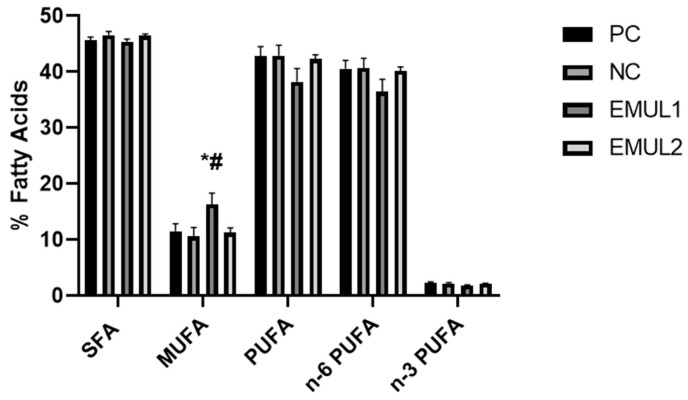
The present study aimed to evaluate the effects of an emulsifier in powder form composed of glycerol polyethylene glycol ricinoleate and bi-distilled oleic acid on the growth performance, nutrient digestibility, excreta nitrogen and liver fatty acid profile of broilers fed reduced-energy diets. A total of 720 male ROSS 308 chicks were divided into four homogeneous groups (9 pens/20 chicks per group): positive control (PC), negative control (NC, -70 kcal/kg of AME), EMUL1 and EMUL2 fed an NC diet + 250 and 500 mg/kg of emulsifier. Body weight, average daily gain, average daily feed intake and feed conversion ratio (FCR) were evaluated. Excreta were collected at 24 and 42 d directly from polyethylene trays and pooled to determine the apparent total tract digestibility of dry matter, crude protein, ether extract and gross energy. The apparent metabolizable energy (AME, AMEn) and nitrogen ammonia in excreta were determined. Performances were improved in EMUL1 and EMUL2 during the trial ( < 0.05). The digestibility of nutrients in EMUL1 and EMUL2 was increased in comparison to NC and PC ( < 0.05). Excreta nitrogen ammonia was reduced by EMUL2 at 42 d ( < 0.05). Glycerol polyethylene glycol ricinoleate and bi-distilled oleic acid in powder form modulated liver fatty acid profiles, enhancing oleic acid content in EMUL1 chickens ( < 0.05), while γ-linolenic acid and arachidonic acid were enhanced in EMUL2 ( < 0.05). Based on the findings, it is recommended to administer solidified glycerol polyethylene glycol ricinoleate and bi-distilled oleic acid in diets with reduced energy content for appreciable advantages in terms of growth through higher nutrient digestibility and better hepatic fatty acid composition.
本研究旨在评估由甘油聚乙二醇蓖麻醇酸酯和双蒸馏油酸组成的粉末状乳化剂对饲喂低能量日粮的肉鸡生长性能、养分消化率、排泄物氮和肝脏脂肪酸谱的影响。总共720只雄性ROSS 308雏鸡被分为四个同质组(每组9个栏/20只雏鸡):阳性对照(PC)、阴性对照(NC,代谢能降低70千卡/千克)、EMUL1和EMUL2,分别饲喂NC日粮+250和500毫克/千克的乳化剂。评估了体重、平均日增重、平均日采食量和饲料转化率(FCR)。在24日龄和42日龄时直接从聚乙烯托盘中收集排泄物并合并,以测定干物质、粗蛋白、乙醚提取物和总能的表观全肠道消化率。测定了排泄物中的表观代谢能(AME、AMEn)和氮氨。在试验期间,EMUL1和EMUL2组的生产性能得到改善(P<0.05)。与NC和PC组相比,EMUL1和EMUL2组的养分消化率有所提高(P<0.05)。EMUL2组在42日龄时排泄物氮氨减少(P<0.05)。粉末状的甘油聚乙二醇蓖麻醇酸酯和双蒸馏油酸调节了肝脏脂肪酸谱,提高了EMUL1组鸡的油酸含量(P<0.05),而EMUL2组的γ-亚麻酸和花生四烯酸含量增加(P<0.05)。基于这些发现,建议在能量含量降低的日粮中添加固化的甘油聚乙二醇蓖麻醇酸酯和双蒸馏油酸,通过提高养分消化率和改善肝脏脂肪酸组成,在生长方面具有明显优势。