
一种基于语义分割的翼状胬肉自动评估与分级系统。
A semantic segmentation-based automatic pterygium assessment and grading system.
作者信息
Ji Qingbo, Liu Wanyang, Ma Qingfeng, Qu Lijun, Zhang Lin, He Hui
机构信息
College of Information and Communication Engineering, Harbin Engineering University, Harbin, China.
Key Laboratory of Advanced Marine Communication and Information Technology, Ministry of Industry and Information Technology, Harbin Engineering University, Harbin, China.
出版信息
Front Med (Lausanne). 2025 Mar 13;12:1507226. doi: 10.3389/fmed.2025.1507226. eCollection 2025.
INTRODUCTION
Pterygium, a prevalent ocular disorder, requires accurate severity assessment to optimize treatment and alleviate patient suffering. The growing patient population and limited ophthalmologist resources necessitate efficient AI-based diagnostic solutions. This study aims to develop an automated grading system combining deep learning and image processing techniques for precise pterygium evaluation.
METHODS
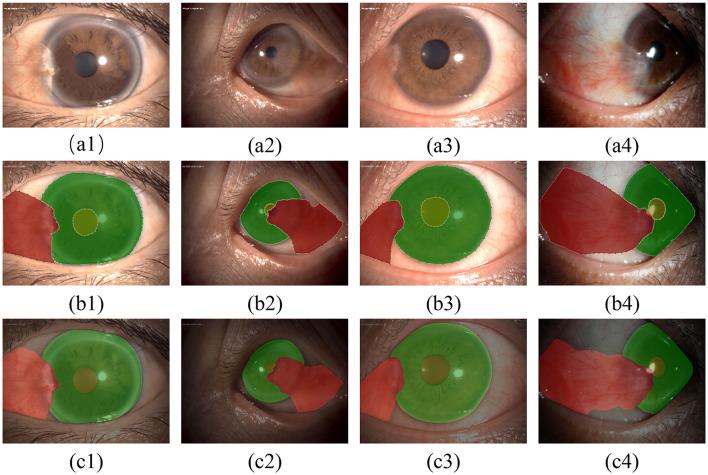
The proposed system integrates two modules: 1) A semantic segmentation module utilizing an improved TransUnet architecture for pixel-level pterygium localization, trained on annotated slit-lamp microscope images from clinical datasets. 2) A severity assessment module employing enhanced curve fitting algorithms to quantify pterygium invasion depth in critical ocular regions. The framework merges deep learning with traditional computational methods for comprehensive analysis.
RESULTS
The semantic segmentation model achieved an average Dice coefficient of 0.9489 (0.9041 specifically for pterygium class) on test datasets. In clinical validation, the system attained 0.9360 grading accuracy and 0.9363 weighted F1 score. Notably, it demonstrated strong agreement with expert evaluations (Kappa coefficient: 0.8908), confirming its diagnostic reliability.
DISCUSSION
The AI-based diagnostic method proposed in this study achieves automatic grading of pterygium by integrating semantic segmentation and curve fitting technology, which is highly consistent with the clinical evaluation of doctors. The quantitative evaluation framework established in this study is expected to meet multiple clinical needs beyond basic diagnosis. The construction of the data set should continue to be optimized in future studies.
引言
翼状胬肉是一种常见的眼部疾病,需要进行准确的严重程度评估,以优化治疗并减轻患者痛苦。患者数量的不断增加以及眼科医生资源的有限,使得基于人工智能的高效诊断解决方案成为必要。本研究旨在开发一种结合深度学习和图像处理技术的自动分级系统,用于精确评估翼状胬肉。
方法
所提出的系统集成了两个模块:1)一个语义分割模块,利用改进的TransUnet架构进行像素级翼状胬肉定位,在来自临床数据集的带注释的裂隙灯显微镜图像上进行训练。2)一个严重程度评估模块,采用增强的曲线拟合算法来量化关键眼部区域的翼状胬肉侵入深度。该框架将深度学习与传统计算方法相结合进行综合分析。
结果
语义分割模型在测试数据集上的平均Dice系数为0.9489(翼状胬肉类别的具体系数为0.9041)。在临床验证中,该系统的分级准确率达到0.9360,加权F1分数达到0.9363。值得注意的是,它与专家评估显示出高度一致性(Kappa系数:0.8908),证实了其诊断可靠性。
讨论
本研究提出的基于人工智能的诊断方法通过整合语义分割和曲线拟合技术实现了翼状胬肉的自动分级,与医生的临床评估高度一致。本研究建立的定量评估框架有望满足除基本诊断之外的多种临床需求。在未来的研究中,数据集的构建应继续优化。




 Zotero 插件