Bishop Jeanette V, Guzeloglu Aydin, Scheller Tom, Docheff Joshua J, Gonzalez-Berrios Carolina L, Van Campen Hana, Nett Terry M, Zezeski Abigail L, Geary Thomas W, Thatcher William W, Hansen Thomas R
Animal Reproduction and Biotechnology Laboratory, Department of Biomedical Sciences, Colorado State University, Fort Collins, CO, USA.
PTSAgLLC, Fort Collins, CO, USA.
Biol Reprod. 2025 May 13;112(5):981-995. doi: 10.1093/biolre/ioaf066.
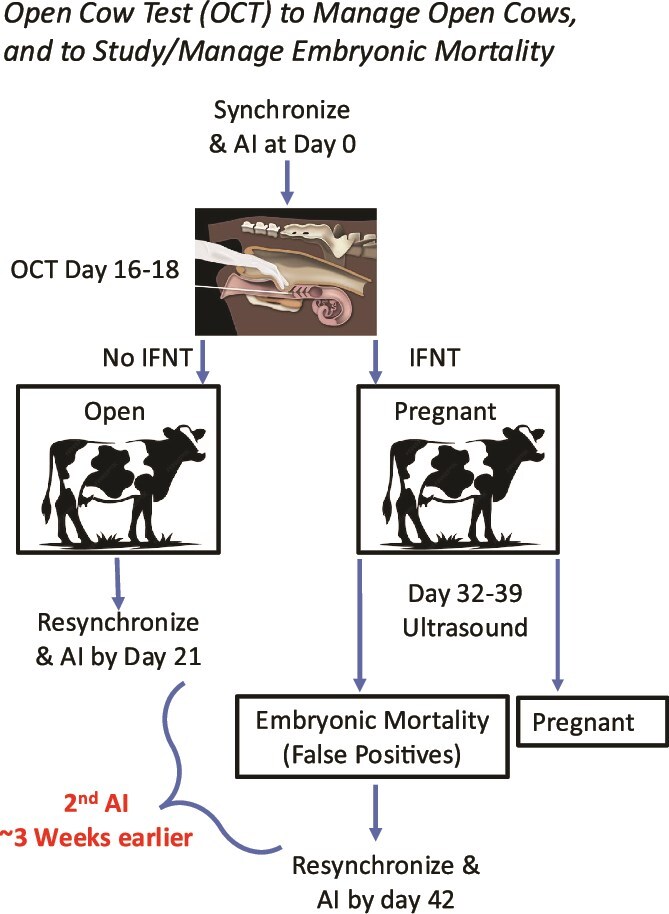
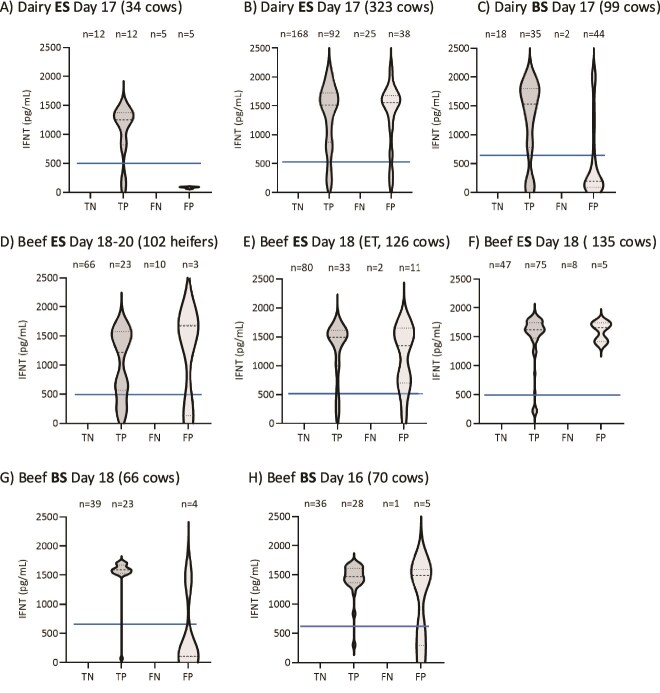
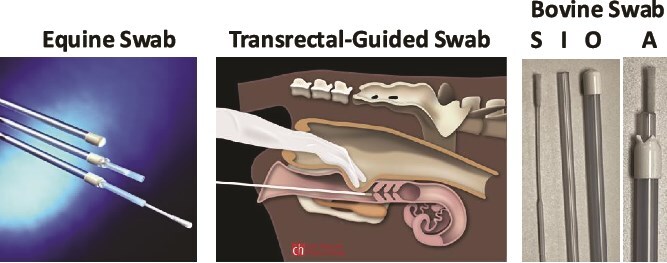
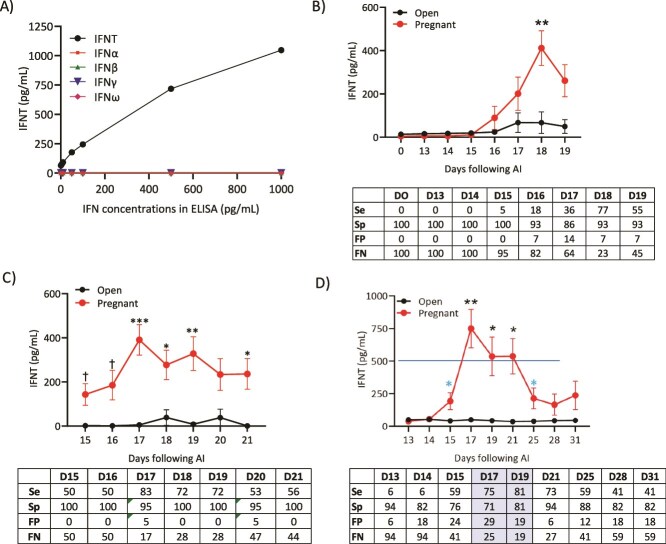
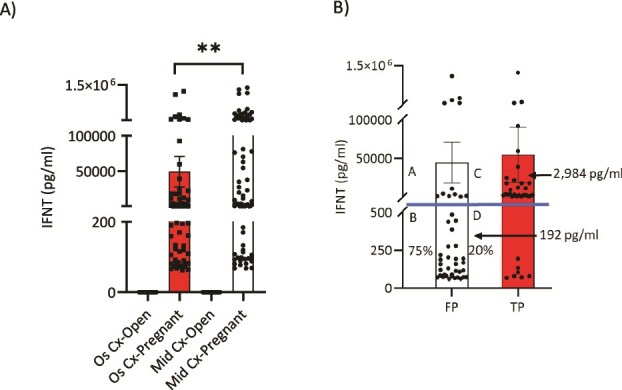
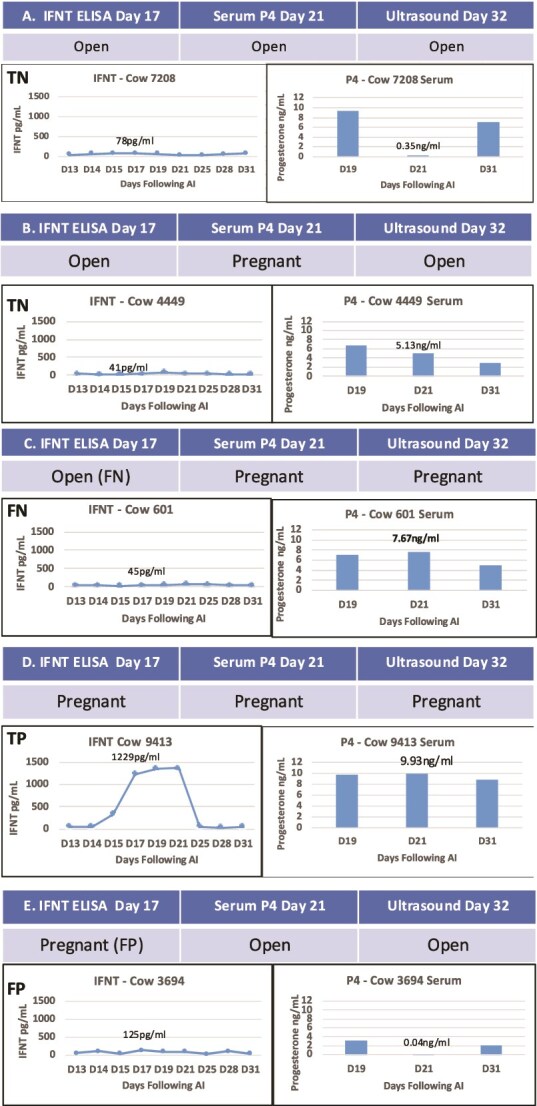
Bovine interferon-tau (bIFNT) is produced by the trophectoderm cells in the bovine conceptus as early as Day 12 following fertilization. It was hypothesized that IFNT detection in blood, milk, and/or cervical secretions could be used to diagnose pregnancy in lactating cows. Recombinant bovine (rb) IFNT was generated to produce goat and rabbit anti-rbIFNT polyclonal antibodies, and an enzyme-linked immunosorbent assay (ELISA) was developed for bIFNT using these reagents. The IFNT ELISA did not cross-react with other type I or II IFNs and had a limit of detection of 50-100 pg/ml. The IFNT ELISA detected IFNT in external ostium (os) cervical swabs from Days 15 to 25 post-AI, but did not detect IFNT in serum, plasma, or milk. The time for most accurately detecting IFNT in cervical fluid was Days 16-19 after AI. A custom bovine swab device used to collect cervical secretions reduced false-negative rates to 5.5% (94.5% sensitivity) in dairy cows on Day 17 and 0% to 3.4% (100% and 96.6% sensitivity) in beef cows on Days 18 or 16, respectively. In summary, the detection of IFNT in cervical fluid by ELISA provides an accurate indication of pregnancy status in lactating dairy cows. Early identification of the non-pregnant cow allows re-insemination on Day 21 compared to waiting until ultrasound (US) on Day ~32-39. In addition, the detection of IFNT on Day 17 followed by the loss of pregnancy detected by US on Day 32 provides a novel research tool for studying pregnancy loss caused by embryonic mortality.
牛干扰素 - τ(bIFNT)最早在受精后第12天由牛孕体的滋养外胚层细胞产生。据推测,检测血液、乳汁和/或宫颈分泌物中的IFNT可用于诊断泌乳奶牛是否怀孕。通过重组牛(rb)IFNT制备了山羊和兔抗rbIFNT多克隆抗体,并使用这些试剂开发了一种用于检测bIFNT的酶联免疫吸附测定(ELISA)。该IFNT ELISA与其他I型或II型干扰素无交叉反应,检测限为50 - 100 pg/ml。IFNT ELISA在人工授精后第15至25天检测到宫颈外口(os)宫颈拭子中的IFNT,但在血清、血浆或乳汁中未检测到IFNT。在宫颈液中最准确检测IFNT的时间是人工授精后的第16 - 19天。一种用于收集宫颈分泌物的定制牛拭子装置,在第17天将奶牛的假阴性率降低至5.5%(敏感性为94.5%),在肉牛中,分别在第18天或第16天假阴性率降至0%至3.4%(敏感性为100%和96.6%)。总之,通过ELISA检测宫颈液中的IFNT可准确指示泌乳奶牛的怀孕状态。与等到约第32 - 39天进行超声检查(US)相比,早期识别未怀孕的奶牛可在第21天进行再次授精。此外,在第17天检测到IFNT,随后在第32天通过超声检查发现妊娠丢失,这为研究胚胎死亡导致的妊娠丢失提供了一种新的研究工具。