Szlachetko Jagoda Agnieszka, Hofmann-Vega Francisca, Budeus Bettina, Schröder Lara-Jasmin, Dumitru Claudia Alexandra, Schmidt Mathias, Deuss Eric, Vollmer Sebastian, Hanschmann Eva-Maria, Busch Maike, Kehrmann Jan, Lang Stephan, Dünker Nicole, Hussain Timon, Brandau Sven
Department of Otorhinolaryngology, University Hospital Essen, Essen, 45147, Germany.
Institute of Cell Biology, University Hospital Essen, Essen, 45147, Germany.
Cell Mol Immunol. 2025 May;22(5):527-540. doi: 10.1038/s41423-025-01283-w. Epub 2025 Mar 28.
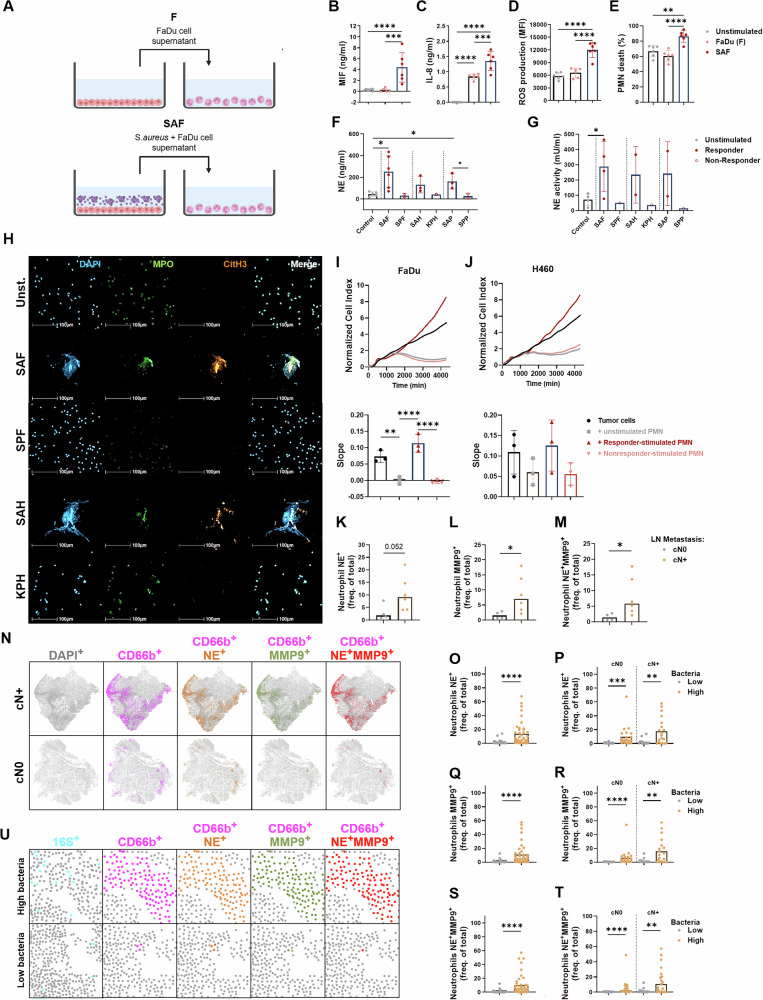
In the tumor host, neutrophils may exhibit protumor or antitumor activity. It is hypothesized that in response to host-derived or therapy-induced factors, neutrophils adopt diverse functional states to ultimately execute these differential functions. Here, we provide an alternative scenario in which the response of an individual tumor cell population determines the overall protumor versus antitumor outcome of neutrophil‒tumor interactions. Experimentally, we show that human neutrophils, which are sequentially stimulated with bacteria and secreted factors from tumor cells, kill a certain proportion of tumor target cells. However, the majority of the tumor cells remained resistant to this neutrophil-mediated killing and underwent a functional, phenotypic and transcriptomic switch that was reminiscent of partial epithelial‒to-mesenchymal transition. This cell biological switch was associated with physical escape from NK-mediated killing and resulted in enhanced metastasis to the lymph nodes in a preclinical orthotopic mouse model. Mechanistically, we identified the antimicrobial neutrophil granule proteins neutrophil elastase (NE) and matrix metalloprotease-9 (MMP-9) as the molecular mediators of this functional switch. We validated these data in patients with head and neck cancer and identified bacterially colonized intratumoral niches that were enriched for mesenchymal tumor cells and neutrophils expressing NE and MMP-9. Our data reveal the parallel execution of tumor cytotoxic and prometastatic activity by activated neutrophils and identify NE and MMP-9 as mediators of lymph node metastasis. The identified mechanism explains the functional dichotomy of tumor-associated neutrophils at the level of the tumor target cell response and has implications for superinfected cancers and the dysbiotic tumor microenvironment.
在肿瘤宿主中,中性粒细胞可能表现出促肿瘤或抗肿瘤活性。据推测,响应宿主来源或治疗诱导的因子,中性粒细胞会采取多种功能状态,最终执行这些不同的功能。在此,我们提供了另一种情况,即单个肿瘤细胞群体的反应决定了中性粒细胞与肿瘤相互作用的总体促肿瘤与抗肿瘤结果。在实验中,我们发现,先用细菌刺激人中性粒细胞,再用肿瘤细胞分泌的因子刺激,会杀死一定比例的肿瘤靶细胞。然而,大多数肿瘤细胞对这种中性粒细胞介导的杀伤具有抗性,并经历了功能、表型和转录组学的转变,这让人联想到部分上皮-间充质转化。这种细胞生物学转变与从自然杀伤细胞(NK)介导的杀伤中物理逃逸有关,并在临床前原位小鼠模型中导致向淋巴结转移的增强。从机制上讲,我们确定了抗菌中性粒细胞颗粒蛋白中性粒细胞弹性蛋白酶(NE)和基质金属蛋白酶-9(MMP-9)是这种功能转变的分子介质。我们在头颈癌患者中验证了这些数据,并确定了细菌定植的肿瘤内生态位,其中富含间充质肿瘤细胞以及表达NE和MMP-9的中性粒细胞。我们的数据揭示了活化的中性粒细胞同时执行肿瘤细胞毒性和促转移活性,并确定NE和MMP-9是淋巴结转移的介质。所确定的机制解释了肿瘤相关中性粒细胞在肿瘤靶细胞反应水平上的功能二分法,对超级感染的癌症和失调的肿瘤微环境具有启示意义。