Casten Lucas G, Koomar Tanner, Thomas Taylor R, Koh Jin-Young, Hofamman Dabney, Thenuwara Savantha, Momany Allison, O'Brien Marlea, Murra Jeffrey C, Bruce Tomblin J, Michaelson Jacob J
Department of Psychiatry, University of Iowa.
Center for Genomic Medicine, Massachusetts General Hospital.
bioRxiv. 2025 Mar 10:2025.03.07.641231. doi: 10.1101/2025.03.07.641231.
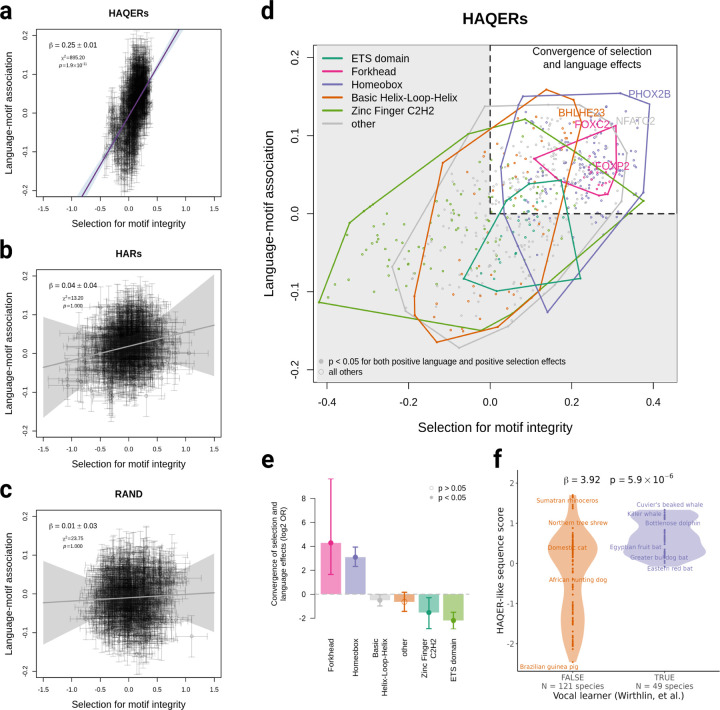
1Minor genetic changes have produced profound differences in cognitive abilities between humans and our closest relatives, particularly in language. Despite decades of research, ranging from single-gene studies to broader evolutionary analyses[1, 2, 3, 4, 5], key questions about the genomic foundations of human language have persisted, including which sequences are involved, how they evolved, and whether similar changes occur in other vocal learning species. Here we provide the first evidence directly linking rapidly evolved genomic regions to language abilities in contemporary humans. Through extensive analysis of 65 million years of evolutionary events in over 30,000 individuals, we demonstrate that Human Ancestor Quickly Evolved Regions (HAQERs)[5] - sequences that rapidly accumulated mutations after the human-chimpanzee split - specifically influence language but not general cognition. These regions evolved to shape language development by altering binding of Forkhead domain transcription factors, including . Strikingly, language-associated HAQER variants show higher prevalence in Neanderthals than modern humans, have been stable throughout recent human history, and show evidence of convergent evolution across other mammalian vocal learners. An unexpected pattern of balancing selection acting on these apparently beneficial alleles is explained by their pleiotropic effects on prenatal brain development contributing to birth complications, reflecting an evolutionary trade-off between language capability and reproductive fitness. By developing the Evolution Stratified-Polygenic Score analysis, we show that language capabilities likely emerged before the human-Neanderthal split - far earlier than previously thought[3, 6, 7]. Our findings establish the first direct link between ancient genomic divergence and present-day variation in language abilities, while revealing how evolutionary constraints continue to shape human cognitive development.
微小的基因变化在人类与我们最近的亲属之间的认知能力上产生了深刻差异,尤其是在语言方面。尽管进行了数十年的研究,从单基因研究到更广泛的进化分析[1,2,3,4,5],关于人类语言基因组基础的关键问题仍然存在,包括哪些序列参与其中、它们如何进化,以及在其他发声学习物种中是否发生类似变化。在这里,我们提供了第一个直接将快速进化的基因组区域与当代人类语言能力联系起来的证据。通过对超过30000个个体6500万年进化事件的广泛分析,我们证明人类祖先快速进化区域(HAQERs)[5]——人类与黑猩猩分化后迅速积累突变的序列——特别影响语言而非一般认知。这些区域通过改变包括叉头结构域转录因子的结合来塑造语言发展。引人注目的是,与语言相关的HAQER变体在尼安德特人中的流行率高于现代人类,在近代人类历史中一直稳定,并显示出在其他哺乳动物发声学习者中趋同进化的证据。对这些明显有益的等位基因进行平衡选择的意外模式可以通过它们对产前大脑发育的多效性影响导致出生并发症来解释,这反映了语言能力和生殖适应性之间的进化权衡。通过开发进化分层多基因评分分析,我们表明语言能力可能在人类与尼安德特人分化之前就已出现——比之前认为的要早得多[3,6,7]。我们的发现建立了古代基因组差异与当今语言能力变化之间的第一个直接联系,同时揭示了进化限制如何继续塑造人类认知发展。