Li Jing-Xing, Hsu Tzu-Ju, Lin Heng-Jun, Hsu Shu-Bai, Lu Chiung-Ray, Chung Wei-Hsin, Liang Shinn-Jye, Tsai Fuu-Jen, Chang Kuan-Cheng
Department of Internal Medicine, China Medical University Hospital, Taichung, Taiwan.
School of Medicine, China Medical University, Taichung, Taiwan.
JAMA Netw Open. 2025 Mar 3;8(3):e252577. doi: 10.1001/jamanetworkopen.2025.2577.
Combination therapy has emerged as a critical area of interest in managing diabetes; however, the association of combination therapy with a glucagon-like peptide 1 receptor agonist (GLP-1RA) and thiazolidinedione and the risk of diabetes-related complications remains incompletely understood.
To compare the hazards of cardiovascular-related morbidities and mortality among patients with type 2 diabetes receiving combination therapy with a GLP-1RA plus thiazolidinedione, those receiving monotherapy with a GLP-1RA or thiazolidinedione, and nonusers.
DESIGN, SETTING, AND PARTICIPANTS: This retrospective cohort study used nationwide data obtained from Taiwan's National Health Insurance Research Database. Patients older than 20 years with type 2 diabetes who received a GLP-1RA or thiazolidinedione between January 1, 2011, and December 31, 2020, were enrolled. The data analysis was performed from May 1 to May 22, 2024.
This study investigated the hazards of all-cause mortality, major adverse cardiovascular events, cardiovascular mortality, cardiovascular complications, and hypoglycemia in GLP-1RA and thiazolidinedione combination or monotherapy users compared with nonusers.
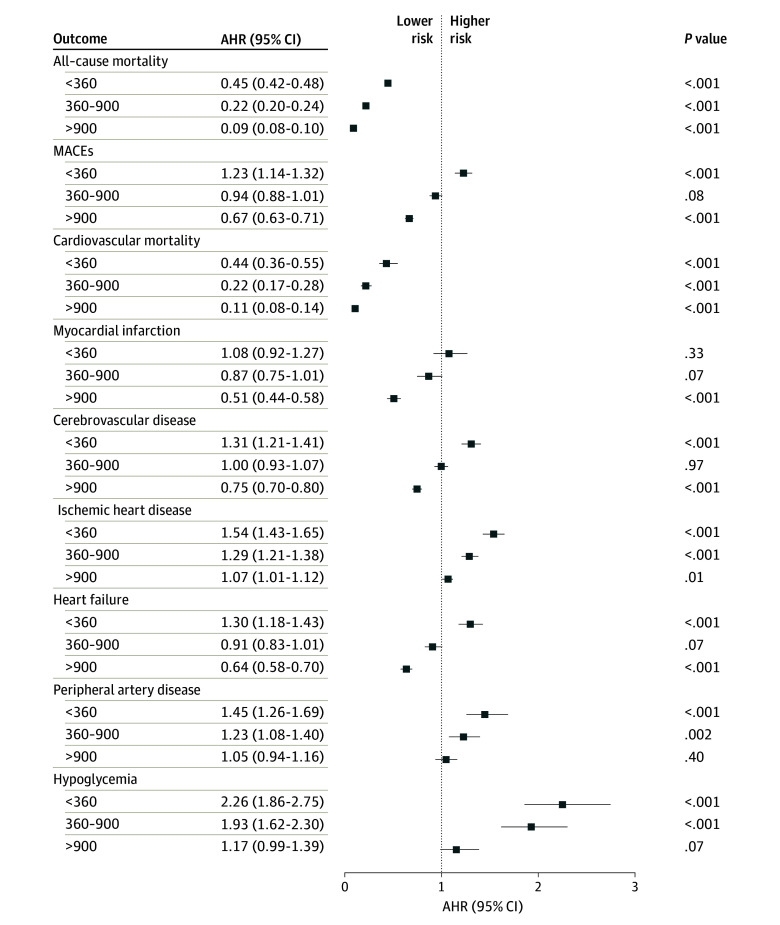
A total of 110 411 patients were enrolled (mean [SD] age, 58.3 [11.9] years; 45.5% female; 47 526 GLP-1RA users, 32 203 thiazolidinedione users, and 30 682 GLP-1RA plus thiazolidinedione users), along with a propensity score-matched group of patients who did not use a GLP-1RA or thiazolidinedione, for a total cohort size of 220 822. Patients receiving GLP-1RA and thiazolidinedione dual therapy had significantly lower risk of all-cause mortality (adjusted hazard ratio [AHR], 0.20; 95% CI, 0.19-0.21; P < .001), major adverse cardiovascular events (AHR, 0.85; 95% CI, 0.82-0.89; P < .001), and cardiovascular mortality (AHR, 0.20; 95% CI, 0.18-0.23; P < .001) than those who did not receive a GLP-1RA or thiazolidinedione. However, a higher risk of hypoglycemia was seen in those receiving combination therapy (AHR, 1.61; 95% CI, 1.43-1.82; P < .001) and those receiving thiazolidinedione monotherapy (AHR, 1.69; 95% CI, 1.51-1.90; P < .001) compared with nonuse. This risk was mitigated with prolonged use. Thiazolidinedione monotherapy users had a significantly higher risk of all-cause mortality (AHR, 1.29; 95% CI, 1.24-1.34; P < .001) and cardiovascular mortality (AHR, 1.28; 95% CI, 1.13-1.45; P < .001) than GLP-1RA monotherapy users. Several sensitivity analyses further supported the robustness of these findings.
In this cohort study of patients with type 2 diabetes, combination therapy with a GLP-1RA plus thiazolidinedione was associated with significantly lower hazards of mortality and cardiovascular complications compared with nonuse. The findings suggest that GLP-1RAs may mitigate the adverse cardiovascular effects of thiazolidinedione.
联合治疗已成为糖尿病管理中一个关键的研究领域;然而,胰高血糖素样肽1受体激动剂(GLP - 1RA)与噻唑烷二酮的联合治疗及其与糖尿病相关并发症风险之间的关联仍未完全明确。
比较接受GLP - 1RA加噻唑烷二酮联合治疗的2型糖尿病患者、接受GLP - 1RA或噻唑烷二酮单药治疗的患者以及未使用者之间心血管相关发病率和死亡率的风险。
设计、背景和参与者:这项回顾性队列研究使用了从台湾国民健康保险研究数据库获得的全国性数据。纳入了2011年1月1日至2020年12月31日期间接受GLP - 1RA或噻唑烷二酮治疗的20岁以上2型糖尿病患者。数据分析于2024年5月1日至5月22日进行。
本研究调查了GLP - 1RA和噻唑烷二酮联合或单药治疗使用者与未使用者相比的全因死亡率、主要不良心血管事件、心血管死亡率、心血管并发症和低血糖的风险。
共纳入110411例患者(平均[标准差]年龄为58.3[11.9]岁;45.5%为女性;47526例GLP - 1RA使用者,32203例噻唑烷二酮使用者,30682例GLP - 1RA加噻唑烷二酮使用者),以及一组倾向评分匹配的未使用GLP - 1RA或噻唑烷二酮的患者,总队列规模为220822例。与未接受GLP - 1RA或噻唑烷二酮治疗的患者相比,接受GLP - 1RA和噻唑烷二酮联合治疗的患者全因死亡率(调整后风险比[AHR],0.20;95%置信区间[CI],0.19 - 0.21;P <.001)、主要不良心血管事件(AHR,0.85;95% CI,0.82 - 0.89;P <.001)和心血管死亡率(AHR,0.20;95% CI,0.18 - 0.23;P <.001)显著更低。然而,与未使用者相比,联合治疗组(AHR,1.61;95% CI,1.43 - 1.82;P <.001)和噻唑烷二酮单药治疗组(AHR,1.69;95% CI,1.51 - 1.90;P <.001)发生低血糖的风险更高。随着使用时间延长,这种风险有所降低。噻唑烷二酮单药治疗使用者的全因死亡率(AHR,1.29;95% CI,1.24 - 1.34;P <.001)和心血管死亡率(AHR,1.28;95% CI,1.13 - 1.45;P <.001)显著高于GLP - 1RA单药治疗使用者。多项敏感性分析进一步支持了这些结果的稳健性。
在这项针对2型糖尿病患者的队列研究中,与未使用相比,GLP - 1RA加噻唑烷二酮联合治疗与显著更低的死亡率和心血管并发症风险相关。研究结果表明,GLP - 1RA可能减轻噻唑烷二酮的不良心血管影响。