Goh Yihui, Jang Yoonhyuk, Shin Soo Jean, Ahn Soo Hyun, Mon Su Yee, Shin Yoon Hee, Chu Kon, Lee Sang Kun, Lee Soon-Tae
Department of Neurology, Seoul National University Hospital, Seoul National University College of Medicine, Seoul, South Korea.
Division of Neurology, Department of Medicine, National University Health System, Singapore.
Ann Clin Transl Neurol. 2025 May;12(5):1054-1064. doi: 10.1002/acn3.70043. Epub 2025 Mar 31.
Cryptogenic new-onset refractory status epilepticus (cNORSE) is a devastating condition characterized by the de novo onset of status epilepticus with unclear etiology. The identification of relevant early biomarkers in cNORSE is important to elucidate pathophysiology, aid clinical decision-making, and prognosticate outcomes in cNORSE.
CSF samples were obtained within 7 days of NORSE onset from an adult cNORSE cohort in a national referral center in South Korea. Nineteen patients with cNORSE were studied: 9 were male (47.4%) and the median age was 35.0 [IQR: 27.0-54.3] years. CSF from 21 patients with other neurological diseases (atypical parkinsonism, postural orthostatic hypotension syndrome, epilepsy, and cerebellar ataxia) was used as controls. Proteomic analysis was conducted using the Olink platform, and potential biomarker candidates were correlated with clinical data and MRI findings.
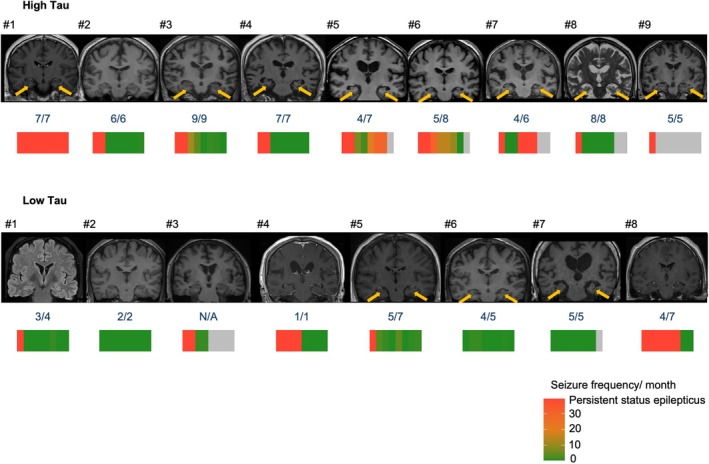
Based on correlation analyses between proteomic data and clinical outcomes, total tau (t-tau) was selected as a potential biomarker. Patients with cNORSE had higher CSF t-tau levels than controls (p < 0.001). Early detection of high CSF t-tau was associated with the presence of hippocampal atrophy in the postacute phase of cNORSE (p = 0.044). The initial elevation of t-tau levels also correlated with a higher number of anti-seizure medications used (p = 0.031) and less improvement in Clinical Assessment Scale in Autoimmune Encephalitis (CASE) scores 1 month after NORSE onset (p = 0.066). T-tau levels were correlated with CSF pro-inflammatory cytokines/chemokines and mediators of neuronal damage.
Elevated CSF t-tau levels detected early after cNORSE onset may be a useful marker of initial brain injury and predict subsequent hippocampal atrophy.
隐匿性新发难治性癫痫持续状态(cNORSE)是一种严重疾病,其特征为癫痫持续状态新发且病因不明。识别cNORSE相关的早期生物标志物对于阐明病理生理学、辅助临床决策以及预测cNORSE的预后至关重要。
在韩国一家国家转诊中心,从成人cNORSE队列中于NORSE发作7天内获取脑脊液样本。对19例cNORSE患者进行研究:9例为男性(47.4%),中位年龄为35.0[四分位间距:27.0 - 54.3]岁。将21例患有其他神经系统疾病(非典型帕金森病、体位性直立性低血压综合征、癫痫和小脑共济失调)患者的脑脊液用作对照。使用Olink平台进行蛋白质组学分析,并将潜在的生物标志物候选物与临床数据和MRI结果相关联。
基于蛋白质组学数据与临床结果之间的相关性分析,总tau蛋白(t-tau)被选为潜在生物标志物。cNORSE患者的脑脊液t-tau水平高于对照组(p < 0.001)。脑脊液t-tau水平升高的早期检测与cNORSE急性期后海马萎缩的存在相关(p = 0.044)。t-tau水平的初始升高还与使用的抗癫痫药物数量较多相关(p = 0.031),并且与NORSE发作1个月后自身免疫性脑炎临床评估量表(CASE)评分的改善较少相关(p = 0.066)。t-tau水平与脑脊液促炎细胞因子/趋化因子以及神经元损伤介质相关。
cNORSE发作后早期检测到的脑脊液t-tau水平升高可能是初始脑损伤的有用标志物,并可预测随后的海马萎缩。