Auclair Joëlle, Roubeau-Dumont Eva, André Chantale, Gagné François
Aquatic Contaminants Research Division, Environnement and Climate Change Canada, 105 McGill, Montréal, Québec, H2Y 2E7, Canada.
Environ Sci Pollut Res Int. 2025 Mar;32(15):9966-9974. doi: 10.1007/s11356-025-36315-5. Epub 2025 Mar 31.
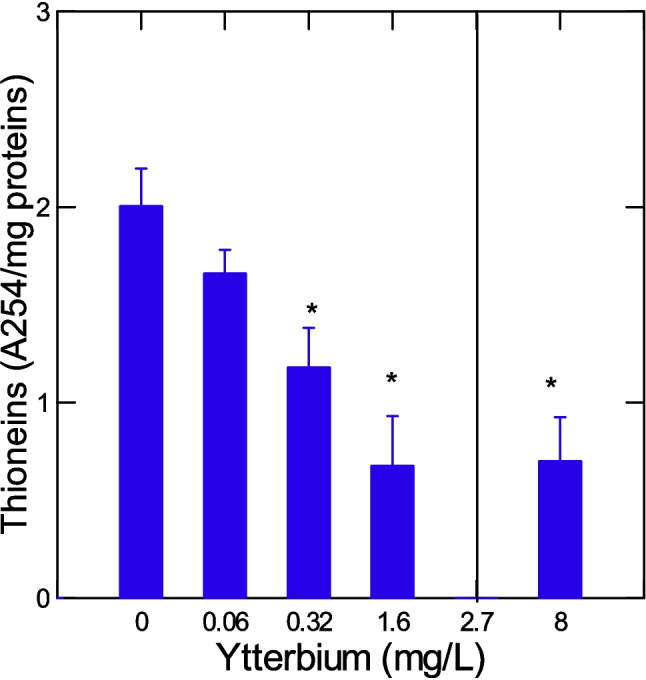
The heavy rare earth element ytterbium (Yb) is a critical element of technology finding its way into urban wastewaters from solid waste disposal sites. The purpose of this study was to investigate the lethal and sublethal toxicity of Yb to rainbow trout juveniles. They were exposed to increasing concentrations of Yb (0.06-40 mg/L) for 96 h at 15 °C. Mortality was recorded, and in the surviving fish, the following biomarkers were determined: protein aggregation, thioneins, lipid peroxidation (LPO), and DNA damage in gills and the liver. The 96-h lethal concentration (LC50) was 2.7 ± 0.66 mg/L indicating that this element is toxic to fish. Biomarker responses to Yb occurred at concentration 45 times less than the LC50 in some cases. The following biomarkers were positively (p < 0.05) correlated to fish survival: liver thioneins, gill DNA strand breaks, LPO, and protein aggregation in the liver. The decrease in LPO in the liver and gills by Yb suggests reduced production of reactive oxygen species production. In conclusion, Yb is toxic to trout juveniles producing sublethal effects at concentrations range of 60 µg/L after 96 h. This concentration represents an upper limit for consideration for aquatic animal health.
重稀土元素镱(Yb)是一种关键技术元素,正从固体废物处理场进入城市废水。本研究的目的是调查镱对虹鳟幼鱼的致死和亚致死毒性。将它们在15℃下暴露于浓度不断增加的镱(0.06 - 40mg/L)中96小时。记录死亡率,并在存活的鱼中测定以下生物标志物:蛋白质聚集、硫蛋白、脂质过氧化(LPO)以及鳃和肝脏中的DNA损伤。96小时致死浓度(LC50)为2.7±0.66mg/L,表明该元素对鱼类有毒。在某些情况下,生物标志物对镱的反应出现在浓度低于LC50 45倍时。以下生物标志物与鱼类存活率呈正相关(p < 0.05):肝脏硫蛋白、鳃DNA链断裂、LPO以及肝脏中的蛋白质聚集。镱使肝脏和鳃中LPO降低,表明活性氧生成减少。总之,镱对虹鳟幼鱼有毒,在96小时后,浓度为60μg/L时会产生亚致死效应。该浓度代表了考虑水生动物健康的上限。