Veschi Veronica, Verona Francesco, Di Bella Sebastiano, Turdo Alice, Gaggianesi Miriam, Di Franco Simone, Mangiapane Laura Rosa, Modica Chiara, Lo Iacono Melania, Bianca Paola, Brancato Ornella Roberta, D'Accardo Caterina, Porcelli Gaetana, Lentini Vincenzo Luca, Sperduti Isabella, Sciacca Elisabetta, Fitzgerald Peter, Lopez-Perez David, Martine Pierre, Brown Kate, Giannini Giuseppe, Appella Ettore, Stassi Giorgio, Todaro Matilde
Department of Precision Medicine in Medical, Surgical and Critical Care, University of Palermo, Palermo, 90127, Italy.
Department of Molecular Medicine, University of Rome La Sapienza, Rome, 00161, Italy.
Mol Cancer. 2025 Mar 31;24(1):102. doi: 10.1186/s12943-025-02293-y.
In many tumors, the tumor suppressor TP53 is not mutated, but functionally inactivated. However, mechanisms underlying p53 functional inactivation remain poorly understood. SETD8 is the sole enzyme known to mono-methylate p53 on lysine 382 (p53), resulting in the inhibition of its pro-apoptotic and growth-arresting functions.
We analyzed SETD8 and p53 expression in clinical colorectal cancer (CRC) and inflammatory bowel disease (IBD) samples. Histopathological examinations, RNA sequencing, ChIP assay and preclinical in vivo CRC models, were used to assess the functional role of p53 inactivation in tumor cells and immune cell infiltration.
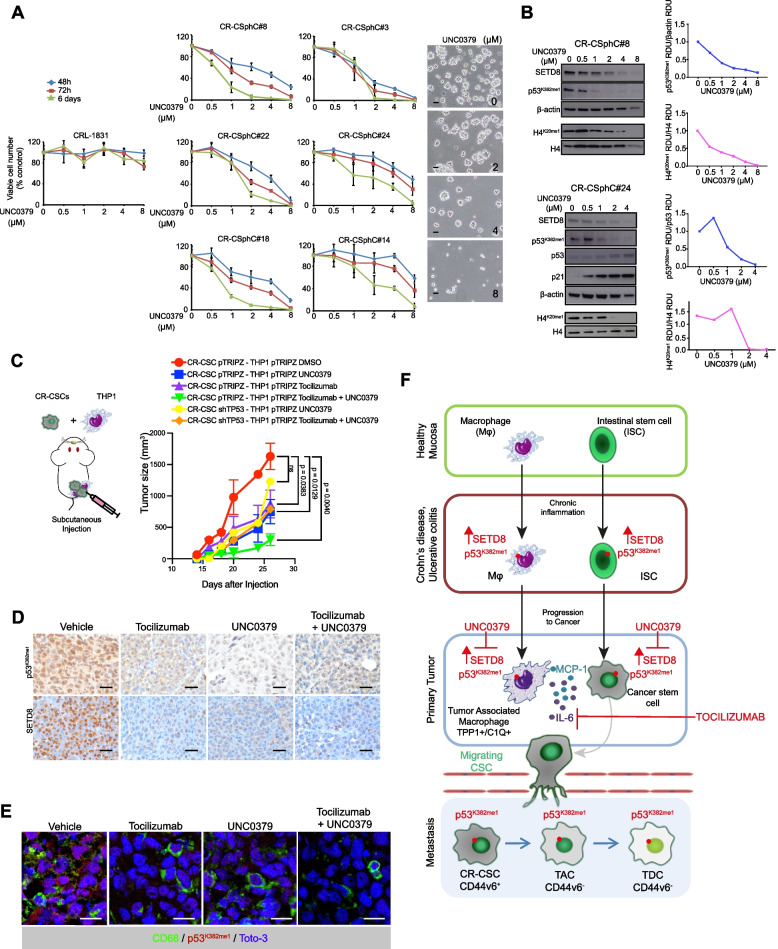
By integrating bulk RNAseq and scRNAseq approaches in CRC patients, SETD8-mediated p53 regulation resulted the most significantly enriched pathway. p53 expression was confined to colorectal cancer stem cells (CR-CSCs) and C1Q TPP1 tumor-associated macrophages (TAMs) in CRC patient tissues, with high levels predicting decreased survival probability. TAMs promote p53 functional inactivation in CR-CSCs through IL-6 and MCP-1 secretion and increased levels of CEBPD, which directly binds SETD8 promoter thus enhancing its transcription. The direct binding of C1Q present on macrophages and C1Q receptor (C1QR) present on cancer stem cells mediates the cross-talk between the two cell compartments. As monotherapy, SETD8 genetic and pharmacological (UNC0379) inhibition affects the tumor growth and metastasis formation in CRC mouse avatars, with enhanced effects observed when combined with IL-6 receptor targeting.
These findings suggest that p53 may be an early step in tumor initiation, especially in inflammation-induced CRC, and could serve as a functional biomarker and therapeutic target in adjuvant setting for advanced CRCs.
在许多肿瘤中,肿瘤抑制因子TP53未发生突变,但功能失活。然而,p53功能失活的潜在机制仍知之甚少。SETD8是已知唯一能使p53赖氨酸382位点发生单甲基化(p53)的酶,从而抑制其促凋亡和生长阻滞功能。
我们分析了临床结直肠癌(CRC)和炎症性肠病(IBD)样本中SETD8和p53的表达。采用组织病理学检查、RNA测序、染色质免疫沉淀分析和临床前体内CRC模型,评估p53失活在肿瘤细胞和免疫细胞浸润中的功能作用。
通过整合CRC患者的大量RNA测序和单细胞RNA测序方法,SETD8介导的p53调控导致了最显著富集的通路。在CRC患者组织中,p53表达局限于结直肠癌干细胞(CR-CSCs)和C1Q TPP1肿瘤相关巨噬细胞(TAMs),高水平表达预示着生存概率降低。TAMs通过分泌IL-6和MCP-1以及增加CEBPD水平促进CR-CSCs中p53功能失活,CEBPD直接结合SETD8启动子从而增强其转录。巨噬细胞上存在的C1Q与癌症干细胞上存在的C1Q受体(C1QR)的直接结合介导了两个细胞区室之间的相互作用。作为单一疗法,SETD8基因和药理学(UNC0379)抑制影响CRC小鼠模型中的肿瘤生长和转移形成,与靶向IL-6受体联合使用时效果增强。
这些发现表明,p53可能是肿瘤发生的早期步骤,尤其是在炎症诱导的CRC中,并且可以作为晚期CRC辅助治疗中的功能生物标志物和治疗靶点。