Caliskan Yasar, Royal Virginie, Troyanov Stéphan, Bonnefoy Arnaud, Merlen Clémence, Schnitzler Mark, Edwards John C, Lentine Krista L, Laurin Louis-Philippe
Division of Nephrology, SSM Health Saint Louis University Hospital, Saint Louis, Missouri.
Division of Pathology, Hôpital Maisonneuve-Rosemont, University of Montreal, Montreal, Quebec, Canada.
Kidney360. 2025 Apr 1;6(8):1384-1393. doi: 10.34067/KID.0000000787.
Complement activation plays a critical role in FSGS pathogenesis and progression. The urine soluble C5b9 protein ratio is emerging as a significant biomarker for FSGS progression. Targeting complement pathways and monitoring urinary soluble C5b9 levels may improve risk stratification and therapeutic approaches in FSGS.
The interplay between complement activation and the immune response in FSGS warrants further investigation. We investigated the association of glomerular C3 and IgM immunostaining with FSGS disease activity, complement system activation, chronicity on kidney biopsy, and initial and follow-up clinical data in the Cure Glomerulonephropathy Network FSGS cohort.
Data for patients with FSGS with available pathology assessment from the Cure Glomerulonephropathy Network cohort were reviewed. We tested associations between glomerular immunoglobulins and C3 staining intensity by immunofluorescence with the Columbia classification, the urinary membrane attack complex (soluble C5b9 [sC5b9]) level, proteinuria, and time to a composite outcome, defined by ESKD or a 40% decline in eGFR. Urinary sC5b9 levels, expressed as ratios to creatinine (sC5b9-to-creatinine ratio) and to protein (urine sC5b9-to-creatinine ratio-to-protein ratio [C5b9uPR]), were also examined.
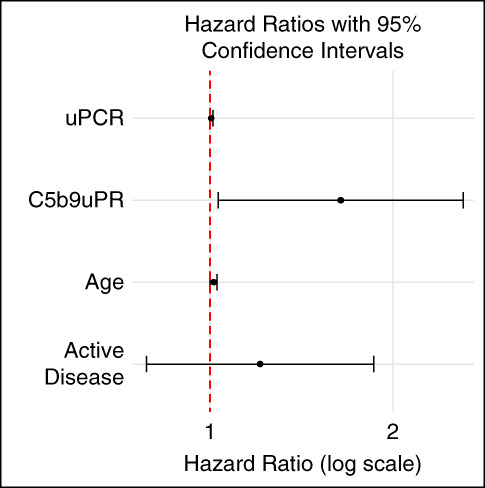
The study cohort comprised 175 patients with FSGS, including 63 (36%) incident subjects enrolled within 6 months of pathology review. Glomerular IgM, C3, and IgG deposits were found in 88 (50%), 48 (27.4%), and 27 (15.4%) patients, respectively. C3 deposition was correlated with global sclerosis (=0.27, < 0.001), tubular microcystic changes (=0.19, < 0.01), interstitial fibrosis (IF) tubular atrophy (=0.17, = 0.03), interstitial inflammation (=0.17, = 0.03), and tip lesion (=-0.16, = 0.04). In incident patients, C5b9uPR correlated with total segmental sclerosis (=0.35, < 0.01), IF (=0.33, = 0.01), IF tubular atrophy (=0.35, < 0.01), and interstitial inflammation (=0.29, = 0.03). Only C5b9uPR (hazard ratio, 1.64 [95% confidence interval, 1.03 to 2.60; = 0.03]) and age at enrollment (hazard ratio, 1.01 [95% confidence interval, 1.00 to 1.03; = 0.02]) were significantly associated with the composite outcome in the adjusted Cox survival models.
C5b9uPR is emerging as a significant biomarker for FSGS progression, reflecting the complex interplay between complement activation, inflammation, and kidney injury. The evidence suggests that elevated C5b9uPR levels are associated with poor kidney outcomes and may serve as a valuable tool in the noninvasive assessment of kidney fibrosis and disease progression.
补体激活在局灶节段性肾小球硬化症(FSGS)的发病机制和进展中起关键作用。尿可溶性C5b9蛋白比率正成为FSGS进展的重要生物标志物。针对补体途径并监测尿可溶性C5b9水平可能会改善FSGS的风险分层和治疗方法。
FSGS中补体激活与免疫反应之间的相互作用值得进一步研究。我们在肾小球肾炎治疗网络FSGS队列中,研究了肾小球C3和IgM免疫染色与FSGS疾病活动、补体系统激活、肾活检慢性病变以及初始和随访临床数据之间的关联。
回顾了肾小球肾炎治疗网络队列中具有可用病理评估的FSGS患者的数据。我们通过免疫荧光检测了肾小球免疫球蛋白和C3染色强度与哥伦比亚分类、尿膜攻击复合物(可溶性C5b9 [sC5b9])水平、蛋白尿以及由终末期肾病(ESKD)或估算肾小球滤过率(eGFR)下降40%定义的复合结局发生时间之间的关联。还检测了尿sC5b9水平,以与肌酐的比率(sC5b9与肌酐比率)和与蛋白的比率(尿sC5b9与肌酐比率与蛋白比率 [C5b9uPR])表示。
研究队列包括175例FSGS患者,其中63例(36%)为在病理检查后6个月内入组的新发患者。分别在88例(50%)、48例(27.4%)和27例(15.4%)患者中发现了肾小球IgM、C3和IgG沉积。C3沉积与全球硬化(r = 0.27,P < 0.001)、肾小管微囊性改变(r = 0.19,P < 0.01)、间质纤维化(IF)伴肾小管萎缩(r = 0.17,P = 0.03)、间质炎症(r = 0.17,P = 0.03)以及顶端病变(r = -0.16,P = 0.04)相关。在新发患者中,C5b9uPR与总节段性硬化(r = 0.35,P < 0.01)、IF(r = 0.33,P = 0.01)、IF伴肾小管萎缩(r = 0.35,P < 0.01)以及间质炎症(r = 0.29,P = 0.03)相关。在调整后的Cox生存模型中,只有C5b9uPR(风险比,1.64 [95%置信区间,1.03至2.60;P = 0.03])和入组时年龄(风险比,1.01 [95%置信区间,1.00至1.03;P = 0.02])与复合结局显著相关。
C5b9uPR正成为FSGS进展的重要生物标志物,反映了补体激活、炎症和肾损伤之间的复杂相互作用。证据表明,C5b9uPR水平升高与不良肾脏结局相关,可能成为无创评估肾纤维化和疾病进展的有价值工具。