Wang Qian, Peng Zichao, Chu Pengfei, Gui Bin, Li Yongming, Liao Lanjie, Zhu Zuoyan, Ke Fei, Wang Yaping, He Libo
State Key Laboratory of Breeding Biotechnology and Sustainable Aquaculture, Institute of Hydrobiology, Chinese Academy of Sciences, Wuhan, China.
University of the Chinese Academy of Sciences, Beijing, China.
J Virol. 2025 May 20;99(5):e0035225. doi: 10.1128/jvi.00352-25. Epub 2025 Apr 2.
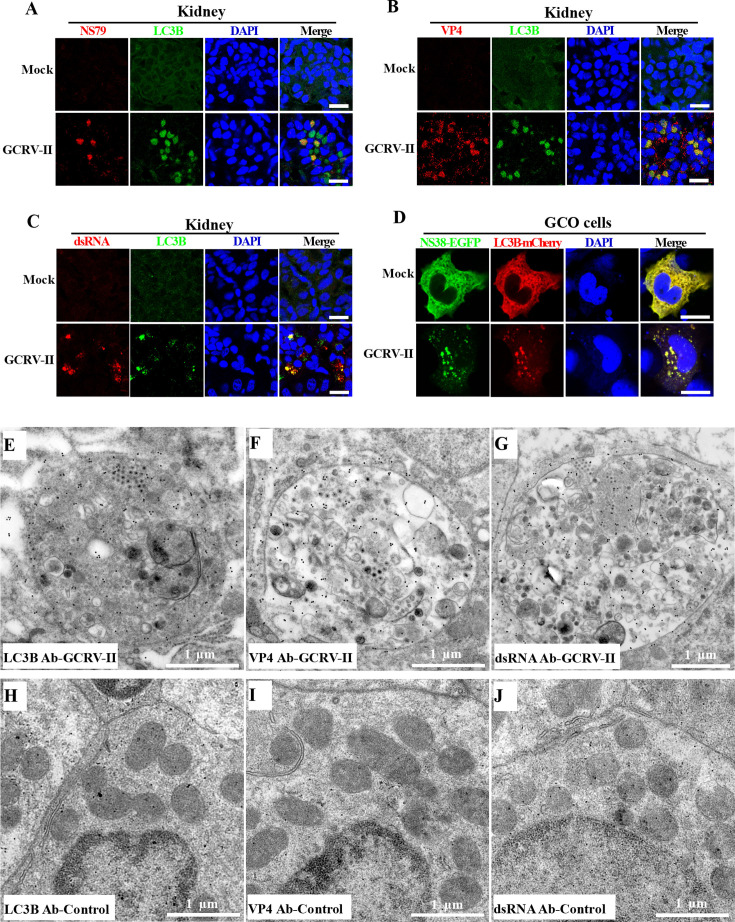
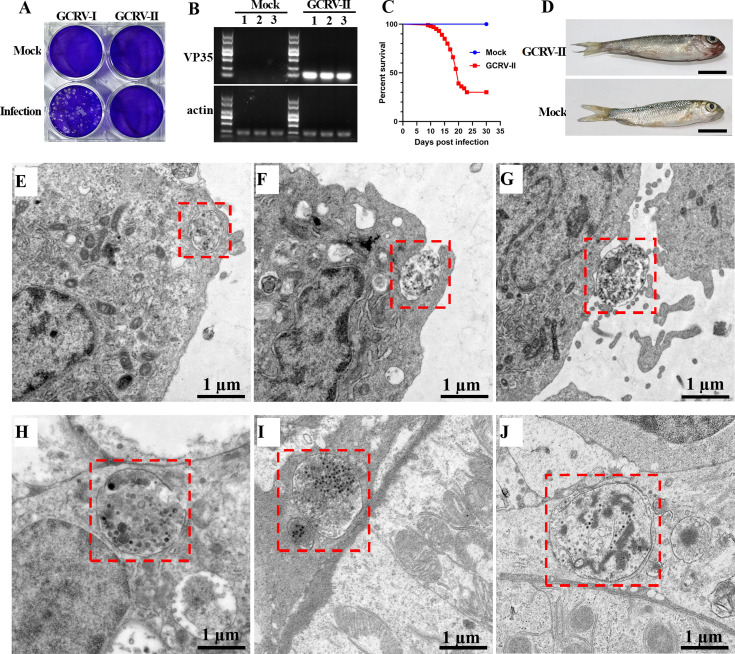
Grass carp reovirus (GCRV) is the most virulent pathogen within the genus , belonging to the family . GCRV is categorized into three genotypes, with type II (GCRV-II) being the predominant strain circulating in China. Reoviruses are known to replicate and assemble in cytoplasmic inclusion bodies termed viroplasms; however, information regarding the formation of GCRV-II viroplasms and their specific roles in virus infection remains largely unknown. In this study, we investigated the formation and characteristics of viroplasms during GCRV-II infection. Immunofluorescence and confocal microscopy indicate that GCRV-II infection induces the formation of viroplasms, with the nonstructural protein NS79 being the key protein responsible for this process. Live-cell imaging and fluorescence recovery after photobleaching assays reveal that GCRV-II viroplasms lack liquid-like properties. Transmission electron microscopy confirms that GCRV-II viroplasms are membranous structures. Notably, we demonstrate that GCRV-II infection induces autophagy and the formation of autophagosomes and that GCRV-II utilizes these autophagosomes for viroplasm formation and virion assembly. Furthermore, we found that GCRV-II uses autophagosomes to evade the host immune system, establishing subclinical persistent infection. GCRV-II also employs autophagosomes for nonlytic release and viral spread. Collectively, these findings highlight distinctive characteristics of GCRV-II viroplasms compared to those of other animal reoviruses, offering valuable insights for the prevention and control of this virus.IMPORTANCEGrass carp reovirus (GCRV) is categorized into three genotypes, with GCRV-II being the most prevalent in China. Despite reoviruses being known for their replication and assembly in viroplasms, the specifics of GCRV-II viroplasm formation and its role in infection were unclear. Our study demonstrates that GCRV-II infection triggers the formation of viroplasms, primarily mediated by the nonstructural protein NS79. GCRV-II viroplasms are membranous structures that lack liquid-like properties, which are significantly different from the viroplasms of other reoviruses. Notably, our research unveils that GCRV-II infection induces autophagy and utilizes autophagosomes for viroplasm formation and virion assembly. Furthermore, we also confirm that GCRV-II utilizes autophagosomes for subclinical persistent infection, nonlytic release, and viral spread. Our results indicate that GCRV-II hijacks autophagosomes to form viroplasms and complete its life cycle. The characteristics of GCRV-II are significantly different from those of other animal reoviruses, providing important information for prevention and control of this virus.
草鱼呼肠孤病毒(GCRV)是该属中最具致病性的病原体,属于 科。GCRV 分为三种基因型,其中 II 型(GCRV-II)是在中国流行的主要毒株。已知呼肠孤病毒在称为病毒质的细胞质包涵体中进行复制和组装;然而,关于 GCRV-II 病毒质的形成及其在病毒感染中的具体作用的信息仍然知之甚少。在本研究中,我们调查了 GCRV-II 感染过程中病毒质的形成和特征。免疫荧光和共聚焦显微镜检查表明,GCRV-II 感染诱导病毒质的形成,非结构蛋白 NS79 是负责这一过程的关键蛋白。活细胞成像和光漂白后荧光恢复实验表明,GCRV-II 病毒质缺乏类液体特性。透射电子显微镜证实,GCRV-II 病毒质是膜状结构。值得注意的是,我们证明 GCRV-II 感染诱导自噬和自噬体的形成,并且 GCRV-II 利用这些自噬体进行病毒质形成和病毒粒子组装。此外,我们发现 GCRV-II 利用自噬体逃避宿主免疫系统,建立亚临床持续感染。GCRV-II 还利用自噬体进行非裂解性释放和病毒传播。总的来说,这些发现突出了 GCRV-II 病毒质与其他动物呼肠孤病毒相比的独特特征,为该病毒的预防和控制提供了有价值的见解。
重要性
草鱼呼肠孤病毒(GCRV)分为三种基因型,其中 GCRV-II 在中国最为普遍。尽管已知呼肠孤病毒在病毒质中进行复制和组装,但 GCRV-II 病毒质形成的具体细节及其在感染中的作用尚不清楚。我们的研究表明,GCRV-II 感染触发病毒质的形成,主要由非结构蛋白 NS79 介导。GCRV-II 病毒质是缺乏类液体特性的膜状结构,这与其他呼肠孤病毒的病毒质有显著差异。值得注意的是,我们的研究揭示,GCRV-II 感染诱导自噬并利用自噬体进行病毒质形成和病毒粒子组装。此外,我们还证实 GCRV-II 利用自噬体进行亚临床持续感染、非裂解性释放和病毒传播。我们的结果表明,GCRV-II 劫持自噬体形成病毒质并完成其生命周期。GCRV-II 的特征与其他动物呼肠孤病毒的特征显著不同,为该病毒的预防和控制提供了重要信息。