• 文献检索
  • 文档翻译
  • 深度研究
  • 学术资讯
  • Suppr Zotero 插件Zotero 插件
  • 邀请有礼
  • 套餐&价格
  • 历史记录
应用&插件
Suppr Zotero 插件Zotero 插件浏览器插件Mac 客户端Windows 客户端微信小程序
定价
高级版会员购买积分包购买API积分包
服务
文献检索文档翻译深度研究API 文档MCP 服务
关于我们
关于 Suppr公司介绍联系我们用户协议隐私条款
关注我们

Suppr 超能文献

核心技术专利:CN118964589B侵权必究
粤ICP备2023148730 号-1Suppr @ 2026

文献检索

告别复杂PubMed语法,用中文像聊天一样搜索,搜遍4000万医学文献。AI智能推荐,让科研检索更轻松。

立即免费搜索

文件翻译

保留排版,准确专业,支持PDF/Word/PPT等文件格式,支持 12+语言互译。

免费翻译文档

深度研究

AI帮你快速写综述,25分钟生成高质量综述,智能提取关键信息,辅助科研写作。

立即免费体验

评估利多卡因在重症监护病房收治的室性心律失常和心力衰竭患者中的初始剂量。

Evaluating the Lidocaine's Initial Dosing in Patients With Ventricular Arrhythmias and Heart Failure Admitted in Intensive Care Units.

作者信息

Kido Kazuhiko

机构信息

Department of Clinical Pharmacy, School of Pharmacy, West Virginia University, Morgantown, West Virginia, USA.

出版信息

Clin Cardiol. 2025 Apr;48(4):e70126. doi: 10.1002/clc.70126.

DOI:10.1002/clc.70126
PMID:40179017
原文链接:https://pmc.ncbi.nlm.nih.gov/articles/PMC11967443/
Abstract

INTRODUCTION

Lidocaine is an antiarrhythmic with narrow therapeutic window indicated for refractory ventricular arrhythmia. Limited guidance is available regarding the initial infusion rate ranging from 1 to 4 mg/min in patients with heart failure (HF).

OBJECTIVES

The primary objective was to assess the optimal initial dosing of lidocaine therapy in patients with HF and ventricular arrhythmia.

METHODS

The retrospective cohort study was performed to include patients aged 18 years or older with past medical history of HF or new onset HF who developed ventricular arrythmia requiring lidocaine therapy in cardiovascular intensive care units. The primary outcome was lidocaine levels within the therapeutic ranges (defined as 1.5 to 5.0 μg/L). The study also described the predictive performance of lidocaine one compartment PK model using correlation efficient between the population PK model-predicted levels and observed levels.

RESULTS

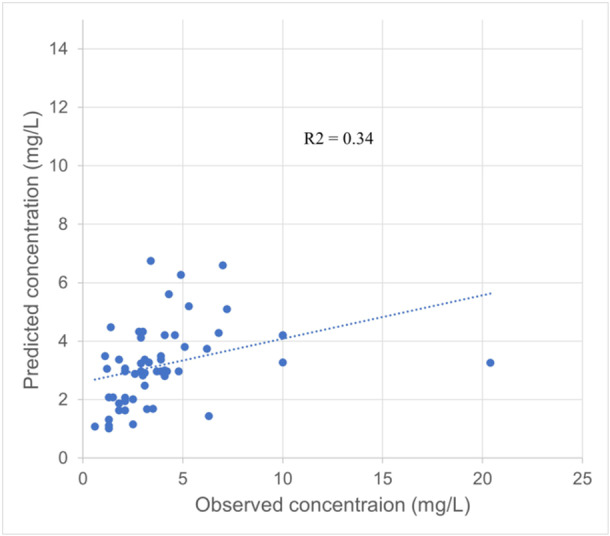
A total of 56 patients with HF and ventricular arrhythmia was included. The mean lidocaine maintenance dose was 1.1 ± 0.5 mg/min. The median (IQR) lidocaine level was 3.1 (2.3, 4.1) μg/L. The probabilities within therapeutic, supratherapeutic, and subtherapeutic ranges were 66.1%, 19.6%, and 14.3%, respectively in the whole cohort. Predicted lidocaine levels with one compartment PK model were not correlated with observed lidocaine levels (R = 0.34). The simulation investigation showed that 1 mg/min rate achieved the highest probability within therapeutic range compared to 0.5, 1.5, and 2.0 mg/min rates (78.6 vs. 53.6, 53.6, and 28.6%, respectively).

CONCLUSION

Lidocaine initial infusion rate should be up to 1 mg/min in patients with HF and ventricular arrhythmia.

摘要

引言

利多卡因是一种治疗窗狭窄的抗心律失常药物,用于难治性室性心律失常。对于心力衰竭(HF)患者,关于初始输注速率为1至4毫克/分钟的指导有限。

目的

主要目的是评估HF合并室性心律失常患者利多卡因治疗的最佳初始剂量。

方法

进行回顾性队列研究,纳入年龄在18岁及以上、有HF病史或新发HF且在心血管重症监护病房发生需要利多卡因治疗的室性心律失常的患者。主要结局是利多卡因水平在治疗范围内(定义为1.5至5.0微克/升)。该研究还使用群体药代动力学模型预测水平与观察水平之间的相关系数描述了利多卡因一室药代动力学模型的预测性能。

结果

共纳入56例HF合并室性心律失常患者。利多卡因的平均维持剂量为1.1±0.5毫克/分钟。利多卡因水平的中位数(四分位间距)为3.1(2.3,4.1)微克/升。在整个队列中,治疗范围内、治疗范围以上和治疗范围以下的概率分别为66.1%、19.6%和14.3%。一室药代动力学模型预测的利多卡因水平与观察到的利多卡因水平不相关(R = 0.34)。模拟研究表明,与0.5、1.5和2.0毫克/分钟的速率相比,1毫克/分钟的速率在治疗范围内达到的概率最高(分别为78.6%对53.6%、53.6%和28.6%)。

结论

HF合并室性心律失常患者利多卡因的初始输注速率应高达1毫克/分钟。

https://cdn.ncbi.nlm.nih.gov/pmc/blobs/acd5/11967443/c3b2159193fa/CLC-48-e70126-g001.jpg
https://cdn.ncbi.nlm.nih.gov/pmc/blobs/acd5/11967443/e151d1c3f8ab/CLC-48-e70126-g002.jpg
https://cdn.ncbi.nlm.nih.gov/pmc/blobs/acd5/11967443/c3b2159193fa/CLC-48-e70126-g001.jpg
https://cdn.ncbi.nlm.nih.gov/pmc/blobs/acd5/11967443/e151d1c3f8ab/CLC-48-e70126-g002.jpg
https://cdn.ncbi.nlm.nih.gov/pmc/blobs/acd5/11967443/c3b2159193fa/CLC-48-e70126-g001.jpg

相似文献

1
Evaluating the Lidocaine's Initial Dosing in Patients With Ventricular Arrhythmias and Heart Failure Admitted in Intensive Care Units.评估利多卡因在重症监护病房收治的室性心律失常和心力衰竭患者中的初始剂量。
Clin Cardiol. 2025 Apr;48(4):e70126. doi: 10.1002/clc.70126.
2
Development of an optimal lidocaine infusion strategy for neonatal seizures.新生儿惊厥最佳利多卡因输注策略的制定。
Eur J Pediatr. 2006 Sep;165(9):598-604. doi: 10.1007/s00431-006-0136-x. Epub 2006 May 12.
3
Comparing intravenous amiodarone or lidocaine, or both, outcomes for inpatients with pulseless ventricular arrhythmias.比较静脉注射胺碘酮或利多卡因,或两者联用,对无脉性室性心律失常住院患者的治疗效果。
Crit Care Med. 2006 Jun;34(6):1617-23. doi: 10.1097/01.CCM.0000217965.30554.D8.
4
Antiarrhythmic drug therapy for sustained ventricular arrhythmias complicating acute myocardial infarction.抗心律失常药物治疗急性心肌梗死后持续性室性心律失常。
Crit Care Med. 2011 Jan;39(1):78-83. doi: 10.1097/CCM.0b013e3181fd6ad7.
5
Lidocaine has a narrow antiarrhythmic dose range against ventricular arrhythmias induced by programmed electrical stimulation in conscious postinfarction dogs.利多卡因在清醒的心肌梗死后犬中,针对程序性电刺激诱发的室性心律失常,其抗心律失常剂量范围较窄。
Naunyn Schmiedebergs Arch Pharmacol. 1992 Aug;346(2):213-8. doi: 10.1007/BF00165304.
6
Population Pharmacokinetics of Intravenous Lidocaine in Adults: A Systematic Review.成人静脉利多卡因的群体药代动力学:系统评价。
Clin Pharmacokinet. 2024 May;63(5):623-643. doi: 10.1007/s40262-024-01373-4. Epub 2024 May 4.
7
Lidocaine toxicity in the setting of HeartMate II left ventricular assist device.HeartMate II型左心室辅助装置情况下的利多卡因毒性
J Clin Pharm Ther. 2018 Oct;43(5):733-736. doi: 10.1111/jcpt.12717. Epub 2018 Jun 9.
8
Efficacy and safety of intravenous tocainide compared with intravenous lidocaine for acute ventricular arrhythmias immediately after cardiac surgery.心脏手术后即刻静脉注射妥卡尼与静脉注射利多卡因治疗急性室性心律失常的疗效和安全性比较。
Am J Cardiol. 1984 Dec 1;54(10):1253-8. doi: 10.1016/s0002-9149(84)80075-2.
9
A neonate with long QT syndrome, refractory ventricular arrhythmias, and lidocaine toxicity.一名患有长 QT 综合征、难治性室性心律失常和利多卡因中毒的新生儿。
Anesth Analg. 2012 Feb;114(2):407-9. doi: 10.1213/ANE.0b013e31823ed423. Epub 2012 Jan 4.
10
Ranolazine therapy in drug-refractory ventricular arrhythmias.雷诺嗪治疗药物难治性室性心律失常。
J Cardiovasc Med (Hagerstown). 2017 Jul;18(7):534-538. doi: 10.2459/JCM.0000000000000521.

本文引用的文献

1
Vancomycin: An analysis and evaluation of eight population pharmacokinetic models for clinical application in general adult population.万古霉素:普通成年人群临床应用的 8 个群体药代动力学模型的分析和评价。
Pharmacotherapy. 2024 Jun;44(6):425-434. doi: 10.1002/phar.2941. Epub 2024 May 28.
2
Population Pharmacokinetics of Intravenous Lidocaine in Adults: A Systematic Review.成人静脉利多卡因的群体药代动力学:系统评价。
Clin Pharmacokinet. 2024 May;63(5):623-643. doi: 10.1007/s40262-024-01373-4. Epub 2024 May 4.
3
2017 AHA/ACC/HRS Guideline for Management of Patients With Ventricular Arrhythmias and the Prevention of Sudden Cardiac Death: A Report of the American College of Cardiology/American Heart Association Task Force on Clinical Practice Guidelines and the Heart Rhythm Society.
2017年美国心脏协会/美国心脏病学会/心律学会室性心律失常患者管理和心脏性猝死预防指南:美国心脏病学会/美国心脏协会临床实践指南工作组和心律学会的报告
J Am Coll Cardiol. 2018 Oct 2;72(14):e91-e220. doi: 10.1016/j.jacc.2017.10.054. Epub 2018 Aug 16.
4
Lidocaine elimination in patients with liver cirrhosis.肝硬化患者利多卡因的消除情况。
Acta Pol Pharm. 2002 Jul-Aug;59(4):321-4.
5
Relationship between alpha 1-acid glycoprotein and lidocaine disposition in myocardial infarction.α1-酸性糖蛋白与利多卡因在心肌梗死中的处置关系。
Clin Pharmacol Ther. 1981 Aug;30(2):154-7. doi: 10.1038/clpt.1981.141.
6
Increased alpha-1-acid glycoprotein and lidocaine disposition in myocardial infarction.心肌梗死时α-1-酸性糖蛋白增加及利多卡因处置变化
Ann Intern Med. 1980 Nov;93(5):701-4. doi: 10.7326/0003-4819-93-5-701.
7
Therapeutic drug monitoring of antiarrhythmic agents.抗心律失常药物的治疗药物监测
Clin Pharmacokinet. 1982 Mar-Apr;7(2):125-48. doi: 10.2165/00003088-198207020-00003.
8
Lidocaine pharmacokinetics in advanced heart failure, liver disease, and renal failure in humans.利多卡因在人类晚期心力衰竭、肝脏疾病和肾衰竭中的药代动力学。
Ann Intern Med. 1973 Apr;78(4):499-508. doi: 10.7326/0003-4819-78-4-499.
9
Clinical pharmacokinetics in heart failure. An updated review.心力衰竭中的临床药代动力学。最新综述。
Clin Pharmacokinet. 1988 Aug;15(2):94-113. doi: 10.2165/00003088-198815020-00002.
10
Influence of congestive heart failure on blood vessels of lidocaine and its active monodeethylated metabolite.充血性心力衰竭对利多卡因及其活性单脱乙基代谢产物血管的影响。
Clin Pharmacol Ther. 1975 Jun;17(6):669-76. doi: 10.1002/cpt1975176669.