
南非东北部农村地区对慢性健康状况、多重疾病及自我管理实践的认知:一项定性研究的结果
Perceptions about chronic health conditions, multimorbidity and self-management practices in rural northeast South Africa: findings from a qualitative study.
作者信息
Dube Audry, Kabudula Chodziwadziwa Whiteson, Njiro Belinda J, Fottrell Edward, Gómez-Olivé F Xavier, Wade Alisha N, Tollman Stephen, Burgess Rochelle, Christofides Nicola Joan
机构信息
SAMRC/Wits Rural Public Health and Health Transitions Research Unit (Agincourt), School of Public Health, Faculty of Health Sciences, University of the Witwatersrand, Johannesburg, South Africa.
SAMRC/Wits Rural Public Health and Health Transitions Research Unit (Agincourt), School of Public Health, Faculty of Health Sciences, University of the Witwatersrand, Johannesburg, South Africa
出版信息
BMJ Open. 2025 Apr 3;15(4):e098219. doi: 10.1136/bmjopen-2024-098219.
INTRODUCTION
Chronic health conditions are the leading causes of morbidity and mortality worldwide, with a disproportionately high burden in low-income and middle-income countries. The burden arising from these conditions presents immense challenges to countries with dysfunctional public healthcare systems, such as South Africa. This necessitates patients to have a good understanding of the conditions and optimal self-management approaches. We explored patients' understanding of chronic health conditions and self-management practices, including self-monitoring, in the rural South African community of Agincourt in the subdistrict of Bushbuckridge, Mpumalanga Province.
METHODS
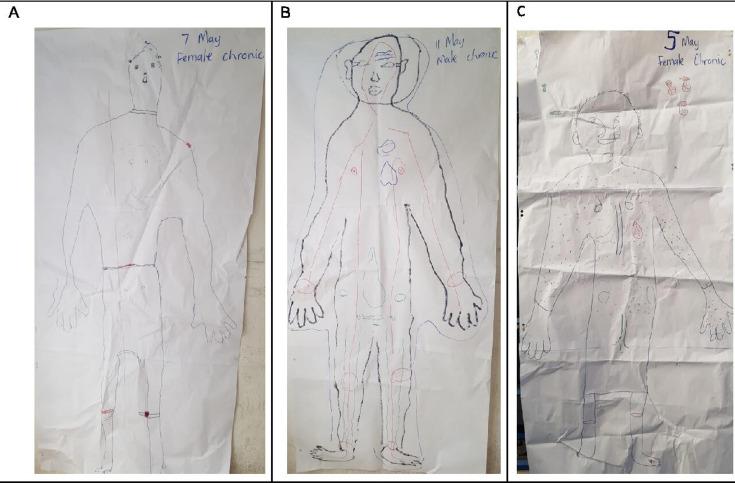
We randomly selected patients receiving routine care for chronic health conditions in primary healthcare facilities who were linked to the Agincourt Health and Demographic Surveillance System to participate in focus group discussions. Six focus groups (three with men and three with women) were conducted, with 17 male and 19 female participants (n=35) living with different chronic health conditions. Data were collected using body mapping exercises and semistructured focus group discussions facilitated by two experienced qualitative research assistants. An inclusive thematic approach was used for analysis.
RESULTS
Participants identified most chronic health conditions and their progression. Participants expressed that some consequences of chronic health conditions were unavoidable and some were attributed to medications. Three themes emerged on the management of chronic health conditions: (1) individual-level management, where participants actively changed or managed lifestyle factors associated with the conditions; (2) clinic-level management and support, where participants believed that following instructions from healthcare providers facilitates better management of their condition(s); and (3) prevention and screening, to prevent disease progression and development of complications. Participants also highlighted the role of religion in the control of chronic disease risk factors and traditional treatments for uncommon conditions such as epilepsy. Costs associated with lifestyle changes and equipment to manage and monitor health were highlighted as barriers to self-management of chronic health conditions.
CONCLUSIONS
Our findings contribute to emerging research on chronic health conditions and self-management approaches. Participants in our study demonstrated a good understanding of various chronic health conditions but lacked knowledge of self-management practices and faced barriers to self-management. There is a need for further studies on self-management of chronic health conditions, including self-monitoring among patients in rural sub-Saharan settings.
引言
慢性健康状况是全球发病和死亡的主要原因,在低收入和中等收入国家负担尤为沉重。这些状况所带来的负担给公共医疗系统功能失调的国家(如南非)带来了巨大挑战。这就要求患者对这些状况以及最佳自我管理方法有很好的理解。我们在姆普马兰加省布什布克里奇分区的阿金库尔农村社区,探讨了患者对慢性健康状况的理解以及自我管理实践,包括自我监测。
方法
我们从与阿金库尔健康与人口监测系统相关联的初级医疗保健机构中,随机挑选接受慢性健康状况常规护理的患者,参与焦点小组讨论。共进行了六个焦点小组讨论(三个男性组和三个女性组),有17名男性和19名女性参与者(n = 35),他们患有不同的慢性健康状况。数据通过身体绘图练习和由两名经验丰富的定性研究助理主持的半结构化焦点小组讨论收集。采用包容性主题方法进行分析。
结果
参与者识别出了大多数慢性健康状况及其发展过程。参与者表示,慢性健康状况的一些后果是不可避免的,一些则归因于药物治疗。在慢性健康状况管理方面出现了三个主题:(1)个人层面的管理,参与者积极改变或管理与这些状况相关的生活方式因素;(2)诊所层面的管理和支持,参与者认为遵循医疗保健提供者的指示有助于更好地管理他们的病情;(3)预防和筛查,以防止疾病进展和并发症的发生。参与者还强调了宗教在控制慢性疾病风险因素方面的作用,以及对癫痫等罕见病症的传统治疗方法。与生活方式改变以及管理和监测健康的设备相关的成本被突出为慢性健康状况自我管理的障碍。
结论
我们的研究结果为关于慢性健康状况和自我管理方法的新兴研究做出了贡献。我们研究中的参与者对各种慢性健康状况有很好的理解,但缺乏自我管理实践知识,并且面临自我管理的障碍。需要进一步研究慢性健康状况的自我管理,包括撒哈拉以南农村地区患者的自我监测。
 Zotero 插件