Ko Moon Yi, Min Euijun, Kim Minjeong, Park Heejin, Jang Sumi, Kim Younhee, Lee Byoung-Seok, Hyun Sung-Ae, Ka Minhan
Department of Advanced Toxicology Research, Korea Institute of Toxicology, Daejeon 34114, Republic of Korea.
Department of Biochemistry, Chungnam National University, Daejeon 34134, Republic of Korea.
Environ Epigenet. 2025 Mar 3;11(1):dvaf005. doi: 10.1093/eep/dvaf005. eCollection 2025.
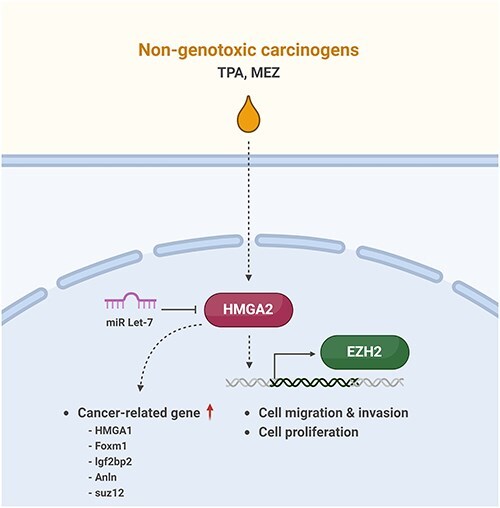
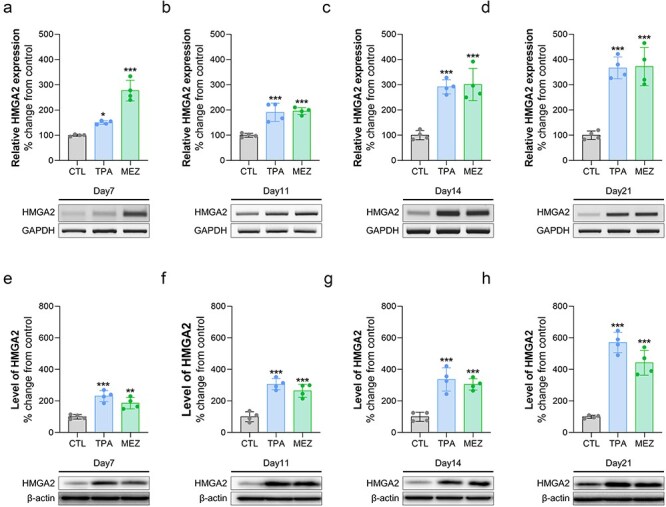
A Bhas42 cell transformation assay is a method used to detect the tumour-promoting activities of chemicals. However, the mechanisms underlying tumour transformations mediated by non-genotoxic carcinogens (NGCs) are poorly understood. This study aimed to examine the correlation between 12--tetradecanoylphorbol 13-acetate (TPA) or mezerein and the initiation of tumourous transformations by epigenetic regulation in Bhas42 cells. We found that TPA and mezerein prompted tumourous transformations by stimulating cell proliferation and migration in Bhas42 cells. Furthermore, we observed alterations in the expression levels of 134 genes, with 87 genes being upregulated and 47 genes being downregulated, following exposure to either TPA or mezerein. Among the differentially regulated genes, we identified 17 upregulated genes and 8 downregulated genes corresponding to differentially expressed genes in TNM [primary tumour (T), regional nodes (N), and metastasis (M)]. Importantly, we found that TPA and mezerein triggered the expression of Hmga2 and Ezh2 by loss of miRNA let-7 (miR let-7) in Bhas42 cells. Finally, the microRNA (miRNA) mimic of let-7 prevented the TPA- and mezerein-induced activation of Hmga2 and Ezh2 in Bhas42 cells. Our findings reveal a connection between tumourous transformations and the epigenetic regulator miR let-7 in NGCs, such as TPA and mezerein in Bhas42 cells. This highlights miR let-7 as a promising therapeutic target for mitigating tumourous transformations induced by NGCs.
Bhas42细胞转化试验是一种用于检测化学物质促肿瘤活性的方法。然而,非遗传毒性致癌物(NGC)介导的肿瘤转化的潜在机制尚不清楚。本研究旨在探讨12-十四酰佛波醇-13-乙酸酯(TPA)或芫花酯素与Bhas42细胞中表观遗传调控引发的肿瘤转化之间的相关性。我们发现TPA和芫花酯素通过刺激Bhas42细胞的增殖和迁移促使肿瘤转化。此外,我们观察到在暴露于TPA或芫花酯素后,134个基因的表达水平发生了变化,其中87个基因上调,47个基因下调。在差异调节的基因中,我们鉴定出17个上调基因和8个下调基因,它们与TNM [原发肿瘤(T)、区域淋巴结(N)和转移(M)]中的差异表达基因相对应。重要的是,我们发现TPA和芫花酯素通过Bhas42细胞中miRNA let-7(miR let-7)的缺失触发了Hmga2和Ezh2的表达。最后,let-7的微小RNA(miRNA)模拟物阻止了Bhas42细胞中TPA和芫花酯素诱导的Hmga2和Ezh2的激活。我们的研究结果揭示了Bhas42细胞中肿瘤转化与NGC(如TPA和芫花酯素)中的表观遗传调节因子miR let-7之间的联系。这突出了miR let-7作为减轻NGC诱导的肿瘤转化的有前景的治疗靶点。