Liu Suo, Ru Jingyi, Guo Xue, Gao Qun, Deng Sihang, Lei Jiesi, Song Jian, Zhai Changchun, Wan Shiqiang, Yang Yunfeng
State Key Joint Laboratory of Environment Simulation and Pollution Control, School of Environment, Tsinghua University, Beijing, China.
School of Life Sciences/Hebei Basic Science Center for Biotic Interaction, Hebei University, Baoding, China.
mSystems. 2025 May 20;10(5):e0124824. doi: 10.1128/msystems.01248-24. Epub 2025 Apr 8.
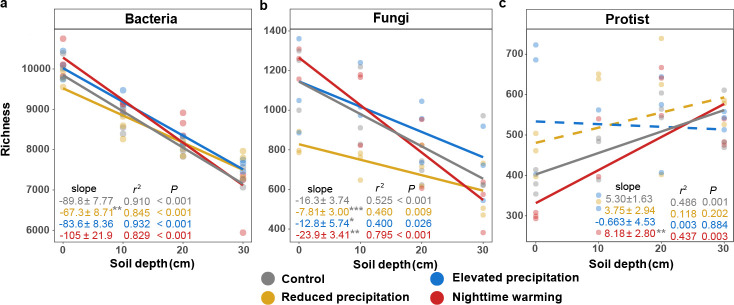
Soil depth determines microbial community composition. Yet, it remains largely unexplored how climate changes affect the vertical distribution of soil microbial communities. Here, we investigated the effects of altered precipitation and nighttime warming on microbial communities in the topsoils (0-20 cm) and subsoils (20-50 cm) of a temperate grassland in Inner Mongolia, China. As commonly observed under nutrient scarcity conditions, bacterial and fungal α-diversity and network complexity decreased with soil depth. However, protistan α-diversity and network complexity increased, which was attributed to less niche overlap and smaller body size. Strikingly, the slopes of linear regressions of microbial α-diversity/network complexity and soil depth were all reduced by altered precipitation. Microbial community composition was significantly influenced by both depth and reduced precipitation, and to a lesser extent by nighttime warming and elevated precipitation. The ribosomal RNA gene operon () copy number, a genomic proxy of bacterial nutrient demand, decreased with soil depth, and the percentages of positive network links were higher in the subsoil, supporting the "hunger game" hypothesis. Both reduced precipitation and nighttime warming decreased the copy number in the subsoils while increasing the percentages of positive links, enhancing potential niche sharing among bacterial species. The stochasticity level of bacterial and fungal community assemblies decreased with soil depth, showing that depth acted as a selection force. Altered precipitation increased stochasticity, attenuating the depth's filtering effect and diminishing its linear relationship with microbial diversity. Collectively, we unveiled the predominant influence of altered precipitation in affecting the vertical distribution of soil microbial communities.IMPORTANCEUnderstanding how climate change impacts the vertical distribution of soil microbial communities is critical for predicting ecosystem responses to global environmental shifts. Soil microbial communities exhibit strong depth-related stratification, yet the effects of climate change variables, such as altered precipitation and nighttime warming, on these vertical patterns have been inadequately studied. Our research uncovers that altered precipitation disrupts the previously observed relationships between soil depth and microbial diversity, a finding that challenges traditional models of soil microbial ecology. Furthermore, our study provides experimental support for the hunger game hypothesis, highlighting that oligotrophic microbes, characterized by lower ribosomal RNA gene operon () copy numbers, are selectively favored in nutrient-poor subsoils, fostering increased microbial cooperation for resource exchange. By unraveling these complexities in soil microbial communities, our findings offer crucial insights for predicting ecosystem responses to climate change and for developing strategies to mitigate its adverse impacts.
土壤深度决定微生物群落组成。然而,气候变化如何影响土壤微生物群落的垂直分布在很大程度上仍未得到充分探索。在此,我们研究了降水变化和夜间变暖对中国内蒙古温带草原表层土壤(0 - 20厘米)和亚表层土壤(20 - 50厘米)中微生物群落的影响。正如在养分稀缺条件下通常观察到的那样,细菌和真菌的α多样性以及网络复杂性随土壤深度降低。然而,原生生物的α多样性和网络复杂性增加,这归因于生态位重叠较少和体型较小。引人注目的是,降水变化降低了微生物α多样性/网络复杂性与土壤深度的线性回归斜率。微生物群落组成受深度和降水减少的显著影响,受夜间变暖和降水增加的影响较小。核糖体RNA基因操纵子()拷贝数是细菌养分需求的基因组指标,随土壤深度降低,亚表层土壤中正向网络连接的百分比更高,支持“饥饿游戏”假说。降水减少和夜间变暖都降低了亚表层土壤中的 拷贝数,同时增加了正向连接的百分比,增强了细菌物种间潜在的生态位共享。细菌和真菌群落组装的随机性水平随土壤深度降低,表明深度起到了选择作用。降水变化增加了随机性,削弱了深度的过滤作用,并减弱了其与微生物多样性的线性关系。总体而言,我们揭示了降水变化对土壤微生物群落垂直分布的主要影响。
重要性
了解气候变化如何影响土壤微生物群落的垂直分布对于预测生态系统对全球环境变化的响应至关重要。土壤微生物群落呈现出与深度相关的强烈分层现象,然而,诸如降水变化和夜间变暖等气候变化变量对这些垂直模式的影响尚未得到充分研究。我们的研究发现,降水变化破坏了先前观察到的土壤深度与微生物多样性之间的关系,这一发现挑战了传统的土壤微生物生态学模型。此外,我们的研究为“饥饿游戏”假说提供了实验支持,强调以较低核糖体RNA基因操纵子()拷贝数为特征的贫营养微生物在养分贫乏的亚表层土壤中受到选择性青睐,促进了微生物为资源交换而增加的合作。通过揭示土壤微生物群落中的这些复杂性,我们的研究结果为预测生态系统对气候变化的响应以及制定减轻其不利影响的策略提供了关键见解。