
绘制产科护理荒漠地图:北卡罗来纳州的驾车距离与健康结果
Mapping maternity care deserts: Driving distance and health outcomes in North Carolina.
作者信息
Sugg Margaret, Shakya Shishir, Ulrich Sarah, Tyson Jennifer Schroeder, Runkle Jennifer
机构信息
Department of Geography and Planning, Appalachian State University, Boone, North Carolina, USA.
Department of Economics, Appalachian State University, Boone, North Carolina, USA.
出版信息
J Rural Health. 2025 Mar;41(2):e70020. doi: 10.1111/jrh.70020.
OBJECTIVE
This study evaluated the association between maternal care deserts (MCDs)-defined by accessibility measures such as travel time and distance to obstetric and gynecological care-and maternal and infant health outcomes in North Carolina from 2016 to 2021.
METHODS
This was a retrospective secondary data analysis examining residents of North Carolina from 2016 to 2021, using travel metrics from residential zip codes to the nearest clinical providers. Maternal and infant health outcomes were assessed using data from the National Plan and Provider Enumeration System (NPPES) from the Centers for Medicare & Medicaid Services (CMS) and inpatient hospitalization records for North Carolina. Outcomes of interest included cesarean delivery rates, severe maternal morbidity (SMM20 and SMM21), and hypertension, which were examined across rural-urban disparities based on RUCA codes. Statistical analyses were conducted to link travel metrics with health outcomes, adjusting for age, race, and insurance status to control for potential confounding factors.
RESULTS
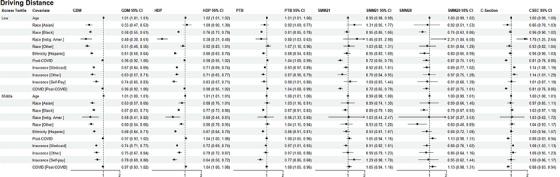
The study found that rural and low-income areas in North Carolina had fewer health care providers. Increased travel times and distances to clinical care were associated with higher cesarean delivery rates, increased severe maternal morbidity, preterm birth, and higher rates of gestational diabetes. These associations remained significant even after adjusting for age, race, and insurance status.
CONCLUSION
Women living in maternal care deserts in North Carolina, often in rural locations, are more likely to experience adverse health outcomes, including severe maternal morbidity and hypertension, likely due to limited access to essential obstetric and gynecological care. These findings highlight the negative impact of health care inaccessibility on maternal and infant health in underserved regions.
目的
本研究评估了2016年至2021年北卡罗来纳州产妇护理荒漠(MCDs,通过诸如前往妇产科护理机构的出行时间和距离等可及性指标来定义)与母婴健康结局之间的关联。
方法
这是一项回顾性二次数据分析,研究对象为2016年至2021年北卡罗来纳州的居民,使用从居住邮政编码到最近临床医疗服务提供者的出行指标。母婴健康结局通过医疗保险和医疗补助服务中心(CMS)的国家计划和医疗服务提供者枚举系统(NPPES)的数据以及北卡罗来纳州的住院记录进行评估。感兴趣的结局包括剖宫产率、严重孕产妇发病率(SMM20和SMM21)以及高血压,根据农村城市社区代码(RUCA)在城乡差异中对这些指标进行了研究。进行了统计分析,以将出行指标与健康结局联系起来,并对年龄、种族和保险状况进行调整,以控制潜在的混杂因素。
结果
研究发现北卡罗来纳州的农村和低收入地区医疗服务提供者较少。前往临床护理机构的出行时间和距离增加与剖宫产率升高、严重孕产妇发病率增加、早产以及妊娠期糖尿病发病率升高相关。即使在对年龄、种族和保险状况进行调整后,这些关联仍然显著。
结论
居住在北卡罗来纳州产妇护理荒漠地区(通常为农村地区)的女性更有可能经历不良健康结局,包括严重孕产妇发病率和高血压,这可能是由于获得基本妇产科护理的机会有限。这些发现凸显了医疗服务不可及性对服务不足地区母婴健康的负面影响。



 Zotero 插件