Yang Yang, Chen Jiayi, Zhao XiaoHua, Gong Fuhong, Liu Ruimin, Miao Jingge, Lin Mengping, Ge Fei, Chen Wenlin
Yunnan Key Laboratory of Breast Cancer Precision Medicine, Department of Breast Surgery, The Third Affiliated Hospital of Kunming Medical University, Peking University Cancer Hospital Yunnan, Yunnan Cancer Hospital, Kunming, China.
Department of Cardiology, Yan'an Hospital Affiliated To Kunming Medical University, Kunming, China.
Front Genet. 2025 Mar 25;16:1450259. doi: 10.3389/fgene.2025.1450259. eCollection 2025.
Epidemiological studies have observed an association between atrial fibrillation (AF) and breast cancer (BC). However, the underlying mechanisms linking these two conditions remain unclear. This study aims to systematically explore the genetic association between AF and BC.
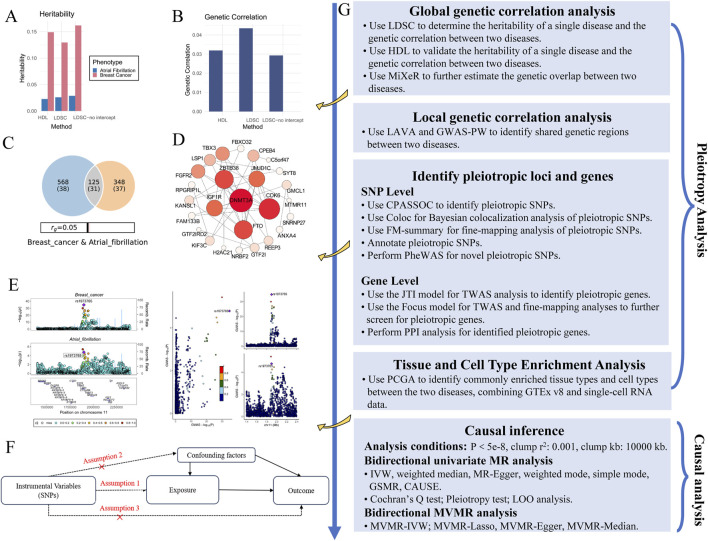
We utilized the largest available genome-wide association study (GWAS) datasets for European individuals, including summary data for AF (N = 1,030,836) and BC (N = 247,173). Multiple approaches were employed to systematically investigate the genetic relationship between AF and BC from the perspectives of pleiotropy and causality.
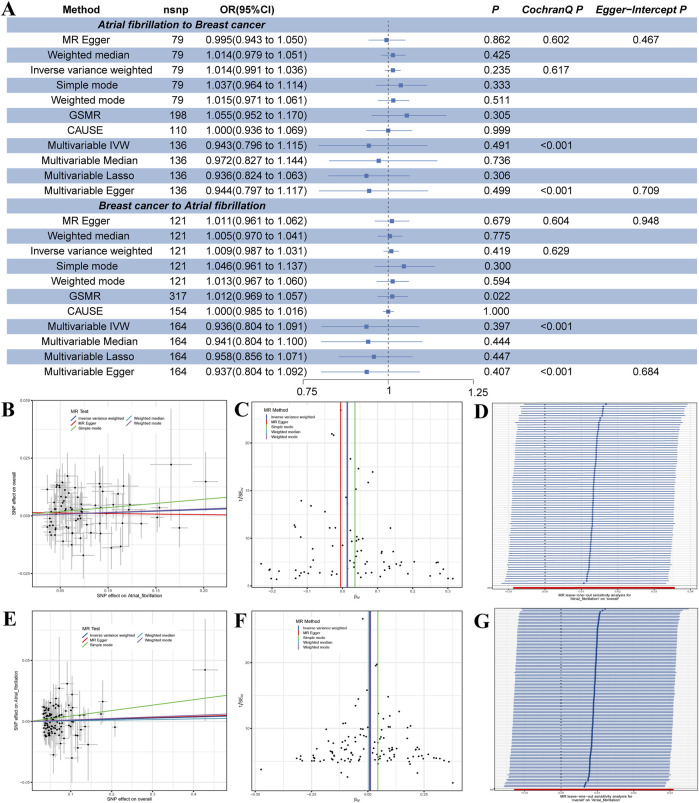
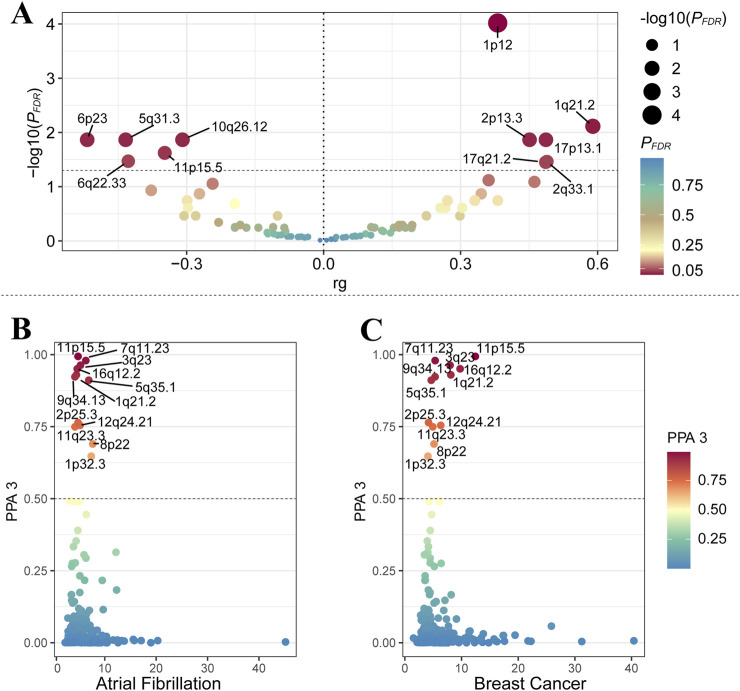
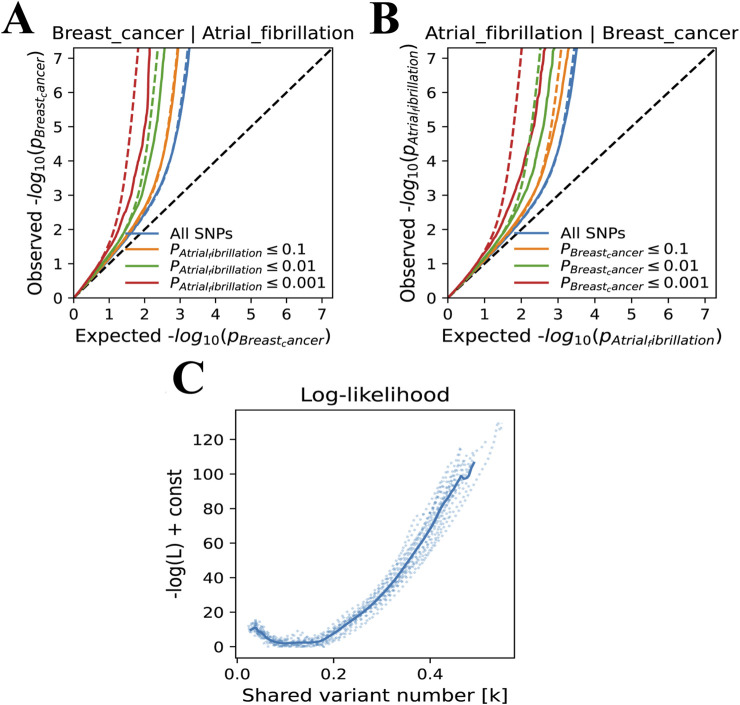
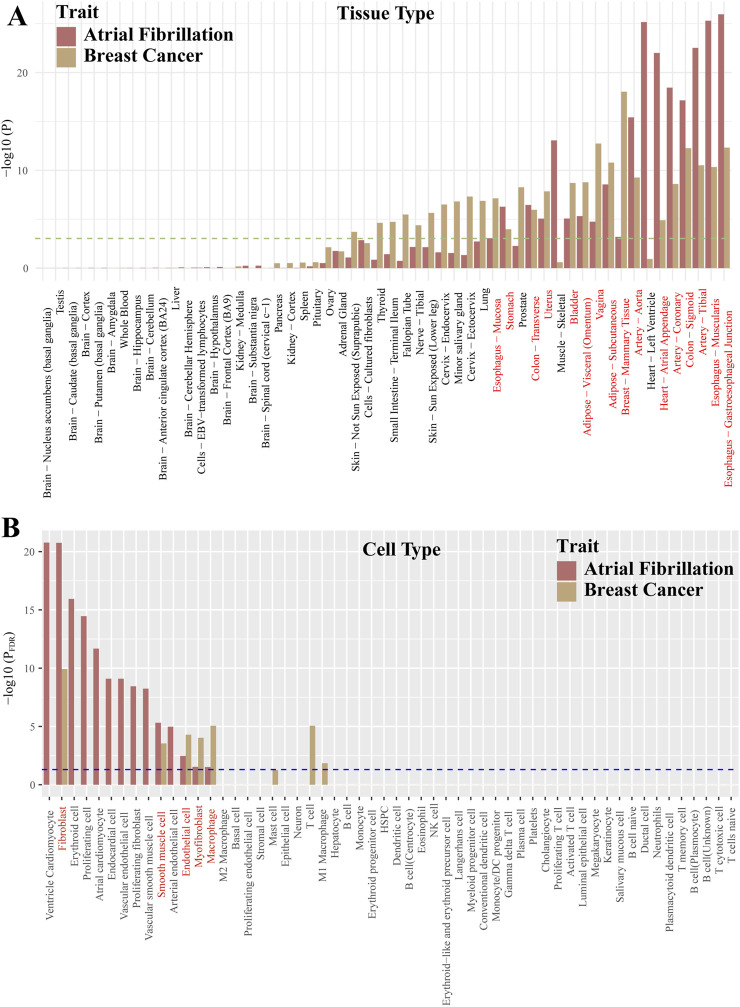
Global genetic analysis using LDSC and HDL revealed a genetic correlation between AF and BC (rg = 0.0435, P = 0.039). Mixer predicted genetic overlap between non-MHC regions of the two conditions (n = 125, rg = 0.05). Local genetic analyses using LAVA and GWAS-PW identified 22 regions with potential genetic sharing. Cross-trait meta-analysis by CPASSOC identified one novel pleiotropic SNP and 14 pleiotropic SNPs, which were subsequently annotated. Eight of these SNPs passed Bayesian colocalization tests, including one novel pleiotropic SNP. Further fine-mapping analysis identified a set of causal SNPs for each significant SNP. TWAS analyses using JTI and FOCUS models jointly identified 10 pleiotropic genes. Phenome-wide association study (PheWAS) of novel pleiotropic SNPs identified two eQTLs (PELO, ITGA1). Gene-based PheWAS results showed strong associations with BMI, height, and educational attainment. PCGA methods combining GTEx V8 tissue data and single-cell RNA data identified 16 co-enriched tissue types (including cardiovascular, reproductive, and digestive systems) and 5 cell types (including macrophages and smooth muscle cells). Finally, univariable and multivariable bidirectional Mendelian randomization analyses excluded a causal relationship between AF and BC.
This study systematically investigated the shared genetic overlap between AF and BC. Several pleiotropic SNPs and genes were identified, and co-enriched tissue and cell types were revealed. The findings highlight common mechanisms from a genetic perspective rather than a causal relationship. This study provides new insights into the AF-BC association and suggests potential experimental targets and directions for future research. Additionally, the results underscore the importance of monitoring the potential risk of one disease in patients diagnosed with the other.
流行病学研究观察到心房颤动(AF)与乳腺癌(BC)之间存在关联。然而,连接这两种疾病的潜在机制仍不清楚。本研究旨在系统地探索AF与BC之间的遗传关联。
我们利用了欧洲个体最大可用的全基因组关联研究(GWAS)数据集,包括AF(N = 1,030,836)和BC(N = 247,173)的汇总数据。采用多种方法从多效性和因果关系的角度系统地研究AF与BC之间的遗传关系。
使用LDSC和HDL进行的全基因组遗传分析揭示了AF与BC之间的遗传相关性(rg = 0.0435,P = 0.039)。Mixer预测了两种疾病非MHC区域之间的遗传重叠(n = 125,rg = 0.05)。使用LAVA和GWAS-PW进行的局部遗传分析确定了22个具有潜在遗传共享的区域。通过CPASSOC进行的跨性状荟萃分析确定了一个新的多效性SNP和14个多效性SNP,随后对其进行了注释。其中8个SNP通过了贝叶斯共定位测试,包括一个新的多效性SNP。进一步的精细定位分析为每个显著SNP确定了一组因果SNP。使用JTI和FOCUS模型进行的TWAS分析共同确定了10个多效性基因。对新的多效性SNP进行全表型关联研究(PheWAS)确定了两个eQTL(PELO,ITGA1)。基于基因的PheWAS结果显示与体重指数、身高和教育程度有很强的关联。结合GTEx V8组织数据和单细胞RNA数据的PCGA方法确定了16种共富集的组织类型(包括心血管、生殖和消化系统)和5种细胞类型(包括巨噬细胞和平滑肌细胞)。最后,单变量和多变量双向孟德尔随机化分析排除了AF与BC之间的因果关系。
本研究系统地研究了AF与BC之间共享的遗传重叠。确定了几个多效性SNP和基因,并揭示了共富集的组织和细胞类型。这些发现从遗传角度突出了共同机制而非因果关系。本研究为AF-BC关联提供了新的见解,并为未来研究提出了潜在的实验靶点和方向。此外,结果强调了在诊断为另一种疾病的患者中监测一种疾病潜在风险的重要性。