Wang Jin, Wang Gan, Qi Chaoyi
Department of Healthcare-associated Infection Management, Qingdao Municipal Hospital, Qingdao, People's Republic of China.
Shanghai Institute of Infectious Disease and Biosecurity, Fudan University, Shanghai, People's Republic of China.
Risk Manag Healthc Policy. 2025 Apr 4;18:1197-1208. doi: 10.2147/RMHP.S520382. eCollection 2025.
This study used data envelopment analysis (DEA), to assess relative efficiency of infection control in different clinical departments of the hospital for performance evaluation purposes.
All wards and departments from January to December 2022 were selected as decision units, and five input and two output indicators related to infection prevention and control were determined using DEA. Pure technical efficiency was evaluated using the Banker-Charnes-Cooper (BCC) model.
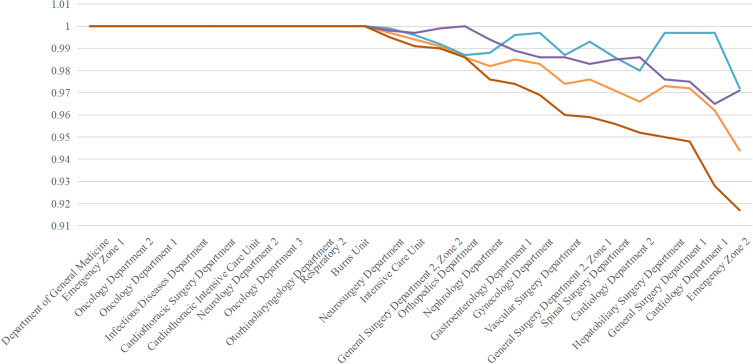
In the study, the input-output indexes of the 27 clinical departments varied significantly. The average values of technical efficiency, pure technical efficiency, scale efficiency, and comprehensive benefit were 0.987, 0.995, 0.992, and 0.980, respectively. Among the 27 departments, 52% exhibited constant returns to scale, 44% showed increasing returns to scale, and 4% had decreasing returns to scale. In the context of DEA, 44% of the departments were classified as highly efficient, indicating that their input-output ratios had reached an optimal state. Meanwhile, 56% of the departments were identified as non-DEA efficient, suggesting that there was room for improvement in their input-output efficiency.
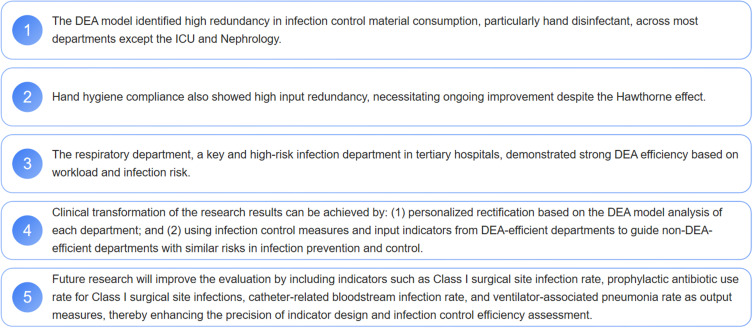
The improvement of input-output indexes of non-DEA effective clinical departments was defined by the BCC model. Use of DMUs could improve the efficiency of inventory control by optimizing the allocation of inventory control resources and refining inventory control measures.
本研究采用数据包络分析(DEA)来评估医院不同临床科室感染控制的相对效率,以进行绩效评估。
选取2022年1月至12月所有病房和科室作为决策单元,运用DEA确定与感染预防控制相关的五个输入指标和两个输出指标。采用班克-查恩斯-库珀(BCC)模型评估纯技术效率。
本研究中,27个临床科室的投入产出指标差异显著。技术效率、纯技术效率、规模效率和综合效益的平均值分别为0.987、0.995、0.992和0.980。在27个科室中,52%呈现规模报酬不变,44%呈现规模报酬递增,4%呈现规模报酬递减。在DEA背景下,44%的科室被归类为高效,表明其投入产出比已达到最优状态。同时,56%的科室被认定为非DEA有效,表明其投入产出效率有提升空间。
通过BCC模型明确了非DEA有效的临床科室投入产出指标的改进方向。使用决策单元可通过优化感染控制资源配置和细化感染控制措施来提高感染控制效率。