• 文献检索
  • 文档翻译
  • 深度研究
  • 学术资讯
  • Suppr Zotero 插件Zotero 插件
  • 邀请有礼
  • 套餐&价格
  • 历史记录
应用&插件
Suppr Zotero 插件Zotero 插件浏览器插件Mac 客户端Windows 客户端微信小程序
定价
高级版会员购买积分包购买API积分包
服务
文献检索文档翻译深度研究API 文档MCP 服务
关于我们
关于 Suppr公司介绍联系我们用户协议隐私条款
关注我们

Suppr 超能文献

核心技术专利:CN118964589B侵权必究
粤ICP备2023148730 号-1Suppr @ 2026

文献检索

告别复杂PubMed语法,用中文像聊天一样搜索,搜遍4000万医学文献。AI智能推荐,让科研检索更轻松。

立即免费搜索

文件翻译

保留排版,准确专业,支持PDF/Word/PPT等文件格式,支持 12+语言互译。

免费翻译文档

深度研究

AI帮你快速写综述,25分钟生成高质量综述,智能提取关键信息,辅助科研写作。

立即免费体验

沙特阿拉伯多个初级医疗保健中心父亲产后抑郁症的患病率及危险因素:一项横断面研究

Prevalence and Risk Factors of Paternal Postpartum Depression in Multiple Primary Healthcare Centers in Saudi Arabia: A Cross-Sectional Study.

作者信息

Bokhari Lujain, Alsulami Areej, Alharbi Ghaida, Nughays Reem, Alabdali Rozan, Alharthi Samiyah, Magliah Sultan, Alsabban Ahmad, Zahid Rania, Abduljabbar Abeer

机构信息

College of Medicine, King Saud Bin Abdulaziz University for Health Sciences, Jeddah, SAU.

Department of Family Medicine, Ministry of the National Guard-Health Affairs, King Abdulaziz Medical City, Jeddah, SAU.

出版信息

Cureus. 2025 Mar 9;17(3):e80302. doi: 10.7759/cureus.80302. eCollection 2025 Mar.

DOI:10.7759/cureus.80302
PMID:40201864
原文链接:https://pmc.ncbi.nlm.nih.gov/articles/PMC11978359/
Abstract

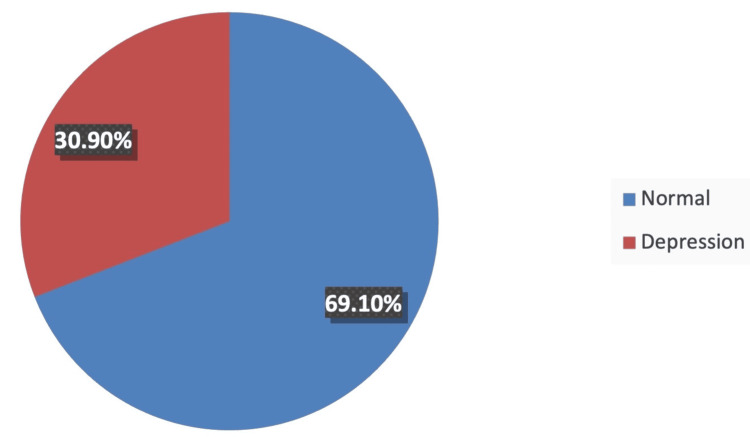
Introduction Paternal postpartum depression (PPPD) is an important public health issue that can negatively affect relationships among fathers, partners, and children. However, research on this issue in Saudi Arabia is lacking. We aimed to determine the prevalence and risk factors for PPPD among Saudi fathers. Methods This cross-sectional study was conducted among Saudi fathers in King Abdulaziz Medical City, Jeddah. We included all fathers of newborns aged ≤6 months while excluding those with a history of depressive disorder. A self-administered questionnaire was sent to all participants. The Arabic version of the Edinburgh Postnatal Depression Scale (EPDS) was used to screen individuals for PPPD. Results The total number of respondents was 223. Approximately 30.9% of participants had PPPD based on an EPDS cutoff value of ≥9. Significant risk factors associated with PPPD were whether the father had lost a child (p = 0.0083) and whether the father had a family history of depression (p = 0.0028). Conclusion Our findings suggest that PPPD is prevalent among Saudi fathers; therefore, there is an urgent need for further research on PPPD. The results of this study will contribute to establishing preventive and intervention programs.

摘要

引言 产后父亲抑郁症(PPPD)是一个重要的公共卫生问题,会对父亲、伴侣和孩子之间的关系产生负面影响。然而,沙特阿拉伯在这方面的研究较为匮乏。我们旨在确定沙特父亲中PPPD的患病率及危险因素。方法 这项横断面研究在吉达阿卜杜勒阿齐兹国王医疗城的沙特父亲中开展。我们纳入了所有6个月及以下新生儿的父亲,排除有抑郁症病史者。向所有参与者发放了一份自填式问卷。采用阿拉伯语版爱丁堡产后抑郁量表(EPDS)对个体进行PPPD筛查。结果 受访者总数为223人。基于EPDS临界值≥9,约30.9%的参与者患有PPPD。与PPPD相关的显著危险因素是父亲是否有孩子夭折经历(p = 0.0083)以及父亲是否有抑郁症家族史(p = 0.0028)。结论 我们的研究结果表明PPPD在沙特父亲中普遍存在;因此,迫切需要对PPPD开展进一步研究。本研究结果将有助于制定预防和干预方案。
https://cdn.ncbi.nlm.nih.gov/pmc/blobs/0638/11978359/969e21f7eac7/cureus-0017-00000080302-i01.jpg

相似文献

1
Prevalence and Risk Factors of Paternal Postpartum Depression in Multiple Primary Healthcare Centers in Saudi Arabia: A Cross-Sectional Study.沙特阿拉伯多个初级医疗保健中心父亲产后抑郁症的患病率及危险因素:一项横断面研究
Cureus. 2025 Mar 9;17(3):e80302. doi: 10.7759/cureus.80302. eCollection 2025 Mar.
2
Paternal Postnatal Depression Among Fathers of Newborn in Saudi Arabia.沙特阿拉伯新生儿父亲的产后抑郁
Am J Mens Health. 2019 Jan-Feb;13(1):1557988319831219. doi: 10.1177/1557988319831219.
3
Prevalence of Paternal Postpartum Depression in Anuradhapura District in Sri Lanka and Its Association With Maternal Postpartum Depression as a Risk Factor.斯里兰卡阿努拉德普勒地区父亲产后抑郁症的患病率及其作为危险因素与母亲产后抑郁症的关联。
J Family Reprod Health. 2022 Dec;16(4):239-242. doi: 10.18502/jfrh.v16i4.11351.
4
Prevalence of Postpartum Depression Among Mothers Giving Birth at King Abdulaziz University Hospital, Jeddah, Kingdom of Saudi Arabia From 2020 Until 2022.2020年至2022年沙特阿拉伯王国吉达阿卜杜勒阿齐兹国王大学医院分娩母亲中产后抑郁症的患病率
Cureus. 2022 Nov 11;14(11):e31365. doi: 10.7759/cureus.31365. eCollection 2022 Nov.
5
Prevalence of Postpartum Depression and Associated Risk Factors Among Women in Jeddah, Western Saudi Arabia.沙特阿拉伯西部吉达市女性产后抑郁症的患病率及相关危险因素
Cureus. 2021 Apr 21;13(4):e14603. doi: 10.7759/cureus.14603.
6
The prevalence and risk factors for postpartum depression symptoms of fathers at one and 6 months postpartum: an adjunct study of the Japan Environment & Children's Study.父亲在产后 1 个月和 6 个月时产后抑郁症状的流行率及危险因素:日本环境与儿童研究的辅助研究。
J Matern Fetal Neonatal Med. 2020 Aug;33(16):2797-2804. doi: 10.1080/14767058.2018.1560415. Epub 2019 Jan 4.
7
Breastfeeding Self-efficacy is Inversely Associated with Postpartum Depression: Findings from a Tertiary Hospital in Saudi Arabia.母乳喂养自我效能感与产后抑郁呈负相关:沙特阿拉伯一家三级医院的研究结果。
Saudi J Med Med Sci. 2023 Oct-Dec;11(4):292-298. doi: 10.4103/sjmms.sjmms_601_22. Epub 2023 Oct 6.
8
Predictors of postpartum depression and its association with sleep quality among mothers in Qassim, Saudi Arabia: A descriptive cross-sectional study.沙特阿拉伯盖西姆地区产妇产后抑郁及其与睡眠质量关系的预测因素:一项描述性横断面研究。
Int J Psychiatry Med. 2024 May;59(3):325-340. doi: 10.1177/00912174231202932. Epub 2023 Sep 28.
9
Mother-to-infant bonding failure and intimate partner violence during pregnancy as risk factors for father-to-infant bonding failure at 1 month postpartum: an adjunct study of the Japan Environment and Children's Study.母婴结合失败和妊娠期间亲密伴侣暴力是父亲在产后 1 个月与婴儿结合失败的风险因素:日本环境与儿童研究的辅助研究。
J Matern Fetal Neonatal Med. 2020 Aug;33(16):2789-2796. doi: 10.1080/14767058.2018.1560414. Epub 2019 Apr 15.
10
Paternal postnatal depression: prevalence and the associated demographic and maternal reproductive factors among Iranian fathers.父亲产后抑郁:伊朗父亲中患病率及相关人口统计学和产妇生殖因素。
J Reprod Infant Psychol. 2024 Sep;42(5):964-976. doi: 10.1080/02646838.2023.2201844. Epub 2023 Apr 25.

本文引用的文献

1
Sample size determination: A practical guide for health researchers.样本量的确定:健康研究人员实用指南。
J Gen Fam Med. 2022 Dec 14;24(2):72-78. doi: 10.1002/jgf2.600. eCollection 2023 Mar.
2
Risk factors of paternal postnatal depression in Pakistan: Findings from an urban sample.巴基斯坦父亲产后抑郁的风险因素:来自城市样本的发现。
Nurs Health Sci. 2022 Sep;24(3):618-624. doi: 10.1111/nhs.12954. Epub 2022 Jun 3.
3
Predictive Factors for Depression and Anxiety in Men During the Perinatal Period: A Mixed Methods Study.围生期男性抑郁和焦虑的预测因素:混合方法研究。
Am J Mens Health. 2022 Jan-Feb;16(1):15579883221079489. doi: 10.1177/15579883221079489.
4
Prevalence and factors associated with mental health problems in Saudi general population during the coronavirus disease 2019 pandemic: A systematic review and meta-analysis.在 2019 年冠状病毒病大流行期间沙特一般人群中心理健康问题的流行情况及相关因素:系统评价和荟萃分析。
Psych J. 2022 Feb;11(1):18-29. doi: 10.1002/pchj.516. Epub 2022 Jan 5.
5
Predictors of postpartum depression among Chinese mothers and fathers in the early postnatal period: A cross-sectional study.中国母婴父亲在产后早期的产后抑郁症预测因素:一项横断面研究。
Midwifery. 2022 Feb;105:103233. doi: 10.1016/j.midw.2021.103233. Epub 2021 Dec 21.
6
Depressive symptoms in men immediately after birth.男性产后即刻出现抑郁症状。
J Psychosom Res. 2021 Dec;151:110650. doi: 10.1016/j.jpsychores.2021.110650. Epub 2021 Oct 27.
7
Informal and formal social support during pregnancy and joint maternal and paternal postnatal depression: Data from the French representative ELFE cohort study.孕期非正式和正式社会支持与母婴产后抑郁的关系:来自法国代表性 ELFE 队列研究的数据。
Int J Soc Psychiatry. 2020 Aug;66(5):431-441. doi: 10.1177/0020764020911409. Epub 2020 Apr 18.
8
A prospective study of postnatal depressive symptoms and associated risk factors in first-time fathers.一项关于初为人父者产后抑郁症状及相关危险因素的前瞻性研究。
J Affect Disord. 2019 Apr 15;249:371-377. doi: 10.1016/j.jad.2019.02.033. Epub 2019 Feb 11.
9
Paternal Postnatal Depression Among Fathers of Newborn in Saudi Arabia.沙特阿拉伯新生儿父亲的产后抑郁
Am J Mens Health. 2019 Jan-Feb;13(1):1557988319831219. doi: 10.1177/1557988319831219.
10
The prevalence and risk factors for postpartum depression symptoms of fathers at one and 6 months postpartum: an adjunct study of the Japan Environment & Children's Study.父亲在产后 1 个月和 6 个月时产后抑郁症状的流行率及危险因素:日本环境与儿童研究的辅助研究。
J Matern Fetal Neonatal Med. 2020 Aug;33(16):2797-2804. doi: 10.1080/14767058.2018.1560415. Epub 2019 Jan 4.