Eyong Efah Denis, Iwara Iwara Aripko, Agwupuye Eyuwa Ignatius, Agboola Abdulhakeem Rotimi, Uti Daniel Ejim, Obio Wilson Arong, Alum Esther Ugo, Atangwho Item Justin
Department of Biochemistry, Faculty of Basic Medical Science, College of Medical Sciences, University of Calabar, P.M.B, Calabar, Nigeria.
Department of Research and Publications, Kampala International University, Kampala, Uganda.
PLoS One. 2025 Apr 9;20(4):e0319756. doi: 10.1371/journal.pone.0319756. eCollection 2025.
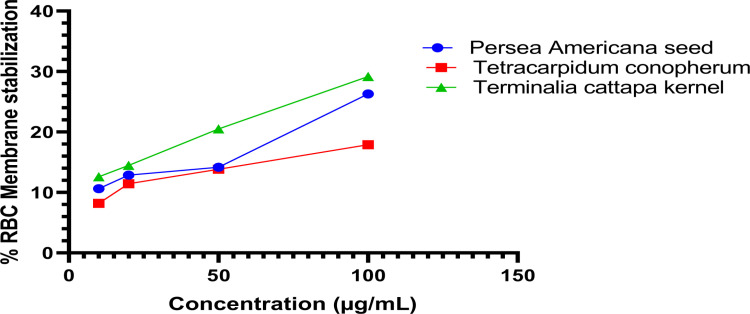
Together with their nutritional qualities, the biosafety, antidiabetic, antioxidant, and anti-inflammatory effects of Tetracarpidium conophorum nuts, Persea americana seeds, and Terminalia cattapa kernels were evaluated in vitro and in silico. RBC membrane stabilisation for anti-inflammatory characteristics, antioxidant activities by ABTS, DPPH, H2O2, and nitric oxide scavenging assays, and α-glucosidase and α-amylase inhibitory assays conducted in vitro were used to evaluate the anti-diabetic activity. With an IC50 value of 208 μg/mL, P. americana showed the maximum amount of inhibition, according to the results, while T. catappa showed a somewhat lower degree of inhibition at 236 μg/mL. P. americana exhibited the highest degree of α-amylase inhibition, with an IC50 value of 312 µg/mL. T. catappa showed the strongest DPPH radical scavenging activity, while T. conophorum showed the highest ABTS radical scavenging activity. T. catappa showed the strongest effectiveness in neutralising hydrogen peroxide. In tests using human red blood cells, T. catappa showed the strongest inhibition of RBC hemolysis. While P. americana showed higher concentrations of copper, manganese, potassium, and calcium, T. catappa showed higher magnesium concentrations. T. catappa had considerably higher levels of ash, proteins, lipids, and carbohydrates than T. conophorum, which had the highest quantity of crude fibre, according to proximate analysis. Molecular docking experiments have revealed that plant extracts from P. americana, T. conophorum, and T. catappa have substantial binding affinities towards α-glucosidase and amylase. Pseudococaine, M-(1-methylbutyl) phenylmethylcarbamate, o-xylene, and 1-deoxynojirimycin were the four compounds that showed binding affinities that were higher than those of acarbose. Acarbose and nitrate were not as compatible with docking scores as compared to the compounds dimethyl phthalate, pseudococaine, M-(1-Methylbutyl)phenyl methylcarbamate, 2-chloro-3-oxohexanedioic acid, and methyl 2-chloro-5-nitrobenzoate. These results suggest that these plant extracts hold great potential for the creation of therapeutic medications that specifically target oxidative stress-related diseases like diabetes.
结合其营养特性,对四棱豆坚果、鳄梨种子和榄仁树果仁的生物安全性、抗糖尿病、抗氧化和抗炎作用进行了体外和计算机模拟评估。通过体外进行的红细胞膜稳定化以评估抗炎特性、ABTS法、DPPH法、H2O2法和一氧化氮清除法测定抗氧化活性,以及α-葡萄糖苷酶和α-淀粉酶抑制试验来评估抗糖尿病活性。结果显示,鳄梨的抑制量最大,IC50值为208μg/mL,而榄仁树的抑制程度稍低,IC50值为236μg/mL。鳄梨表现出最高程度的α-淀粉酶抑制作用,IC50值为312μg/mL。榄仁树表现出最强的DPPH自由基清除活性,而四棱豆表现出最高的ABTS自由基清除活性。榄仁树在中和过氧化氢方面表现出最强的效果。在使用人红细胞的试验中,榄仁树对红细胞溶血的抑制作用最强。虽然鳄梨中铜、锰、钾和钙的浓度较高,但榄仁树中镁的浓度较高。根据近似分析,榄仁树的灰分、蛋白质、脂质和碳水化合物含量明显高于四棱豆,而四棱豆的粗纤维含量最高。分子对接实验表明,鳄梨、四棱豆和榄仁树的植物提取物对α-葡萄糖苷酶和淀粉酶具有显著的结合亲和力。假可卡因、M-(1-甲基丁基)苯基甲基氨基甲酸酯、邻二甲苯和1-脱氧野尻霉素这四种化合物的结合亲和力高于阿卡波糖。与邻苯二甲酸二甲酯、假可卡因、M-(1-甲基丁基)苯基甲基氨基甲酸酯、2-氯-3-氧代己二酸和2-氯-5-硝基苯甲酸甲酯相比,阿卡波糖和硝酸盐与对接分数的兼容性较差。这些结果表明,这些植物提取物在开发针对糖尿病等氧化应激相关疾病的治疗药物方面具有巨大潜力。