Saito Akiko, Nagayama Kazuaki, Okada Hiroyuki, Onodera Shoko, Aida Natsuko, Nakamura Takashi, Sawada Takashi, Hojo Hironori, Kato Shigeaki, Azuma Toshifumi
Department of Biochemistry, Tokyo Dental College, Tokyo 101-0061, Japan.
Oral Health Science Center, Tokyo Dental College, Tokyo 101-0061, Japan.
Proc Natl Acad Sci U S A. 2025 Apr 15;122(15):e2320138122. doi: 10.1073/pnas.2320138122. Epub 2025 Apr 10.
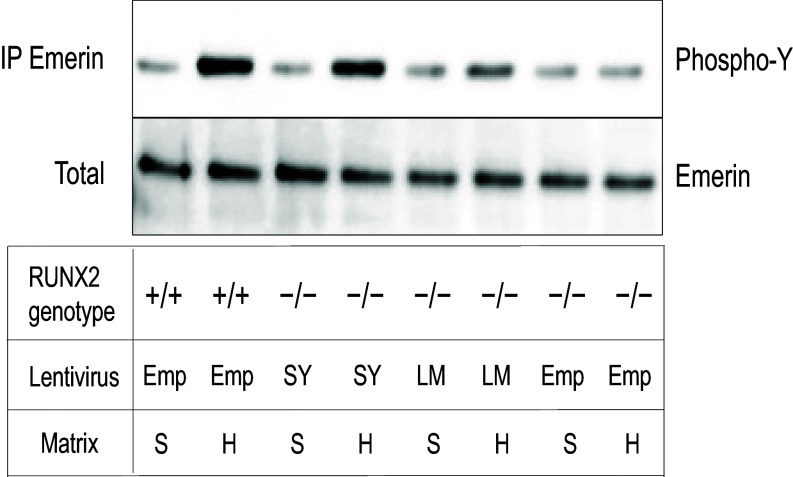
Runx2 is a master regulator of bone formation, and its dysfunction causes cleidocranial dysplasia (CCD) in humans. When iPS cells were generated from patients with CCD and Runx2-deficient iPS cells were generated using gene-editing techniques, abnormal laminopathy-like nuclei were observed. Runx2-deficient cells showed reduced Lamin A/C expression, but not protein levels. However, in Runx2-deficient cells, both the gene expression and protein levels of Nesprin1 were reduced, perinuclear actin fibers were sparser, and nuclear stiffness was reduced. Forced expression of Lamin A/C increased nuclear stiffness but did not improve nuclear morphology. In contrast, the induction of Nesprin1 expression alone normalized nuclear stiffness and restored nuclear morphology and perinuclear actin distribution. In Runx2-null cells, mechanical stress-induced phosphorylation of emerin was not observed. In contrast, forced expression of Nesprin1 in Runx2-null cells resulted in phosphorylation of emerin, indicating the restoration of intracellular tension. These observations were confirmed by atomic force microscopy. Therefore, the intracellular tension was inferred to pull the nuclear membrane into its normal shape. CUT&RUN assay and single RNA-seq analysis showed that an aberrant nuclear membrane caused loss of nuclear lamina gene regulation machinery, making the progression of normal osteogenic differentiation impossible; however, supplementation with Nesprin1 restored gene regulation mechanisms and promoted preosteoblast formation with normal nuclear morphology. Nesprin1 expression induced by Runx2 is essential for epigenetic regulation of the nuclear lamina. We propose CCD as a type of laminopathy involving defective expression of Nesprin1 regulated by Runx2.
Runx2是骨形成的主要调节因子,其功能障碍会导致人类锁骨颅骨发育不全(CCD)。当从CCD患者中产生诱导多能干细胞(iPS细胞),并使用基因编辑技术产生Runx2缺陷的iPS细胞时,观察到异常的核纤层病样细胞核。Runx2缺陷细胞显示核纤层蛋白A/C表达降低,但蛋白质水平未降低。然而,在Runx2缺陷细胞中,Nesprin1的基因表达和蛋白质水平均降低,核周肌动蛋白纤维更稀疏,核硬度降低。强制表达核纤层蛋白A/C可增加核硬度,但不能改善核形态。相反,单独诱导Nesprin1表达可使核硬度正常化,并恢复核形态和核周肌动蛋白分布。在Runx2缺失的细胞中,未观察到机械应力诱导的emerin磷酸化。相反,在Runx2缺失的细胞中强制表达Nesprin1会导致emerin磷酸化,表明细胞内张力得以恢复。这些观察结果通过原子力显微镜得到证实。因此,推断细胞内张力将核膜拉成正常形状。CUT&RUN分析和单RNA测序分析表明,异常的核膜导致核纤层基因调控机制丧失,使正常成骨分化无法进行;然而,补充Nesprin1可恢复基因调控机制,并促进具有正常核形态的前成骨细胞形成。Runx2诱导的Nesprin1表达对于核纤层的表观遗传调控至关重要。我们提出将CCD作为一种涉及由Runx2调节的Nesprin1表达缺陷的核纤层病类型。