Khoramaki Zakieh, Fallahipour Leila, Karimi Masoud, Nazari Mahin
Student Research Committee, Department of Health Promotion, School of Health, Shiraz University of Medical Sciences, Shiraz, Iran.
Research Committee, Department of Health Promotion, School of Health, Shiraz University of Medical Sciences, Shiraz, Iran.
BMC Womens Health. 2025 Apr 11;25(1):169. doi: 10.1186/s12905-025-03706-2.
Physical activity is one of the most important indicators of health in the society and plays an important role in the lives of people, especially women. Nevertheless, one of the major challenges in modern society is the inactivity and lack of optimal physical activity of women, which has caused a rising prevalence in chronic diseases. Models and theories help to better understand these behaviors and better planning for behavior change in target groups. This study was conducted with the aim of investigating the predictors of regular physical activity among middle-aged women based on the trans-theoretical model.
The present study was conducted cross-sectionally on 250 middle-aged women (age range 45-59) covered by comprehensive health databases.
Inclusion conditions included willingness to participate, living in the area under study, not having certain diseases and disorders that would cause changes in lifestyle or physical activity. The random sampling method was simple. In this study, questionnaires of transtheoretical model constructs and short international questionnaire of physical activity were used. Data were analyzed using SPSS version 26 and Amos 24 software.
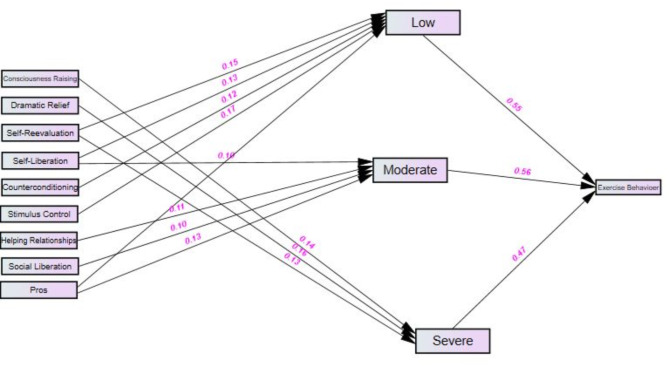
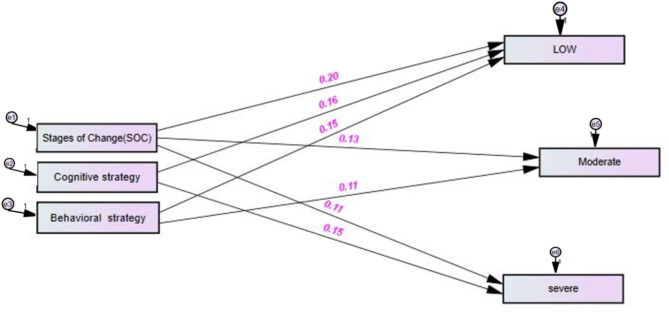
In path analysis, change methods with path coefficient β = 0.20 are the strongest predictors of physical activity behavior in middle-aged women, and it clearly shows a significant positive relationship with the amount of physical activity (P < 0.05). Also, the stimulus control substructure with a factor loading of β = 0.17 and a confidence interval (CI) of 95% also has a high predictive power of the tendency to physical activity behavior. Chi-square ratio to degrees of freedom (χ²/DF) < 3 and RMSEA = 0.065 indicate a good fit of the model with the data (GFI = 0.91, CFI = 0.98).
The path analysis revealed that the proposed model by Prochaska fits well with the research data, indicating that change processes are strong predictors of physical behavior. These findings can serve as a foundation for developing targeted, evidence-based interventions to promote physical activity among middle-aged women.
身体活动是社会健康的最重要指标之一,在人们尤其是女性的生活中起着重要作用。然而,现代社会的一大主要挑战是女性缺乏运动以及缺乏最佳身体活动,这导致慢性病患病率不断上升。模型和理论有助于更好地理解这些行为,并为目标群体的行为改变进行更好的规划。本研究旨在基于跨理论模型调查中年女性定期进行身体活动的预测因素。
本研究对综合健康数据库涵盖的250名中年女性(年龄范围45 - 59岁)进行了横断面研究。
纳入条件包括愿意参与、居住在研究区域、没有会导致生活方式或身体活动改变的特定疾病和障碍。采用简单随机抽样方法。在本研究中,使用了跨理论模型构建的问卷和简短的国际身体活动问卷。数据使用SPSS 26版和Amos 24软件进行分析。
在路径分析中,路径系数β = 0.20的改变方法是中年女性身体活动行为的最强预测因素,并且它与身体活动量明显呈显著正相关(P < 0.05)。此外,因子载荷β = 0.17且95%置信区间(CI)的刺激控制子结构对身体活动行为倾向也具有较高的预测能力。卡方与自由度之比(χ²/DF)< 3且RMSEA = 0.065表明模型与数据拟合良好(GFI = 0.91,CFI = 0.98)。
路径分析表明,普罗查斯卡提出的模型与研究数据拟合良好,表明改变过程是身体行为的强预测因素。这些发现可为制定有针对性地、基于证据的干预措施以促进中年女性的身体活动提供基础。