Guy Rebecca L, Hopkins Katie L, Budd Emma L, Wilson Kate, Fountain Holly, Meunier Danièle, Pike Rachel, Gerver Sarah M, Gnanadurai Roshina, Brown Colin S, Hopkins Susan, Muller-Pebody Berit
AMR & HCAI Division, UK Health Security Agency, London, United Kingdom.
Antimicrobial Resistance and Healthcare Associated Infections (AMRHAI) Reference Unit, UK Health Security Agency, London, United Kingdom.
Euro Surveill. 2025 Apr;30(14). doi: 10.2807/1560-7917.ES.2025.30.14.2400399.
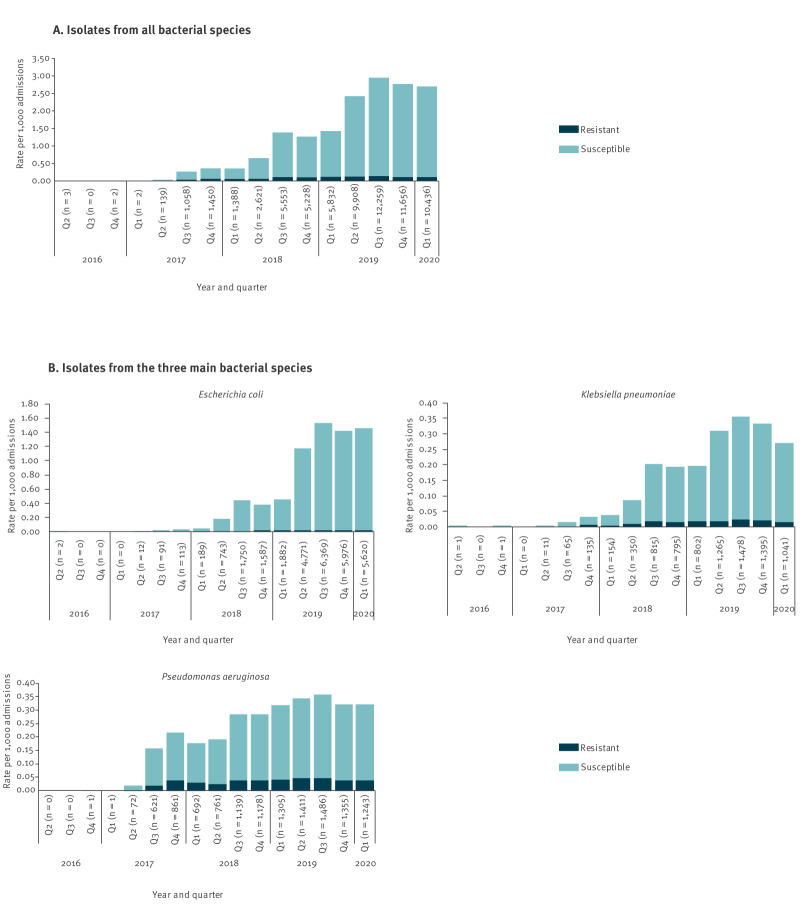
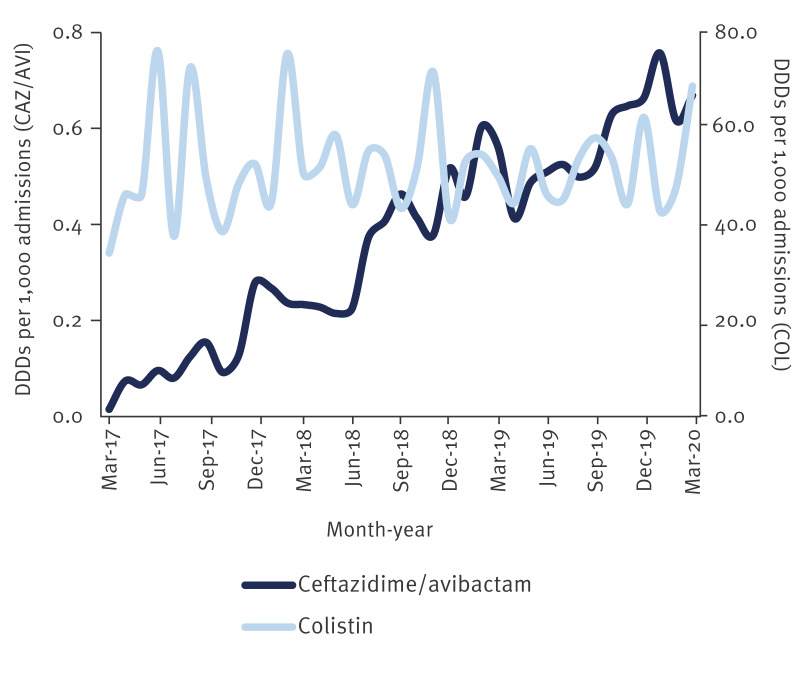
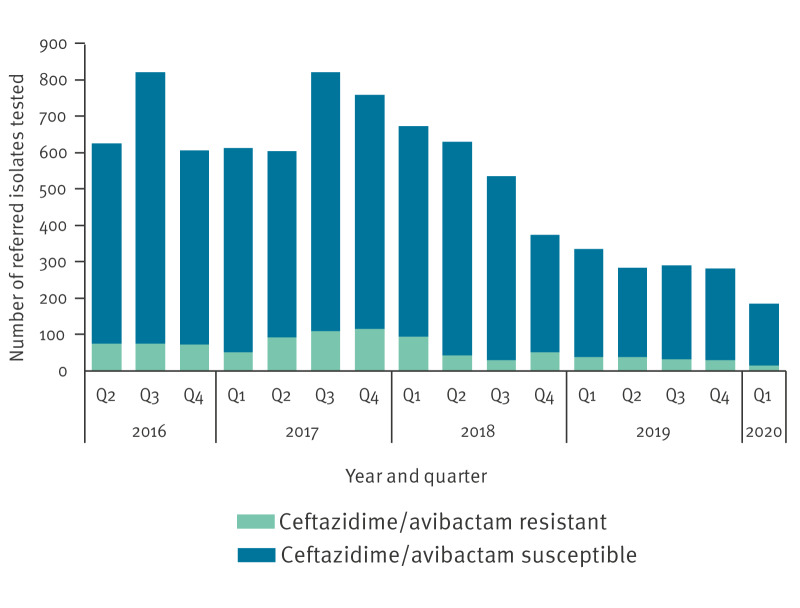
BackgroundCeftazidime/avibactam, launched in the United Kingdom (UK) in March 2017, is an antibiotic against multidrug-resistant Gram-negative pathogens. It was selected for the government's subscription model pilot, for incentivising new antibiotic development, which began in December 2020.AimAhead of the pilot, we assessed ceftazidime/avibactam testing, resistance (2016-2020) and usage (2017-2020) levels in England, as baselines for future surveillance.MethodsFrom routine surveillance samples, we retrieved reported ceftazidime/avibactam resistance categorisation. From reference laboratory samples, we reviewed minimum inhibitory concentration (MICs) and molecular data. Among surveillance samples, per cent resistance was estimated. Referred samples' MICs, by carbapenemase gene presence, were investigated. Ceftazidime/avibactam hospital use was measured in defined daily doses (DDDs).ResultsOverall, 6.3% (4,200/66,914; 95% confidence interval (95%CI): 6.1-6.4%) of surveillance-reported ceftazidime/avibactam-tested Gram-negative bacteria were resistant. Percentage resistance per bacterial species varied over time, somewhat stabilising as testing was established, with between April 2019 and March 2020, 1.3% (288/22,736; 95%CI: 1.1-1.4%), 12.6% (690/5,495; 95%CI: 11.7-13.5%) and 6.1% of (314/5,179; 95%CI: 5.4-6.7%) being resistant. For 8,437 referred Enterobacterales, MIC determination found 11.5% (968/8,437; 95%CI: 10.8-12.2%) resistant. Among resistant isolates, 89.3% (864/968; 95%CI: 87.1-91.1%) had metallo-β-lactamase (MBL) genes. Of 908 MBL-negative isolates, producing ≥ 1 non-metallo-carbapenemase(s), 2.1% (19/908; 95%CI: 1.3-3.2%) were resistant. Since March 2017, 69.5% (105/151) of English National Health Service Trusts used ceftazidime/avibactam. Monthly usage progressed from 21 to 744 DDDs in March 2020.ConclusionFor appropriate treatment, carbapenemase gene detection and variant identification in ceftazidime/avibactam surveillance matters. Detecting emerging resistant pathogens and preventing spread within healthcare settings requires vigilance.
背景
头孢他啶/阿维巴坦于2017年3月在英国上市,是一种针对多重耐药革兰氏阴性病原体的抗生素。它被选入政府的订阅模式试点项目,以激励新型抗生素的研发,该试点项目于2020年12月启动。
目的
在试点之前,我们评估了英格兰地区头孢他啶/阿维巴坦的检测情况、耐药性(2016 - 2020年)和使用情况(2017 - 2020年)水平,作为未来监测的基线。
方法
从常规监测样本中,我们获取报告的头孢他啶/阿维巴坦耐药分类。从参考实验室样本中,我们审查最低抑菌浓度(MIC)和分子数据。在监测样本中,估算耐药百分比。按碳青霉烯酶基因存在情况,对送检样本的MIC进行研究。以限定日剂量(DDD)衡量头孢他啶/阿维巴坦在医院的使用情况。
结果
总体而言,监测报告中经头孢他啶/阿维巴坦检测的革兰氏阴性菌有6.3%(4200/66914;95%置信区间(95%CI):6.1 - 6.4%)耐药。各细菌物种的耐药百分比随时间变化,随着检测的开展有所稳定,在2019年4月至2020年3月期间,耐药率分别为1.3%(288/22736;95%CI:1.1 - 1.4%)、12.6%(690/5495;95%CI:11.7 - 13.5%)和6.1%(314/5179;95%CI:5.4 - 6.7%)。对于8437份送检的肠杆菌科细菌,MIC测定发现11.5%(968/8437;95%CI:10.8 - 12.2%)耐药。在耐药菌株中,89.3%(8