Glahn Castille Megan, Resendiz Ortega Susan
Orthotics and Prosthetics, Baylor College of Medicine, Houston, TX, USA.
Align Clinic, The Woodlands, TX, USA.
Discov Ment Health. 2025 Apr 11;5(1):54. doi: 10.1007/s44192-025-00180-y.
Friend support and social support have been suggested to be beneficial for adolescents facing medical challenges; however, there is little research to identify who is providing emotional support for children and adolescents with scoliosis. Therefore, the purpose of this study was to investigate the sources of emotional support and to analyze a program designed to encourage social support, the Scolios-us Mentor Program (Mentor Program).
This study consisted of a cross-sectional survey. The survey included the SRS-22r, BSSQ-Brace, and questions about demographics, mental health, the Scolios-us Mentor Program, and general scoliosis experience. The survey was distributed via email to Mentor Program participants and to scoliosis clinicians to provide to their patients. Descriptive statistics, Mann-Whitney U tests, and correlations (Cochran-Armitage, Pearson's correlation, and Spearman's correlation) were used to analyze responses.
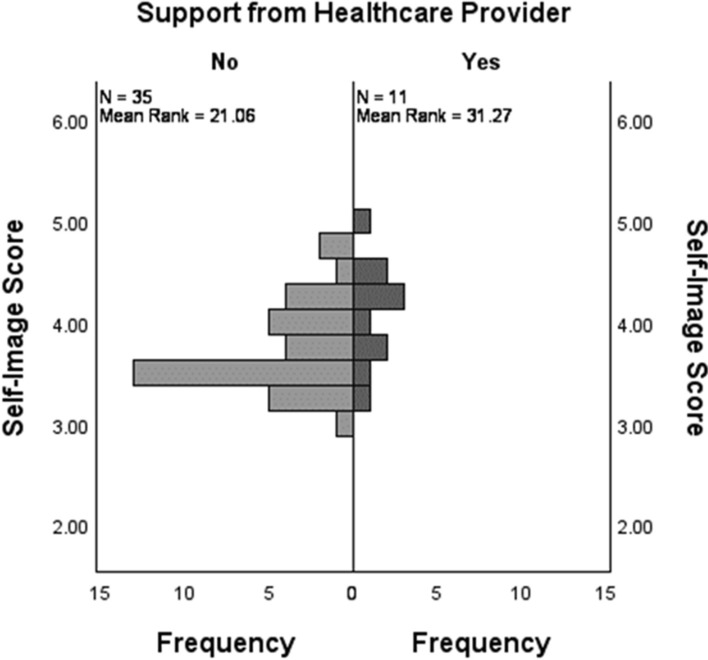
A total of 46 participants with an age range was 8-18 were included in the final analysis. The median current age was 13 (IQR: 3), and the median diagnosis age was 10 (IQR: 4). Our results indicate that most participants (76.1%) received emotional support from at least two sources, including family, friends, healthcare providers, and support groups. Participants with two or more support sources had significantly higher self-image scores than those below this threshold (p =.042). Self-image scores were significantly higher for those who reported receiving emotional support from a healthcare provider (p =.027). Over 60% (29/46) of participants participated in the Scolios-us Mentor Program. No significant differences were noted in BSSQ-Brace or SRS- 22r scores between those who participate in the Mentor Program versus those who do not, but mentees scored lower for function, self-image, and management than mentors. Interestingly, as program satisfaction increased, BSSQ-Brace scores decreased (p =.012).
Having a strong emotional support system is important for self-image in children and adolescents with scoliosis. Healthcare providers appear to play an important role in promoting a positive self-image in their scoliosis patients. To help patients foster a strong support system, healthcare providers should be knowledgeable of the available psychosocial resources, including scoliosis support groups, for children and adolescents with scoliosis.
已有研究表明,朋友支持和社会支持对面临医疗挑战的青少年有益;然而,对于为脊柱侧弯儿童和青少年提供情感支持的人员,相关研究较少。因此,本研究旨在调查情感支持的来源,并分析一项旨在鼓励社会支持的项目——脊柱侧弯导师项目(导师项目)。
本研究采用横断面调查。调查内容包括SRS - 22r、BSSQ - 支具问卷,以及关于人口统计学、心理健康、脊柱侧弯导师项目和脊柱侧弯总体经历的问题。调查问卷通过电子邮件分发给导师项目参与者以及脊柱侧弯临床医生,由临床医生提供给他们的患者。使用描述性统计、曼 - 惠特尼U检验和相关性分析( Cochr an - Armitage检验、皮尔逊相关性分析和斯皮尔曼相关性分析)来分析调查结果。
最终分析纳入了46名年龄在8至18岁之间的参与者。当前年龄中位数为13岁(四分位间距:3岁),诊断年龄中位数为10岁(四分位间距:4岁)。我们的研究结果表明,大多数参与者(76.1%)从至少两个来源获得情感支持,包括家人、朋友、医疗保健提供者和支持小组。有两个或更多支持来源的参与者的自我形象得分显著高于低于此阈值的参与者(p = 0.042)。报告从医疗保健提供者那里获得情感支持的参与者的自我形象得分显著更高(p = 0.027)。超过60%(29/46)的参与者参加了脊柱侧弯导师项目。参加导师项目的参与者与未参加者在BSSQ - 支具问卷或SRS - 22r得分上未发现显著差异,但受指导者在功能、自我形象和管理方面的得分低于指导者。有趣的是,随着项目满意度的提高,BSSQ - 支具问卷得分下降(p = 0.012)。
拥有强大的情感支持系统对脊柱侧弯儿童和青少年的自我形象很重要。医疗保健提供者在提升脊柱侧弯患者的积极自我形象方面似乎发挥着重要作用。为帮助患者建立强大的支持系统,医疗保健提供者应了解可为脊柱侧弯儿童和青少年提供的心理社会资源,包括脊柱侧弯支持小组。