Hotor Prince, Kotey Fleischer C N, Donkor Eric S
Department of Medical Microbiology, University of Ghana Medical School, 00233, Accra, Ghana.
BMC Public Health. 2025 Apr 11;25(1):1364. doi: 10.1186/s12889-025-22513-w.
The occurrence of antibiotic-resistant bacteria (ARB) has become a global menace and therefore increases morbidity, mortality and healthcare costs. Globally, hospital wastewater (HWW) has been identified as a significant source of antibiotic-resistant elements.
This review aims to systematically review and to perform meta-analyses from evidence on antibiotic resistance studies in HWW in West Africa.
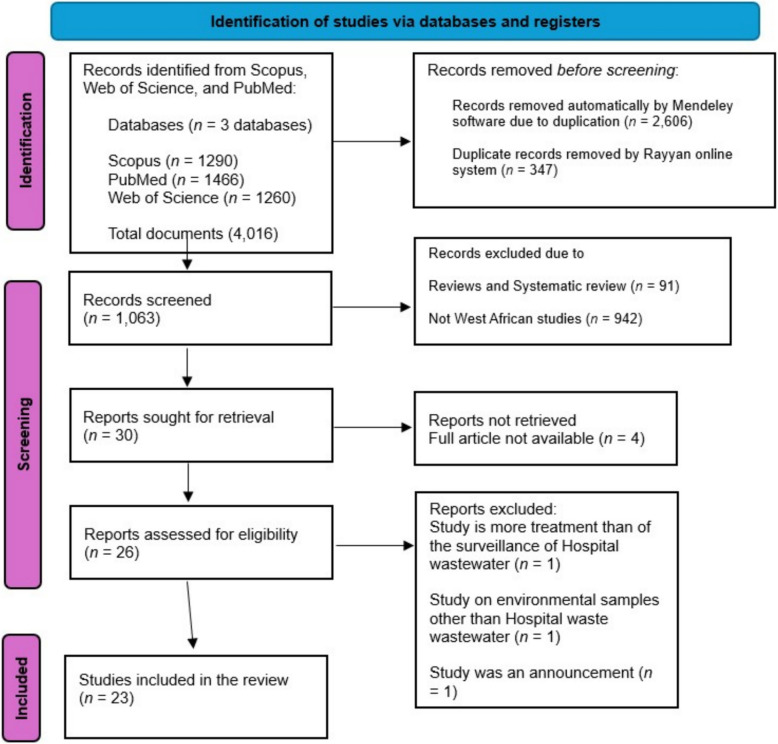
The review was conducted in compliance with PRISMA and included studies published between 1990 and 2024 in West Africa from the Scopus, PubMed, and Web of Science databases. Eligible studies that characterized resistant bacteria, genes, or antibiotic residues in HWW were included. Meta-analyses for resistant bacteria and genes as well risk of bias using the Newcastle-Ottawa scale were conducted.
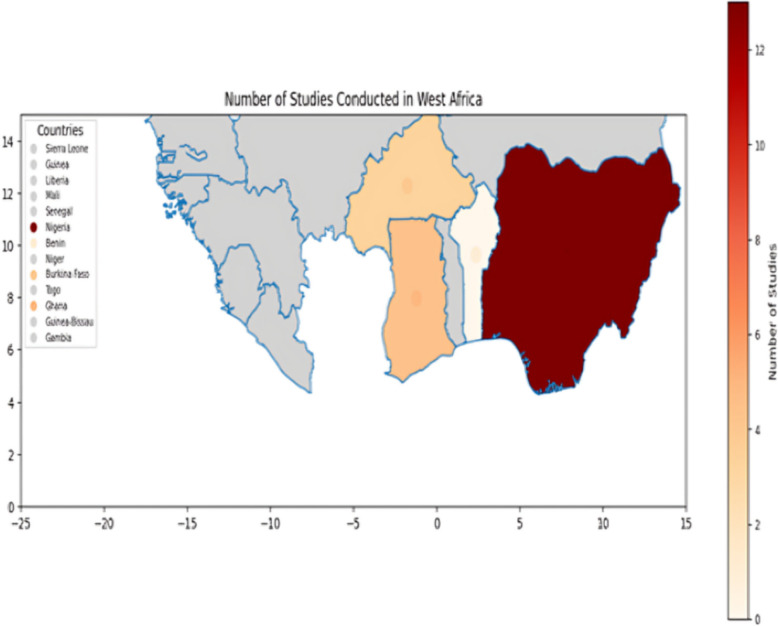
Out of 23 studies reviewed, resistant bacteria were reported in 39% (E. coli), 26% (K. pneumoniae), and 17% (P. aeruginosa), while 17 studies reported ARGs, with blaTEM (29%), blaOXA- 48 (18%), blaSHV (18%), and mecA (18%) being the most common. Only 4% and 9% of studies focused on toxin genes and antibiotic residues, respectively. Meta-analysis showed pooled prevalence rates for resistant bacteria: E. coli 42.6% (95% CI: 26.7%-60.3%) and K. pneumoniae 32.1% (95% Cl: 28.8%- 36.5%), and ARGs: blaTEM 76.0% (95% CI = 64.6%-84.6%) and blaSHV 59.3% (95% CI = 19.5%-89.8%).
This systematic review highlights significant findings of high levels of ARGs and ARBs of public health concern in HWW in West Africa. This highlights the need to improve upon the monitoring of antibiotic resistance and treatment of HWW in West Africa.
抗生素耐药菌(ARB)的出现已成为全球威胁,进而增加了发病率、死亡率和医疗成本。在全球范围内,医院废水(HWW)已被确定为抗生素耐药元素的重要来源。
本综述旨在系统回顾并对西非医院废水中抗生素耐药性研究的证据进行荟萃分析。
本综述按照PRISMA进行,纳入了1990年至2024年间在西非发表于Scopus、PubMed和Web of Science数据库的研究。纳入了对医院废水中耐药菌、基因或抗生素残留进行特征描述的合格研究。对抗药菌和基因进行了荟萃分析,并使用纽卡斯尔-渥太华量表评估了偏倚风险。
在纳入综述的23项研究中,39%(大肠杆菌)、26%(肺炎克雷伯菌)和17%(铜绿假单胞菌)报告了耐药菌,17项研究报告了抗生素耐药基因,其中blaTEM(29%)、blaOXA - 48(18%)、blaSHV(18%)和mecA(18%)最为常见。分别仅有4%和9%的研究关注毒素基因和抗生素残留。荟萃分析显示,耐药菌的合并流行率:大肠杆菌为42.6%(95%置信区间:26.7% - 60.3%),肺炎克雷伯菌为32.1%(95%置信区间:28.8% - 36.5%),抗生素耐药基因:blaTEM为76.0%(95%置信区间 = 64.6% - 84.6%),blaSHV为59.3%(95%置信区间 = 19.5% - 89.8%)。
本系统综述突出了西非医院废水中存在大量对公共卫生构成威胁的抗生素耐药基因和耐药菌这一重要发现。这凸显了加强西非抗生素耐药性监测和医院废水处理的必要性。