Yang Man, Li Yinchao, Liu Xianyue, Zou Shangnan, Lei Lei, Zou Qihang, Zhang Yaqian, Fang Yubao, Chen Shuda, Zhou Liemin
Department of Neurology, The Seventh Affiliated Hospital, Sun Yat-Sen University, Shenzhen, 518107, Guangdong Province, China.
Acta Epileptol. 2024 Apr 25;6(1):16. doi: 10.1186/s42494-024-00160-9.
Autophagy plays essential roles in the development and pathogenesis of mesial temporal lobe epilepsy (mTLE). In this research, we aim to identify and validate the autophagy-related genes associated with mTLE through bioinformatics analysis and experimental validations.
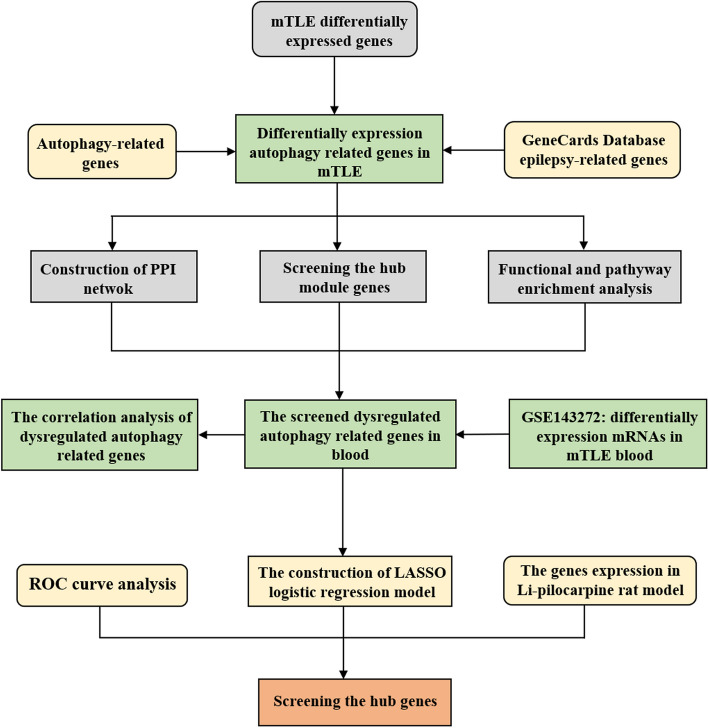
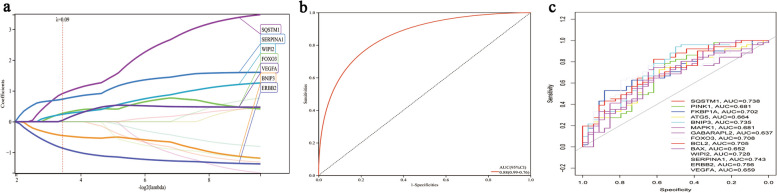
We obtained the dataset GSE143272 and high-throughput sequencing results of mTLE from public databases. Potential differentially expressed autophagy-related genes related to mTLE were identified using R software. Subsequently, genomes pathway enrichment analysis, protein-protein interactions (PPIs), and the gene ontology (GO) enrichment were performed for the selected autophagy-related genes. The mRNA expression profiles of hub genes were then used to establish a least absolute shrinkage and selection operator (LASSO) model. Finally, seven hub candidate autophagy-related genes were confirmed in hippocampus using the lithium-pilocarpine chronic epilepsy model.
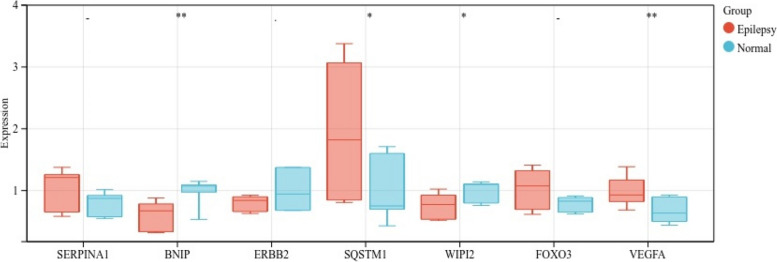
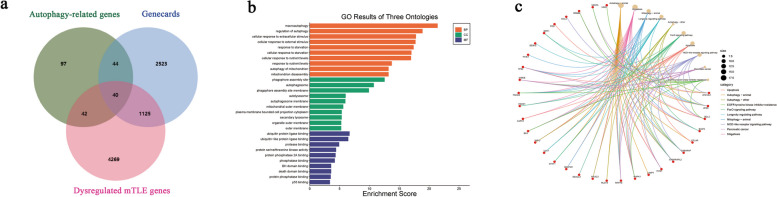
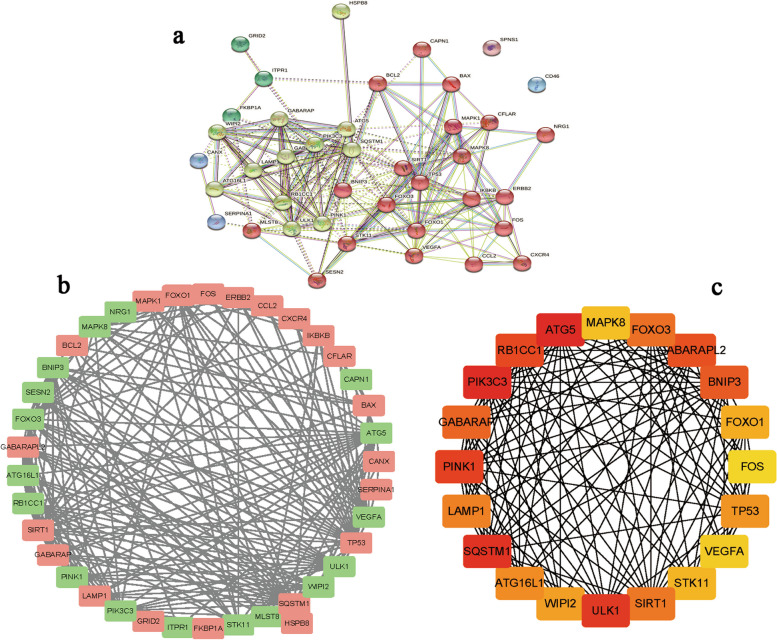
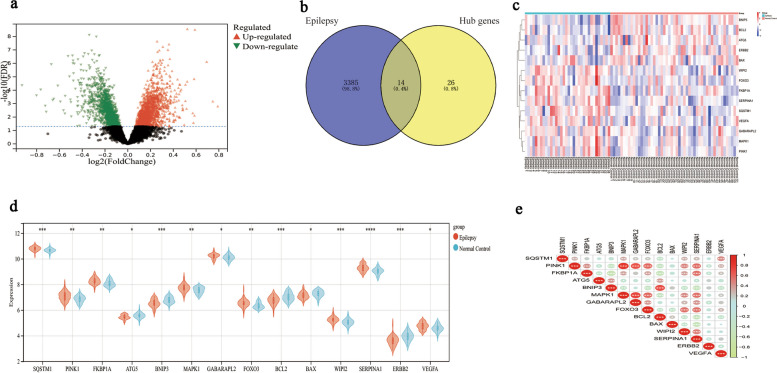
A total of 40 differential expression genes (DEGs) among the core autophagy-related genes were identified. The analysis results of PPI revealed that interactions among these DEGs. KEGG pathway and GO analysis of selected candidate autophagy-related genes indicated that those enriched terms mainly focused on macroautophagy, regulation of autophagy, cellular response to extracellular stimulus and mitochondrion disassembly. The results suggested that SQSTM1, VEGFA, BNIP and WIPI2 were consistent with the bioinformatics analysis. The expression levels of SQSTM1 and VEGFA in epilepsy model samples were significantly higher than those in normal control, while BNIP and WIPI2 expression levels were notably decreased. The final hub gene-based LASSO regression model accurately predicted the occurrence of epilepsy (AUC = 0.88).
Through bioinformatics analysis of public data, we identified 40 candidate autophagy-related genes associated with mTLE. SQSTM1, VEGFA, BNIP and WIPI2 may play significant roles in autophagy, influencing the onset and development of mTLE by regulating autophagy pathway. These findings deepen our understanding of mTLE, and may serve as sensitive and valuable indicators for the prognosis and diagnosis of this condition.
自噬在颞叶内侧癫痫(mTLE)的发生发展及发病机制中起重要作用。在本研究中,我们旨在通过生物信息学分析和实验验证来鉴定和验证与mTLE相关的自噬相关基因。
我们从公共数据库中获取了数据集GSE143272和mTLE的高通量测序结果。使用R软件鉴定与mTLE相关的潜在差异表达自噬相关基因。随后,对选定的自噬相关基因进行基因组通路富集分析、蛋白质-蛋白质相互作用(PPI)和基因本体(GO)富集分析。然后使用枢纽基因的mRNA表达谱建立最小绝对收缩和选择算子(LASSO)模型。最后,使用锂-匹罗卡品慢性癫痫模型在海马体中确认了7个枢纽候选自噬相关基因。
在核心自噬相关基因中总共鉴定出40个差异表达基因(DEG)。PPI分析结果显示了这些DEG之间的相互作用。对选定的候选自噬相关基因的KEGG通路和GO分析表明,富集的术语主要集中在巨自噬、自噬调节、细胞对细胞外刺激的反应和线粒体解体。结果表明,SQSTM1、VEGFA、BNIP和WIPI2与生物信息学分析结果一致。癫痫模型样本中SQSTM1和VEGFA的表达水平显著高于正常对照,而BNIP和WIPI2的表达水平显著降低。最终基于枢纽基因的LASSO回归模型准确预测了癫痫的发生(AUC = 0.88)。
通过对公共数据的生物信息学分析,我们鉴定出40个与mTLE相关的候选自噬相关基因。SQSTM1、VEGFA、BNIP和WIPI2可能在自噬中起重要作用,通过调节自噬途径影响mTLE的发生和发展。这些发现加深了我们对mTLE的理解,并可能作为该疾病预后和诊断的敏感且有价值的指标。