Pradeep Kundur Sukruth, Malik Ali, Sivalokanathan Sanjay
Faculty of Life Sciences and Medicine, King's College London, London WC2R 2LS, UK.
Mount Sinai Health System, Icahn School of Medicine at Mount Sinai, New York, NY 10029, USA.
J Clin Med. 2025 Mar 22;14(7):2183. doi: 10.3390/jcm14072183.
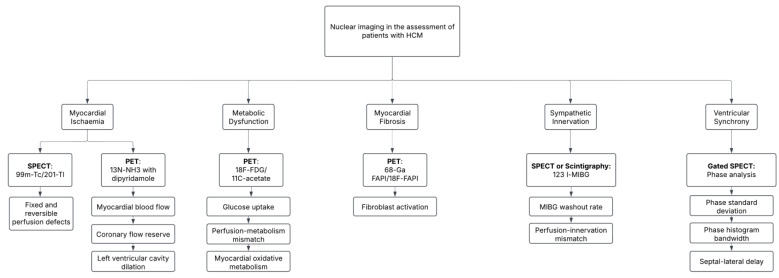
Hypertrophic cardiomyopathy (HCM) is the most common genetically inherited cardiac condition, characterized by clinical heterogeneity and a significantly increased risk of adverse cardiovascular outcomes, including sudden cardiac death. Current diagnostic methods primarily use echocardiography, often supplemented by cardiovascular magnetic resonance imaging (MRI), to assess the clinical profile of the disorder. Effective risk stratification protocols are essential for managing patients with HCM. These models rely on patient histories, imaging findings, and genetic information to evaluate the prognosis. Important factors in risk assessment include severe left ventricular hypertrophy (>30 mm), late gadolinium enhancement (>15%), or the presence of an apical aneurysm. However, these imaging techniques may lack sensitivity when it comes to detecting ischemia or microvascular dysfunction. Nuclear imaging methods, such as single-photon emission computed tomography (SPECT) and positron emission tomography (PET), offer a more comprehensive analysis of HCM. They provide valuable insights into the complex physiological mechanisms underlying the disease and facilitate early detection of functional abnormalities. This is particularly important for identifying high-risk phenotypes and understanding associated risk factors that may increase morbidity or mortality. This narrative review focuses on the role of nuclear imaging in the context of hypertrophic cardiomyopathy.
肥厚型心肌病(HCM)是最常见的遗传性心脏疾病,其特点是临床异质性以及心血管不良结局风险显著增加,包括心源性猝死。目前的诊断方法主要使用超声心动图,常辅以心血管磁共振成像(MRI),以评估该疾病的临床特征。有效的风险分层方案对于管理HCM患者至关重要。这些模型依靠患者病史、影像学检查结果和基因信息来评估预后。风险评估中的重要因素包括严重左心室肥厚(>30毫米)、钆延迟强化(>15%)或心尖部动脉瘤的存在。然而,这些成像技术在检测缺血或微血管功能障碍方面可能缺乏敏感性。核成像方法,如单光子发射计算机断层扫描(SPECT)和正电子发射断层扫描(PET),能对HCM进行更全面的分析。它们为该疾病潜在的复杂生理机制提供了有价值的见解,并有助于早期发现功能异常。这对于识别高危表型以及了解可能增加发病率或死亡率的相关风险因素尤为重要。本叙述性综述聚焦于核成像在肥厚型心肌病中的作用。