Oh Young T, Lee Choung A, Park Hang A, Park Juok, Kim Sola, Park Hye J, Han Sangsoo, Wang Soonjoo, Kim Jong W
Department of Emergency Medicine, College of Medicine, Chung-Ang University, 84 Heukseok-ro, Dongjak-gu, Seoul 06974, Republic of Korea.
Department of Emergency Medicine, Chung-Ang University Hospital, 102 Heukseok-ro, Dongjak-gu, Seoul 06973, Republic of Korea.
J Clin Med. 2025 Mar 31;14(7):2394. doi: 10.3390/jcm14072394.
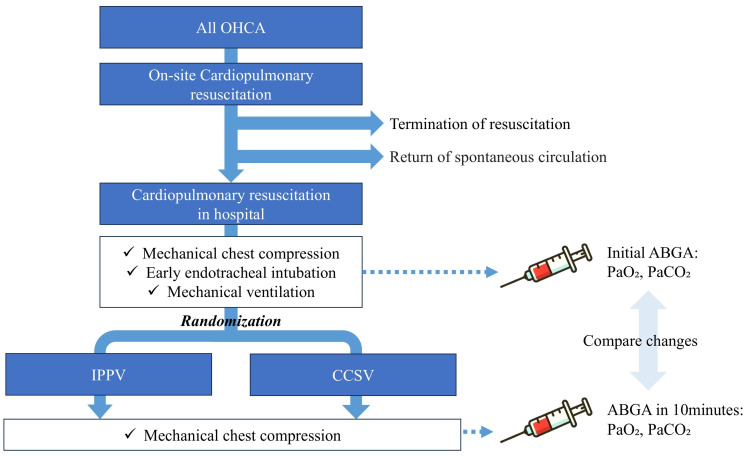
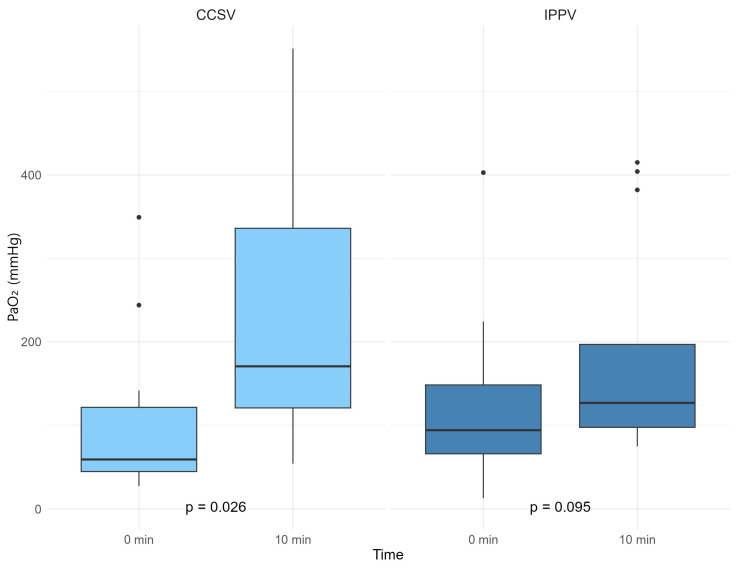
The aim of this study was to determine the optimal ventilation mode during cardiopulmonary resuscitation (CPR) by comparing the effects of chest compression-synchronized ventilation (CCSV) and intermittent positive-pressure ventilation (IPPV) on arterial blood gases. This prospective randomized controlled study included patients presenting with out-of-hospital cardiac arrest who were randomly assigned to the CCSV or IPPV groups. Arterial blood gas analysis was performed at the start of CPR and 10 min after initiating mechanical ventilation. Primary outcomes included changes in the arterial oxygen and carbon dioxide pressures. Of the 144 patients with out-of-hospital cardiac arrest, 30 were included in the study, with 15 each assigned to the CCSV and IPPV groups. The median arterial oxygen pressure in the CCSV group was 76.1 [22.8; 260.3 interquartile range], compared with 8.8 [-1.6; 113.9 interquartile range] in the IPPV group ( = 0.250). The change in carbon dioxide pressure was -10.3 [-18.3; -2.7 interquartile range] in the CCSV group and -11.5 [-39.5; 5.6 interquartile range] in the IPPV group ( = 0.935). Wilcoxon signed-rank test results revealed significant differences in arterial oxygen and carbon dioxide pressure levels before and after treatment in the CCSV group ( = 0.026 and 0.048, respectively). However, in the IPPV group, changes in arterial partial pressure of oxygen and carbon dioxide before and after treatment were non-significant ( = 0.095 and 0.107, respectively). Although CCSV significantly improved oxygenation and ventilation in patients undergoing CPR, it cannot be considered superior to IPPV.
本研究的目的是通过比较胸外按压同步通气(CCSV)和间歇正压通气(IPPV)对动脉血气的影响,确定心肺复苏(CPR)期间的最佳通气模式。这项前瞻性随机对照研究纳入了院外心脏骤停患者,这些患者被随机分配到CCSV组或IPPV组。在CPR开始时和开始机械通气10分钟后进行动脉血气分析。主要结局包括动脉血氧和二氧化碳分压的变化。在144例院外心脏骤停患者中,30例被纳入研究,每组15例分别分配到CCSV组和IPPV组。CCSV组的动脉血氧分压中位数为76.1[四分位间距22.8;260.3],而IPPV组为8.8[四分位间距-1.6;113.9](P =0.250)。CCSV组二氧化碳分压变化为-10.3[四分位间距-18.3;-2.7],IPPV组为-11.5[四分位间距-39.5;5.6](P =0.935)。Wilcoxon符号秩检验结果显示,CCSV组治疗前后动脉血氧和二氧化碳压力水平有显著差异(分别为P =0.026和0.048)。然而,在IPPV组中,治疗前后动脉血氧分压和二氧化碳分压变化不显著(分别为P =0.095和0.107)。虽然CCSV显著改善了接受CPR患者的氧合和通气,但不能认为它优于IPPV。