Wiedermann Christian J, Barbieri Verena, Ausserhofer Dietmar, Engl Adolf, Piccoliori Giuliano, Mahlknecht Angelika
Institute of General Practice and Public Health, Claudiana College of Health Professions, 39100 Bolzano, Italy.
Diagnostics (Basel). 2025 Apr 2;15(7):915. doi: 10.3390/diagnostics15070915.
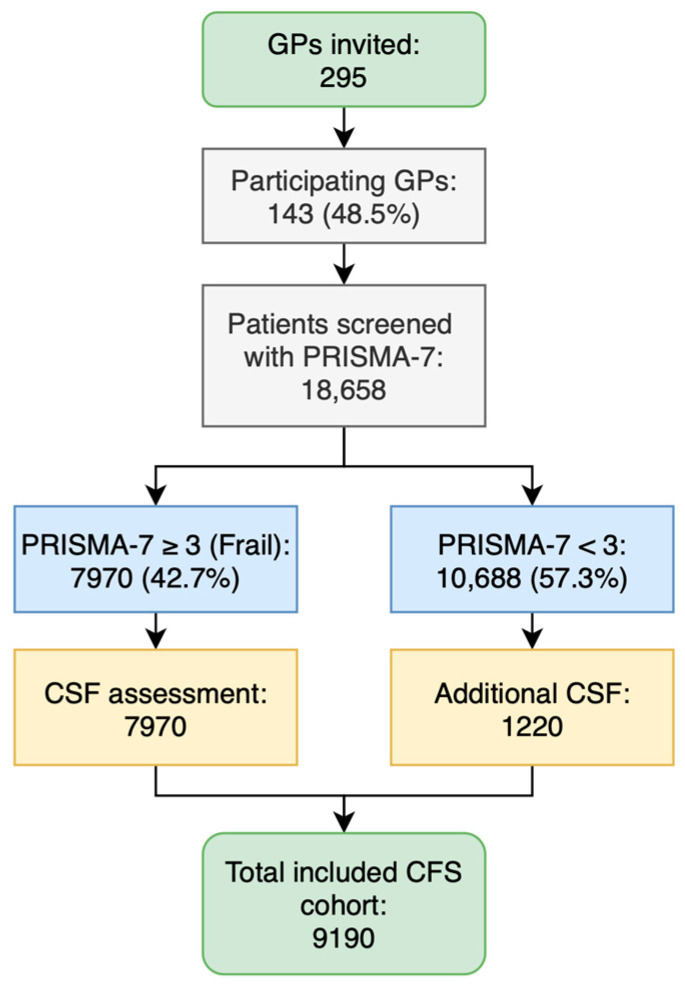
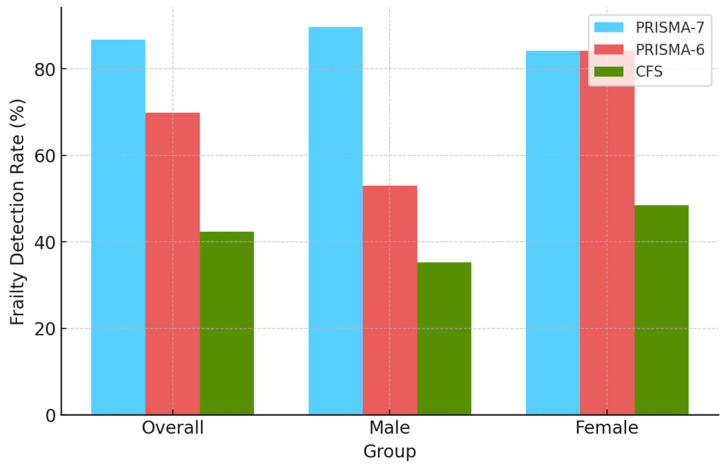
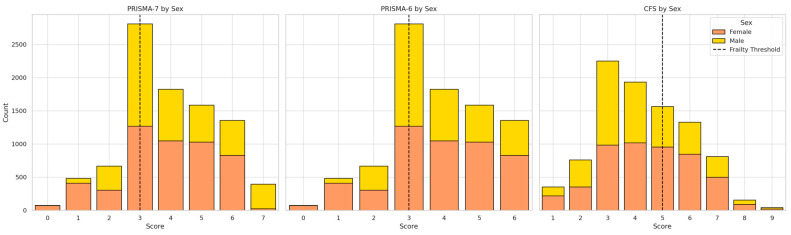
: Frailty screening is essential in primary care for the early identification of vulnerable older adults. PRISMA-7 is a widely used screening tool, but Item 2 ("Are you male?") introduces potential sex bias and overestimates frailty in men. PRISMA-6, a modified version that excludes Item 2, might provide a more equitable alternative. This study evaluates PRISMA-6's alignment with the Clinical Frailty Scale (CFS) and its impact on sex-specific frailty classification. A cross-sectional study was conducted in 142 general practices across South Tyrol, including 9190 general practice patients aged ≥75 years. Frailty was assessed using PRISMA-7, PRISMA-6, and the CFS. Correlations between tools were calculated using Kendall's Tau-b, whereas Fisher's z-test was used to compare differences in alignment. The frailty prevalence and odds ratios were stratified according to sex and age. PRISMA-6 showed a stronger correlation with the CFS (τ = 0.492) than PRISMA-7 (τ = 0.308, = -10.2, < 0.001). This effect was pronounced in men ( = -9.8, < 0.001), whereas no difference was observed in women ( = 0.00, = 1.000). PRISMA-6 reduced the frailty detection rate in men and was more closely aligned with the CFS. PRISMA-6 demonstrated improved alignment with the CFS and reduced sex bias compared to PRISMA-7. However, its use as a screening tool for men requires prospective validation in diverse settings. PRISMA-6 shows promise as a reliable and equitable frailty screening tool and should be considered for use in future studies, particularly in primary care settings, while awaiting further prospective validation.
衰弱筛查在初级保健中对于早期识别脆弱的老年人至关重要。PRISMA - 7是一种广泛使用的筛查工具,但第2项(“您是男性吗?”)引入了潜在的性别偏见,并高估了男性的衰弱情况。PRISMA - 6是排除第2项的修改版本,可能提供更公平的替代方案。本研究评估PRISMA - 6与临床衰弱量表(CFS)的一致性及其对特定性别衰弱分类的影响。在南蒂罗尔的142家全科诊所进行了一项横断面研究,包括9190名年龄≥75岁的全科诊所患者。使用PRISMA - 7、PRISMA - 6和CFS评估衰弱情况。使用肯德尔tau - b计算工具之间的相关性,而费舍尔z检验用于比较一致性差异。根据性别和年龄对衰弱患病率和比值比进行分层。与PRISMA - 7(τ = 0.308,z = -10.2,P < 0.001)相比,PRISMA - 6与CFS的相关性更强(τ = 0.492)。这种效应在男性中很明显(z = -9.8,P < 0.001),而在女性中未观察到差异(z = 0.00,P = 1.00)。PRISMA - 6降低了男性的衰弱检测率,并且与CFS的一致性更高。与PRISMA - 7相比,PRISMA - 6与CFS的一致性得到改善,性别偏见减少。然而,将其用作男性的筛查工具需要在不同环境中进行前瞻性验证。PRISMA - 6有望成为一种可靠且公平的衰弱筛查工具,在等待进一步前瞻性验证期间,应考虑在未来研究中使用,特别是在初级保健环境中。