
角鼻龙类体型的宏观进化趋势:系统发育比较方法的见解
Macroevolutionary trends in Ceratosauria body size: insights of phylogenetic comparative methods.
作者信息
Pereyra Enzo E Seculi, Pérez Damian E, Méndez Ariel H
机构信息
CONICET. Instituto Patagónico de Geología y Paleontología (CCT CONICET CENPAT), Bv. Brown 2915, 9120, Puerto Madryn, Chubut, Argentina.
出版信息
BMC Ecol Evol. 2025 Apr 12;25(1):32. doi: 10.1186/s12862-025-02374-y.
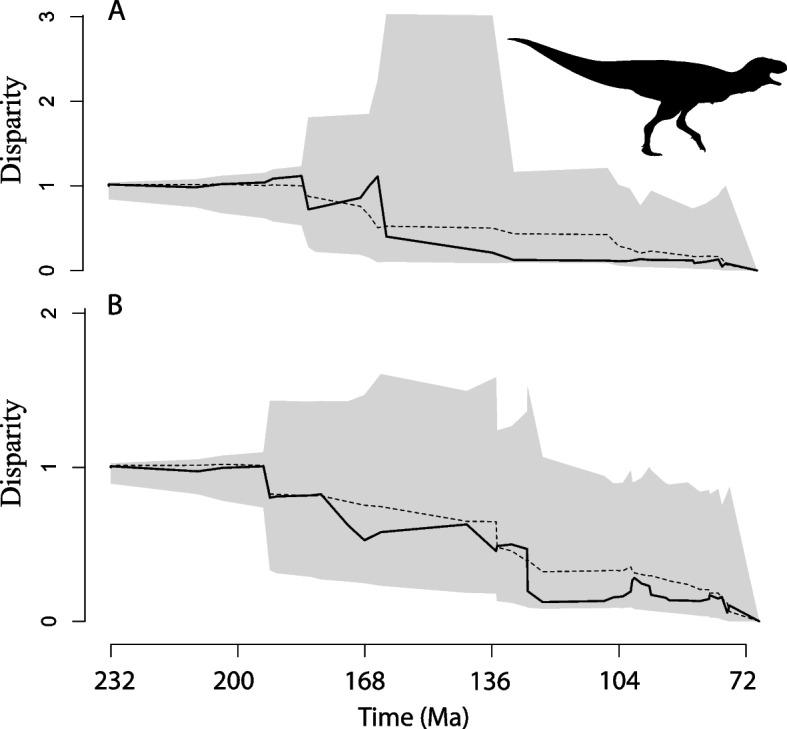
Patterns of body size evolution in dinosaurs are relevant for understanding the evolutionary trends that have shaped the disparity of phenotypes observed in the fossil record. In this sense, previous studies have suggested that Abelisauridae followed Cope´s rule and Noasauridae exhibited a phylogenetic trend towards decreasing body size. However, the absence of a comprehensive analysis including ecological, phylogenetic and socio-sexual factors make it necessary to reevaluate body size evolution in Ceretatosauria under a modern phylogenetic comparative approach. Therefore, we aimed to test whether body size evolved in Ceratosauria in accordance with Cope´s rule, evaluate what factors best explain differences in body size within Ceratosauria and examine what patterns of evolution rates, selection strength and constrain explain the diversification body size in Ceratosauria. Differences in body size were found between specialized taxa (= Late Cretaceous abelisaurids) and "generalized taxa" (= Outgroups + Noasauridae). This results suggested that the presence of a specialized feeding strategy in Late Cretaceous abelisaurids was associated with differences in body size, regardless of the phylogenetic topology and evolutionary model used. Additionally, the low levels of morphological disparity, low evolutionary rates for taxa with a specialist feeding behavior in Brownian motion model and the fossil record suggest that the evolution of body size in Late Cretaceous abelisaurids was constrained. The cursorial abilities suggested for abelisaurids joined with the specialized predation strategy could have constrained the increase in body size in Late Cretaceous abelisaurids after the extinction of carcharodontosaurids. On the other hand, Noasauridae exhibited a phylogenetic trend towards decreased body size, likely to avoid niche overlap with medium size theropods and minimize structural and maintenance cost while living in stressful environments and having a generalist diet. Understanding how the dynamics of dinosaur communities, such as competition and predator-prey interactions, operated in South America during the Late Cretaceous is crucial for reconstructing the evolutionary and ecological processes that shaped its unique faunal assemblage. Futures works should be focus on process-based community-evolution model and species distribution modeling to further understand the macroevolution dynamics of South America dinosaur community.
恐龙体型进化模式对于理解塑造化石记录中所观察到的表型差异的进化趋势具有重要意义。从这个意义上讲,先前的研究表明阿贝力龙科遵循柯普法则,而西北阿根廷龙科则呈现出体型减小的系统发育趋势。然而,由于缺乏包括生态、系统发育和社会性别因素在内的全面分析,因此有必要在现代系统发育比较方法下重新评估角鼻龙类的体型进化。因此,我们旨在测试角鼻龙类的体型是否按照柯普法则进化,评估哪些因素最能解释角鼻龙类内部体型的差异,并研究进化速率、选择强度和限制模式如何解释角鼻龙类体型的多样化。在特化类群(=晚白垩世阿贝力龙科)和“广义类群”(=外类群+西北阿根廷龙科)之间发现了体型差异。这一结果表明,晚白垩世阿贝力龙科中特化摄食策略的存在与体型差异有关,而与所使用的系统发育拓扑结构和进化模型无关。此外,形态差异水平较低、布朗运动模型中具有特化摄食行为的类群进化速率较低以及化石记录表明,晚白垩世阿贝力龙科的体型进化受到了限制。为阿贝力龙科所提出的奔跑能力与特化捕食策略相结合,可能限制了晚白垩世阿贝力龙科在鲨齿龙科灭绝后体型的增加。另一方面,西北阿根廷龙科呈现出体型减小的系统发育趋势,这可能是为了避免与中型兽脚类恐龙的生态位重叠,并在生活在压力环境且食性广泛的情况下,将结构和维持成本降至最低。了解晚白垩世期间南美洲恐龙群落的动态,如竞争和捕食者-猎物相互作用,对于重建塑造其独特动物群组合的进化和生态过程至关重要。未来的工作应侧重于基于过程的群落进化模型和物种分布建模,以进一步了解南美洲恐龙群落的宏观进化动态。


 Zotero 插件