Ruzafa-Martínez Maria, Fernández-Salazar Serafin, Leal-Costa César, Ramos-Morcillo Antonio Jesús
University of Murcia, Department of Nursing, El Palmar 30120, Murcia, Spain.
Andalusia Care Strategy, Andalusian Health Service, AGS Northeast Jaén, Úbeda, Spain.
J Nurs Manag. 2024 Feb 28;2024:7246547. doi: 10.1155/2024/7246547. eCollection 2024.
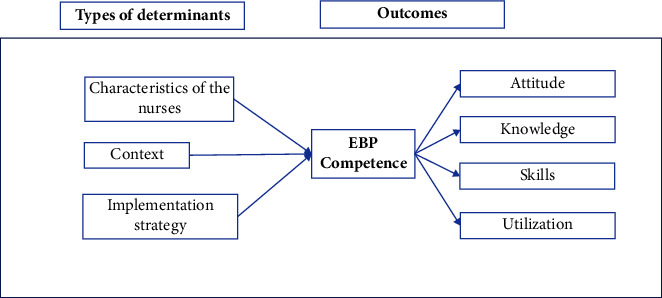
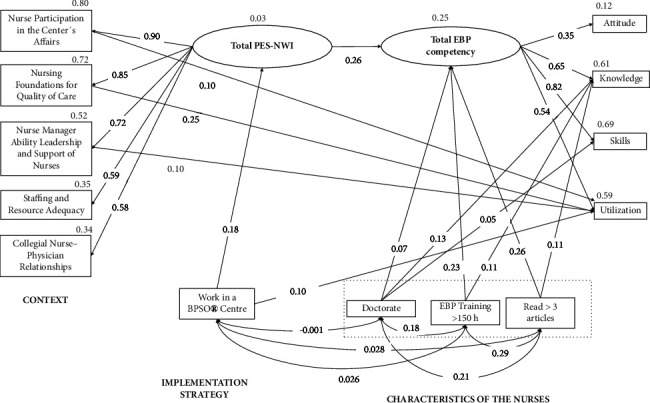
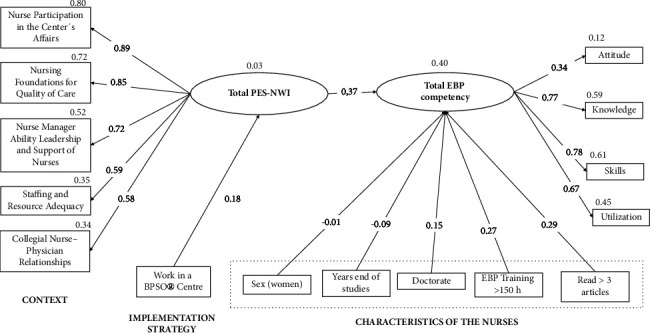
Existing studies have identified specific factors influencing some dimensions of evidence-based practice (EBP) competence and use. However, the way these factors interact still needs to be clarified. The purpose of the study was to test a model based on the Determinant Frameworks that explain the relationships and the direct pathways between the characteristics of the nurses, the context, and the implementation strategies and the dimensions of EBP competence, attitude, knowledge, skills, and use of EBP. A cross-sectional study was carried out in Spain during January and February 2020, involving 2,370 nurses employed in public health centers across all autonomous communities within the National Health System. An online survey was administered to gather data, addressing various topics related to the nurses' characteristics, the context in which they worked, the implementation strategy, and their competence in evidence-based practice (EBP). As depicted in the conceptual framework, a structural equation model was constructed to test the hypothesized relationships among key study variables. The model obtained showed a good fit ( / = 3.20, < 0.001; RMSEA = 0.030 [90% CI 0.025, 0.036]; CFI = 0.989; GFI = 0.990; TLI = 0.983). The context, more specifically, the dimensions of nurse participation in the center's affairs, nursing foundations for quality of care, nurse manager ability leadership and support of nurses, and implementation strategy have a direct and positive effect on EBP use. Training in EBP, reading scientific articles, and having a doctorate are associated with higher competence and knowledge in EBP. The final fit shows the #Evidencer model for the use of EBP (#EvidencerMUSEBP) with two main components: the contextual and strategic factors that influence the implementation of EBP and the characteristics of the professionals, such as their training and reading of articles, which have an impact on EBP competence. This model could guide healthcare organizations in proposing comprehensive interventions to improve EBP use and the competency of nurses.
现有研究已确定了影响循证实践(EBP)能力及应用某些维度的具体因素。然而,这些因素之间的相互作用方式仍有待阐明。本研究的目的是检验一个基于决定因素框架的模型,该模型解释护士特征、背景、实施策略与EBP能力、态度、知识、技能及EBP应用维度之间的关系和直接路径。2020年1月和2月在西班牙开展了一项横断面研究,涉及国家卫生系统内所有自治区公共卫生中心雇用的2370名护士。通过在线调查收集数据,涉及与护士特征、工作背景、实施策略以及他们的循证实践(EBP)能力相关的各种主题。如概念框架所示,构建了一个结构方程模型来检验关键研究变量之间的假设关系。得到的模型显示拟合良好(χ²/df = 3.20,p < 0.001;RMSEA = 0.030 [90% CI 0.025, 0.036];CFI = 0.989;GFI = 0.990;TLI = 0.983)。具体而言,背景,即护士参与中心事务的维度、护理质量基础、护士长的领导能力及对护士的支持以及实施策略,对EBP应用有直接的正向影响。EBP培训、阅读科学文章以及拥有博士学位与更高的EBP能力和知识相关。最终拟合显示了EBP应用的#Evidencer模型(#EvidencerMUSEBP)有两个主要组成部分:影响EBP实施及专业人员特征(如他们的培训和文章阅读)的背景和战略因素,这些因素对EBP能力有影响。该模型可为医疗保健组织提出全面干预措施以改善EBP应用和护士能力提供指导。