Nwaozuru Ucheoma, Miller Lindsay, Gunn Laura H, Marin-Cespedes Sebastian, Hanff Margaret, Robinson Patrick, Dulin Michael, Muralidhar Meghana, Jha Prashant, Mirikwe Goodness C, Conserve Donaldson F, Gulden Chelsea, Davis Bernard A, Foley Kristie, Tucker Joseph, Zarwell Meagan
Department of Implementation Science, Division of Public Health Sciences, Wake Forest University School of Medicine, Winston-Salem, NC, United States.
Department of Epidemiology and Community Health, College of Health and Human Services, University of North Carolina at Charlotte, Charlotte, NC, United States.
Front Health Serv. 2025 Mar 28;5:1536236. doi: 10.3389/frhs.2025.1536236. eCollection 2025.
HIV testing is the gateway to entering HIV care and prevention services. However, HIV testing rates remain low among young adults (18-29 years old) in Mecklenburg County, North Carolina (NC), an ending the HIV epidemic (EHE) priority jurisdiction. We aim to utilize community-engaged and participatory approaches to co-create implementation strategies to promote the reach and uptake of HIV self-testing (HIVST) among young adults in the region. This study protocol outlines the phases of the project and the proposed outcomes.
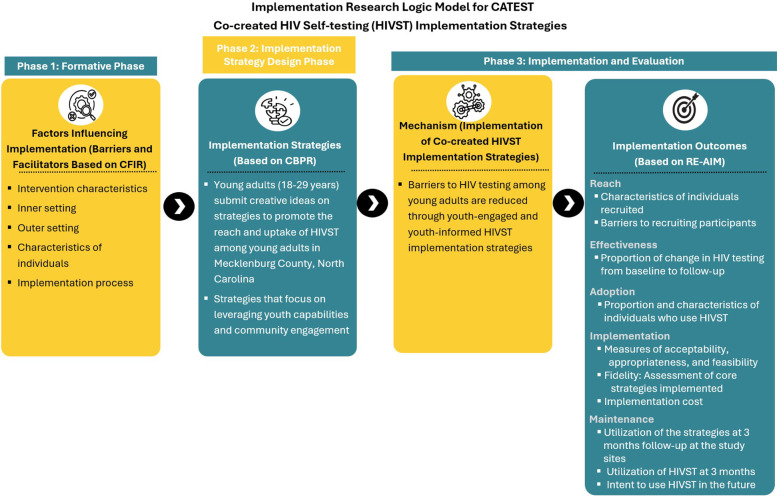
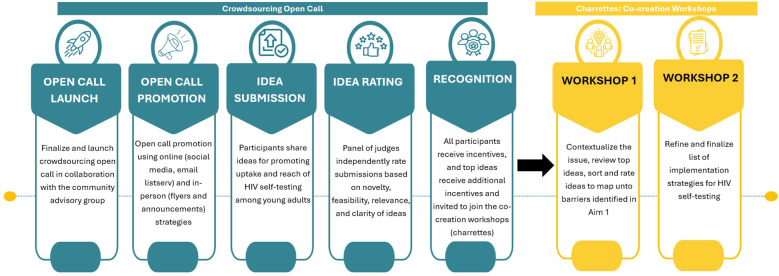
The Community-engaged Approaches to Expand HIV Self-Testing among Young Adults in Mecklenburg County, North Carolina (CATEST) project will be conducted in three phases, guided by the Consolidated Framework for Implementation Research (CFIR), Community-based Participatory Research (CBPR), and Reach, Effectiveness, Adoption, Implementation, and Maintenance (RE-AIM) frameworks. The formative phase of the study, guided by CFIR, will focus on understanding the barriers, facilitators, and opportunities for implementing HIVST among young adults in Mecklenburg County, North Carolina. The second phase, guided by CBPR, will utilize participatory approaches such as crowdsourcing open calls and charrettes to co-create implementation strategies for HIVST. Then, the final pilot implementation phase, guided by CFIR and RE-AIM, will use mixed methods to evaluate the success of the co-created HIVST implementation strategies using a pre-post design. Participants in the study will complete a baseline survey and a follow-up survey immediately following intervention completion. In addition, a purposive sample of participants and representatives at the participating community organization will complete qualitative exit interviews within 1 month of intervention completion.
This study protocol outlines the co-creation of implementation strategies, tests their feasibility, and explores preliminary effectiveness in promoting HIVST uptake among young adults in Mecklenburg County, NC. The study will yield insights on the feasibility of leveraging the capabilities of community and youth innovation to promote young adults-centered implementation strategies to advance the reach and adoption of HIVST among young adults.
Registered on Open Science Forum-DOI 10.17605/OSF.IO/2BZWV.
艾滋病毒检测是进入艾滋病毒护理和预防服务的途径。然而,在北卡罗来纳州梅克伦堡县的年轻人(18至29岁)中,艾滋病毒检测率仍然很低,该县是结束艾滋病毒流行(EHE)的重点辖区。我们旨在利用社区参与和参与式方法共同制定实施策略,以促进该地区年轻人对艾滋病毒自我检测(HIVST)的接受和使用。本研究方案概述了该项目的各个阶段和预期成果。
北卡罗来纳州梅克伦堡县年轻人中扩大艾滋病毒自我检测的社区参与方法(CATEST)项目将分三个阶段进行,以实施研究综合框架(CFIR)、基于社区的参与式研究(CBPR)以及覆盖、效果、采用、实施和维持(RE-AIM)框架为指导。在CFIR的指导下,研究的形成阶段将侧重于了解在北卡罗来纳州梅克伦堡县的年轻人中实施HIVST的障碍、促进因素和机会。第二阶段,在CBPR的指导下,将利用众包公开征集和研讨会等参与式方法共同制定HIVST的实施策略。然后,在CFIR和RE-AIM的指导下,最后的试点实施阶段将使用混合方法,采用前后设计评估共同制定的HIVST实施策略的成功程度。该研究的参与者将在干预完成后立即完成基线调查和后续调查。此外,参与社区组织的参与者和代表的目标样本将在干预完成后的1个月内完成定性退出访谈。
本研究方案概述了实施策略的共同制定,测试了其可行性,并探索了在促进北卡罗来纳州梅克伦堡县年轻人接受HIVST方面的初步效果。该研究将深入了解利用社区和青年创新能力促进以年轻人为中心的实施策略以推进年轻人对HIVST的接受和采用的可行性。
在开放科学论坛注册-DOI 10.17605/OSF.IO/2BZWV。