Soodi Deepa, Yeung Paul, Umukoro Peter, Nwaedozie Somto T, Gabor Rachel, DeJarlaris Eric, Sharma Param, Garcia-Montilla Romel
Cardiology, Marshfield Clinic Health System, Marshfield, USA.
Internal Medicine, Marshfield Medical Center, Marshfield, USA.
Cureus. 2025 Mar 12;17(3):e80465. doi: 10.7759/cureus.80465. eCollection 2025 Mar.
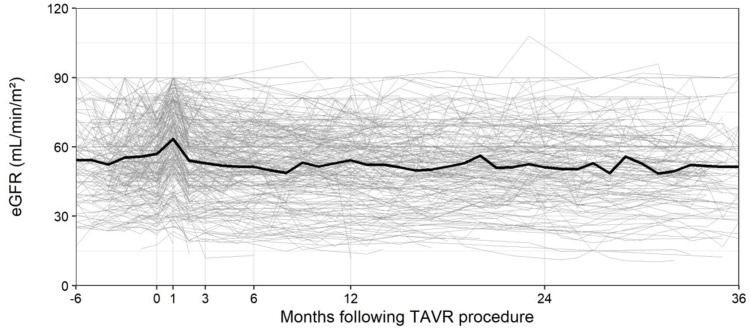
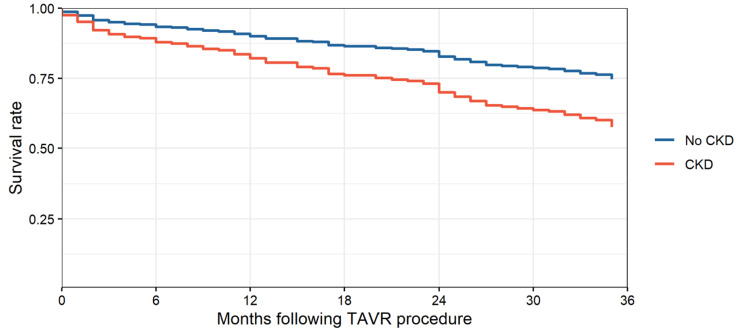
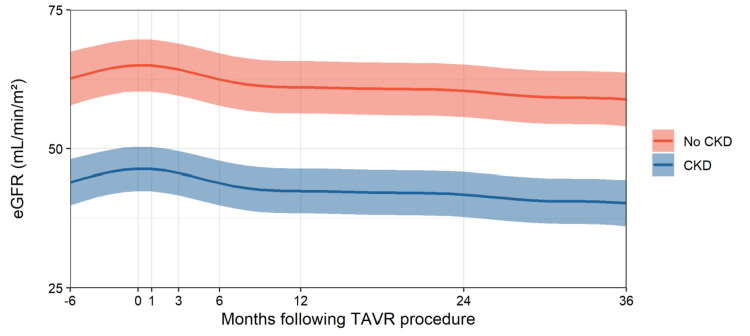
Background The incidence of aortic stenosis (AS) is steadily increasing, posing a significant healthcare burden. Transcatheter aortic valve replacement (TAVR) is being used more frequently to treat patients with symptomatic AS. This study evaluated long-term changes in renal function and mortality in TAVR patients over a period of up to three years, including those with normal creatinine (Cr) levels and those with chronic kidney disease (CKD). Methods We conducted a retrospective review of 270 patients who underwent TAVR between 2012 and 2017 at a rural tertiary referral center. Collected data included baseline serum Cr and estimated glomerular filtration rate (eGFR), with follow-up measurements taken at 30 days, six months, one year, two years, and three years post-TAVR. Patients were categorized into two groups: those with CKD and those without. Results Both groups showed similar improvements in eGFR at one month (6.3 mL/min/m², p < 0.001). However, by three months, eGFR levels returned to their pre-TAVR baseline. At the three-year mark, an average decline of 5.3 mL/min/m² was observed in both groups (p < 0.001). Despite CKD patients having worse kidney function throughout the study period, the extent of eGFR reduction was similar between the CKD and non-CKD groups, indicating that eGFR decline was independent of CKD status. Mortality rates were higher in CKD patients (56.9 (39%) vs. 24.6 (22%); p = 0.006). Multivariate analysis identified CKD as the most reliable predictor of mortality. Conclusions Renal function significantly improved at one month post-TAVR in both CKD and non-CKD patients. Although eGFR initially improved after TAVR, the subsequent decline was similar in both groups, suggesting that the reduction in eGFR is independent of CKD status. Cardiorenal syndrome, which can occur with AS, may improve with TAVR. These findings support the potential renoprotective effect of TAVR in patients with CKD.
主动脉瓣狭窄(AS)的发病率正在稳步上升,带来了重大的医疗负担。经导管主动脉瓣置换术(TAVR)越来越频繁地用于治疗有症状的AS患者。本研究评估了TAVR患者长达三年的肾功能长期变化和死亡率,包括肌酐(Cr)水平正常的患者和患有慢性肾脏病(CKD)的患者。方法:我们对2012年至2017年在一家农村三级转诊中心接受TAVR的270例患者进行了回顾性研究。收集的数据包括基线血清Cr和估计肾小球滤过率(eGFR),并在TAVR后30天、6个月、1年、2年和3年进行随访测量。患者分为两组:患有CKD的患者和未患CKD的患者。结果:两组在1个月时eGFR均有相似程度的改善(6.3 mL/min/m²,p < 0.001)。然而,到3个月时,eGFR水平恢复到TAVR前的基线水平。在三年时,两组均观察到平均下降5.3 mL/min/m²(p < 0.001)。尽管CKD患者在整个研究期间肾功能较差,但CKD组和非CKD组的eGFR降低程度相似,表明eGFR下降与CKD状态无关。CKD患者的死亡率更高(56.9(39%)对24.6(22%);p = 0.006)。多变量分析确定CKD是死亡率最可靠的预测因素。结论:CKD和非CKD患者在TAVR后1个月时肾功能均显著改善。尽管TAVR后eGFR最初有所改善,但随后两组的下降情况相似,这表明eGFR的降低与CKD状态无关。AS可能伴发的心肾综合征可能会随着TAVR而改善。这些发现支持了TAVR对CKD患者潜在的肾脏保护作用。