Emengen Atakan, Yilmaz Eren, Gokbel Aykut, Uzuner Ayse, Balci Sibel, Tavukcu Ozkan Sedef, Ergen Anil, Caklili Melih, Cabuk Burak, Anik Ihsan, Ceylan Savas
Department of Neurosurgery, Bahcesehir University School of Medicine, 34734 Istanbul, Turkey.
Department of Neurosurgery, VM Pendik Medical Park Hospital, 34899 Istanbul, Turkey.
Cancers (Basel). 2025 Mar 26;17(7):1107. doi: 10.3390/cancers17071107.
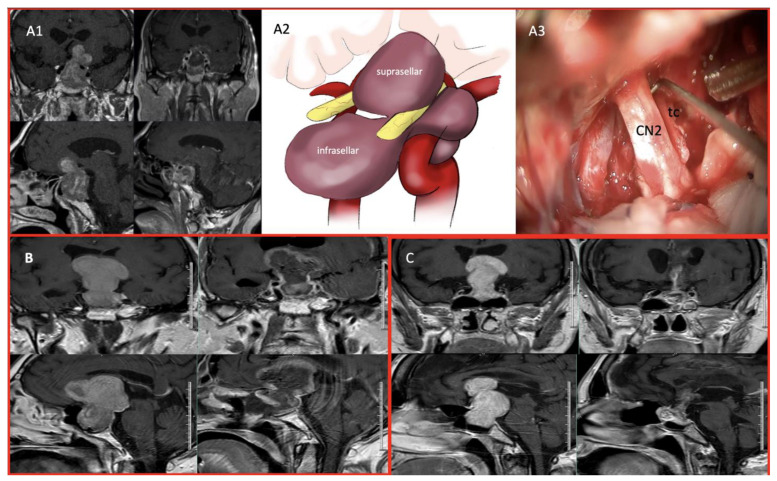
: Giant pituitary adenomas (GPAs) pose significant surgical challenges due to their large size, parasellar/suprasellar extensions, and proximity to critical neurovascular structures. Although the endoscopic endonasal approach (EEA) is preferred for pituitary tumors, achieving gross total resection (GTR) in GPAs remains difficult. Additional transcranial approaches may improve resection rates while minimizing morbidity. This study evaluates the impact of endoscopic and combined surgical approaches on resection outcomes using a classification system previously defined in GPA patients treated over the past year. : Among 517 pituitary adenomas treated in our clinic between September 2023 and September 2024, 49 GPA patients underwent endoscopic endonasal, transcranial, or combined surgery. Their medical records and surgical videos were retrospectively reviewed. Data included demographics, symptoms, imaging, surgical details, and follow-up outcomes. Tumor resection rates were analyzed based on the "landmark-based classification", considering radiological and pathological features and surgical approach. : The mean age was 45.5 years (female/male: 14/35). Zone distribution was 8 (Zone 1), 21 (Zone 2), and 20 (Zone 3). GTR was achieved in 34.6%, near-total resection in 36.7%, and subtotal resection in 28.5%. Endoscopic surgery was performed in 41 patients, combined surgery in 7, and a transcranial approach in 1. Complications included diabetes insipidus (9/49), cerebrospinal fluid leakage (2/49), apoplexy (2/49), hypocortisolism (3/49), epidural hematoma (1/49), and epistaxis (1/49). : While EEA is effective for Zone 1 and 2 GPAs, Zone 3 tumors often require combined or transcranial approaches for better resection. A multimodal strategy optimizes tumor removal while minimizing morbidity. Individualized surgical planning based on tumor classification is crucial for improving outcomes.
巨大垂体腺瘤(GPA)因其体积大、鞍旁/鞍上扩展以及靠近关键神经血管结构而带来重大手术挑战。尽管内镜鼻内入路(EEA)是垂体肿瘤的首选方法,但在GPA中实现全切除(GTR)仍然困难。额外的经颅入路可能会提高切除率,同时将发病率降至最低。本研究使用先前为过去一年接受治疗的GPA患者定义的分类系统,评估内镜和联合手术入路对切除结果的影响。:在2023年9月至2024年9月期间在我们诊所治疗的517例垂体腺瘤中,49例GPA患者接受了内镜鼻内、经颅或联合手术。对他们的病历和手术视频进行了回顾性审查。数据包括人口统计学、症状、影像学、手术细节和随访结果。基于“基于地标分类”分析肿瘤切除率,同时考虑放射学和病理学特征以及手术入路。:平均年龄为45.5岁(女性/男性:14/35)。区域分布为8例(1区)、21例(2区)和20例(3区)。GTR实现率为34.6%,近全切除率为36.7%,次全切除率为28.5%。41例患者接受了内镜手术,7例接受了联合手术,1例接受了经颅入路。并发症包括尿崩症(9/49)、脑脊液漏(2/49)、卒中(2/49)、皮质醇减退(3/49)、硬膜外血肿(1/49)和鼻出血(1/49)。:虽然EEA对1区和2区GPA有效,但3区肿瘤通常需要联合或经颅入路以实现更好的切除。多模式策略可优化肿瘤切除,同时将发病率降至最低。基于肿瘤分类的个体化手术规划对于改善结果至关重要。