Zu Xiangyu, Chen Shenghong, Li Zhengyuan, Hao Lin, Fu Wenhan, Zhang Hui, Yin Zongsheng, Wang Yin, Wang Jun
Department of Oncology, The First Affiliated Hospital of Anhui Medical University, Anhui, China.
Department of Orthopaedics, The First Affiliated Hospital of Anhui Medical University, Anhui, China.
Bone Res. 2025 Apr 14;13(1):47. doi: 10.1038/s41413-025-00421-4.
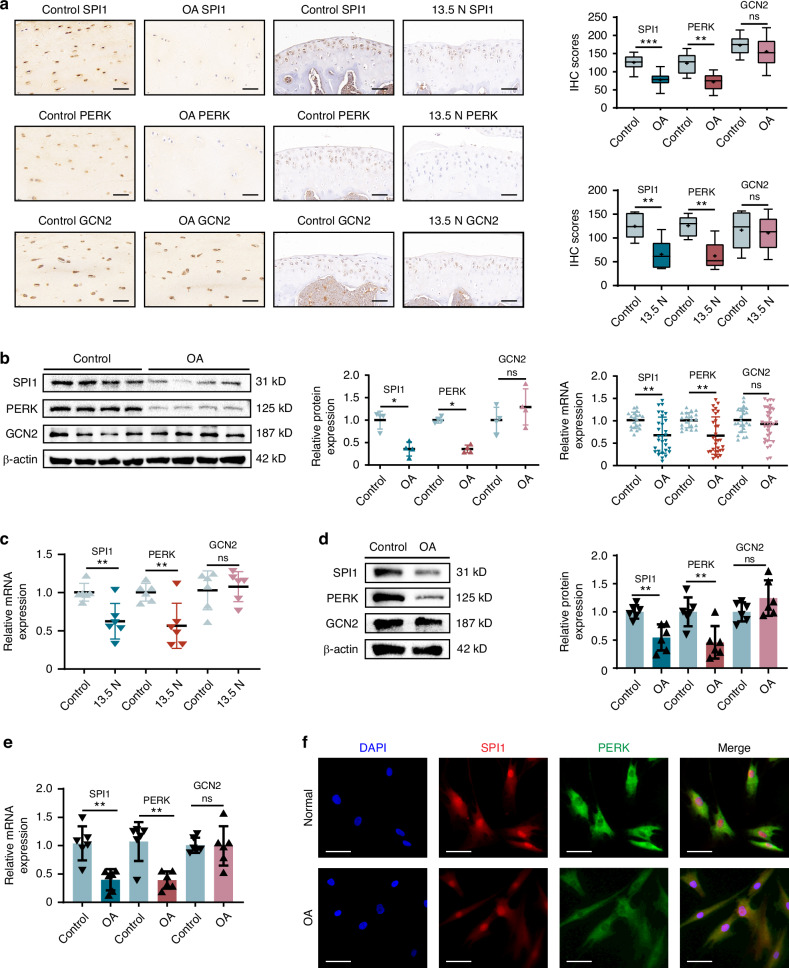
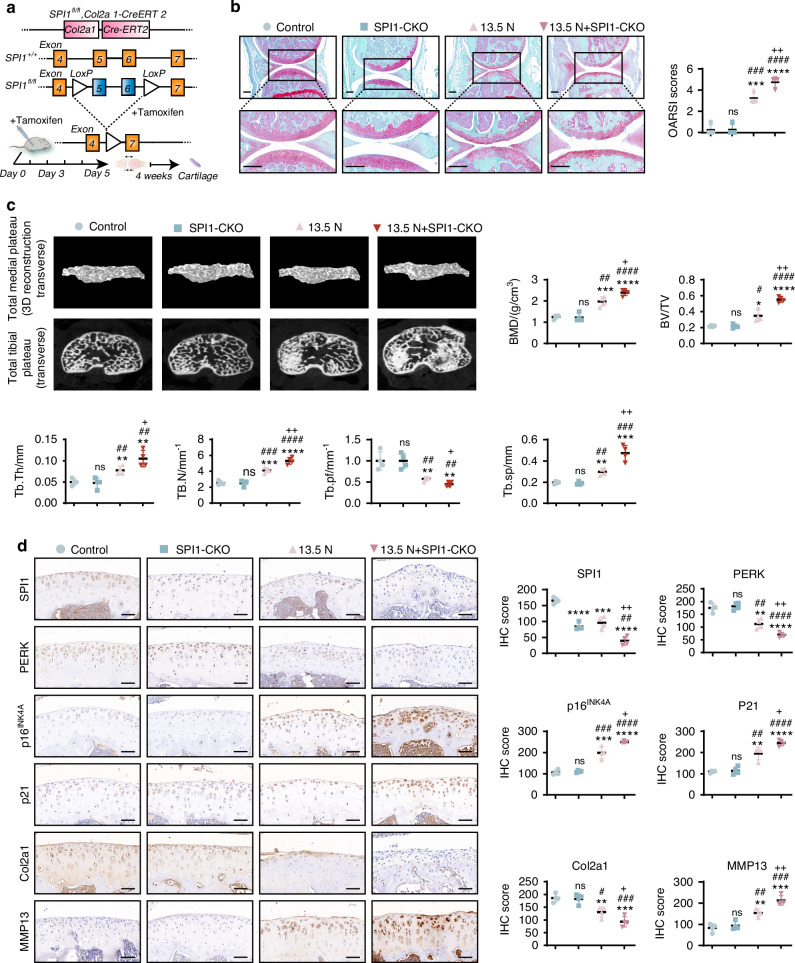
Chondrocyte senescence is a critical pathological hallmark of osteoarthritis (OA). Aberrant mechanical stress is considered a pivotal determinant in chondrocyte aging; however, the precise underlying mechanism remains elusive. Our findings demonstrate that SPI1 plays a significant role in counteracting chondrocyte senescence and inhibiting OA progression. SPI1 binds to the PERK promoter, thereby promoting its transcriptional activity. Importantly, PERK, rather than GCN2, facilitates eIF2α phosphorylation, activating the mitochondrial unfolded protein response (UPR) and impeding chondrocyte senescence. Deficiency of SPI1 in mechanical overload-induced mice leads to diminished UPR activation and accelerated OA progression. Intra-articular injection of adenovirus vectors overexpressing SPI1 and PERK effectively mitigates cartilage degeneration. In summary, our study elucidates the crucial regulatory role of SPI1 in the pathogenesis of chondrocyte senescence by activating UPR signaling through PERK, which may present a novel therapeutic target for treating OA. SPI1 alleviates the progression of OA by inhibiting mechanical stress-induced chondrocyte senescence through mitochondrial UPR signaling.
软骨细胞衰老 是骨关节炎(OA)的一个关键病理标志。异常机械应力被认为是软骨细胞衰老的一个关键决定因素;然而,其确切的潜在机制仍然不清楚。我们的研究结果表明,SPI1在对抗软骨细胞衰老和抑制OA进展中起重要作用。SPI1与PERK启动子结合,从而促进其转录活性。重要的是,PERK而非GCN2促进eIF2α磷酸化,激活线粒体未折叠蛋白反应(UPR)并阻止软骨细胞衰老。机械过载诱导的小鼠中SPI1缺乏导致UPR激活减弱和OA进展加速。关节内注射过表达SPI1和PERK的腺病毒载体可有效减轻软骨退变。总之,我们的研究通过PERK激活UPR信号,阐明了SPI1在软骨细胞衰老发病机制中的关键调节作用,这可能为治疗OA提供一个新的治疗靶点。SPI1通过线粒体UPR信号抑制机械应力诱导的软骨细胞衰老,从而减轻OA的进展。