
转化型硒纳米药物与纳米白蛋白结合型紫杉醇协同作用,通过硒蛋白N介导的内质网应激增强对食管鳞状细胞癌的抗肿瘤作用。
Translational selenium nanomedicine synergizes with nab-paclitaxel to enhance antitumor effects in esophageal squamous cell cancer via selenoprotein N-mediated ER stress.
作者信息
Huang Haoyang, Liu Shaowei, Xu Ligeng, Liang Hengrui, Wu Zihao, Chen Tianfeng, Wang Jinlin, Liu Jun
机构信息
Department of Thoracic Surgery and Oncology, State Key Laboratory of Respiratory Disease & National Clinical Research Center for Respiratory Disease, The First Affiliated Hospital of Guangzhou Medical University, Guangzhou, 510120, China.
Department of Chemistry, Jinan University, Guangzhou, 510632, China.
出版信息
J Nanobiotechnology. 2025 Apr 15;23(1):294. doi: 10.1186/s12951-025-03356-4.
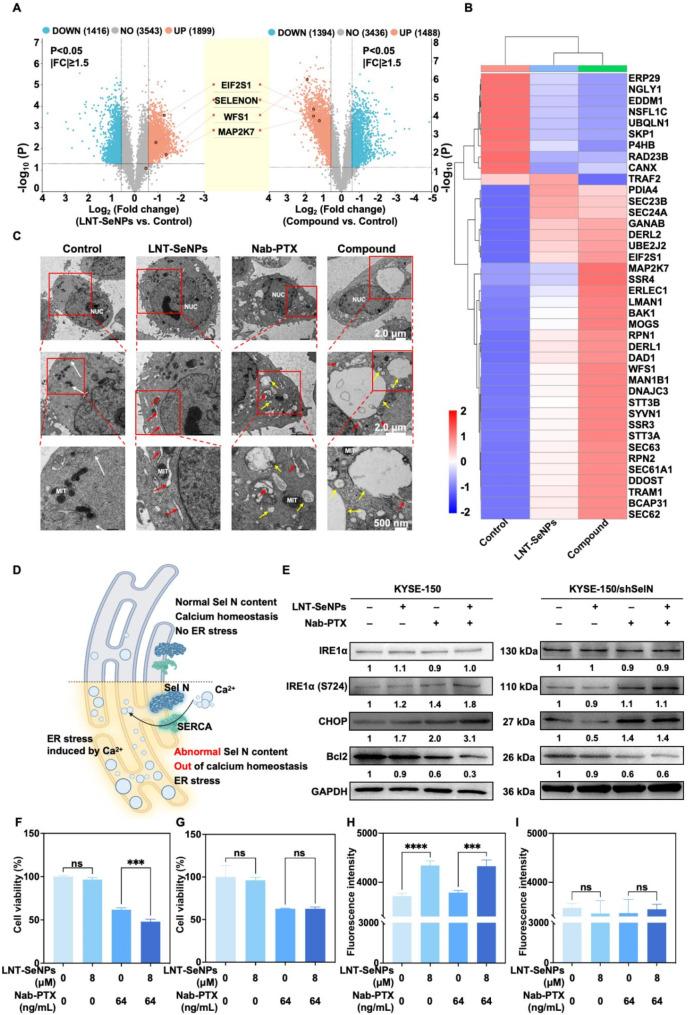
Though prescribed as first-line drugs for esophageal squamous cell cancer (ESCC) therapy, the antitumor efficacy of Nab-Paclitaxel (Nab-PTX) is still unsatisfactory owing to the limitation on the dosage and therapy duration of Nab-PTX caused by adverse effects. Inspired by the very essential role of Selenoprotein N (SelN) in mediating the calcium homeostasis and the associated redox homeostasis in cells, herein, in this essay, we screened the inhibition effect of selenium-containing drugs in different forms on ESCC cell line. Investigation on KYSE-150 cells demonstrated that Nab-PTX in combination with low dosage of LNT-SeNPs may synergistically improve its antitumor efficacy on ESCC cells through promoting the cellular apoptosis. Proteomics analysis uncovered the core synergistic mechanism of LNT-SeNPs on Nab-PTX was significantly dependent on the endoplasmic reticulum (ER) stress induced by SelN-mediated Ca-IRE1α, IRE1α(S724)-CHOP-BCL2 axis. SelN knockdown KYSE-150 cell model further confirmed the very indispensable role of SelN in mediating the synergistic effect on Nab-PTX. Moreover, in vivo evaluation on KYSE-150 tumor-bearing mice models also demonstrated the supplementation of LNT-SeNPs with low dosage during the Nab-PTX treatment may synergize the antitumor efficacy and significantly mitigate the adverse reactions or toxicity resulting from a substantial dose of Nab-PTX. Overall, along with the facile accessibility of raw materials, this study reports LNT-SeNPs as a synergistic agent to promote the antitumor efficacy of Nab-PTX, which may be translated as a wide-applicable, efficient and highly safe strategy for clinical treatment of ESCC.
尽管纳米白蛋白结合型紫杉醇(Nab-PTX)被规定为食管鳞状细胞癌(ESCC)治疗的一线药物,但由于不良反应导致的Nab-PTX剂量和治疗持续时间的限制,其抗肿瘤疗效仍不尽人意。受硒蛋白N(SelN)在介导细胞内钙稳态和相关氧化还原稳态中至关重要作用的启发,本文我们筛选了不同形式的含硒药物对ESCC细胞系的抑制作用。对KYSE-150细胞的研究表明,Nab-PTX与低剂量的LNT-SeNPs联合使用可能通过促进细胞凋亡协同提高其对ESCC细胞的抗肿瘤疗效。蛋白质组学分析发现,LNT-SeNPs对Nab-PTX的核心协同作用机制显著依赖于SelN介导的Ca-IRE1α、IRE1α(S724)-CHOP-BCL2轴诱导的内质网(ER)应激。SelN敲低的KYSE-150细胞模型进一步证实了SelN在介导对Nab-PTX的协同作用中不可或缺的作用。此外,对KYSE-150荷瘤小鼠模型的体内评估也表明,在Nab-PTX治疗期间补充低剂量的LNT-SeNPs可能协同抗肿瘤疗效,并显著减轻大剂量Nab-PTX引起的不良反应或毒性。总体而言,随着原材料的易得性,本研究报道LNT-SeNPs作为一种协同剂可提高Nab-PTX的抗肿瘤疗效,这可能转化为一种广泛适用、高效且高度安全的ESCC临床治疗策略。



 Zotero 插件