
群体遗传学与生态学相遇:连续景观中基于个体模拟的指南。
Population Genetics Meets Ecology: A Guide to Individual-Based Simulations in Continuous Landscapes.
作者信息
Chevy Elizabeth T, Min Jiseon, Caudill Victoria, Champer Samuel E, Haller Benjamin C, Rehmann Clara T, Smith Chris C R, Tittes Silas, Messer Philipp W, Kern Andrew D, Ramachandran Sohini, Ralph Peter L
机构信息
Center for Computational Molecular Biology Brown University Providence Rhode Island USA.
Institute of Ecology and Evolution University of Oregon Eugene Oregon USA.
出版信息
Ecol Evol. 2025 Apr 15;15(4):e71098. doi: 10.1002/ece3.71098. eCollection 2025 Apr.
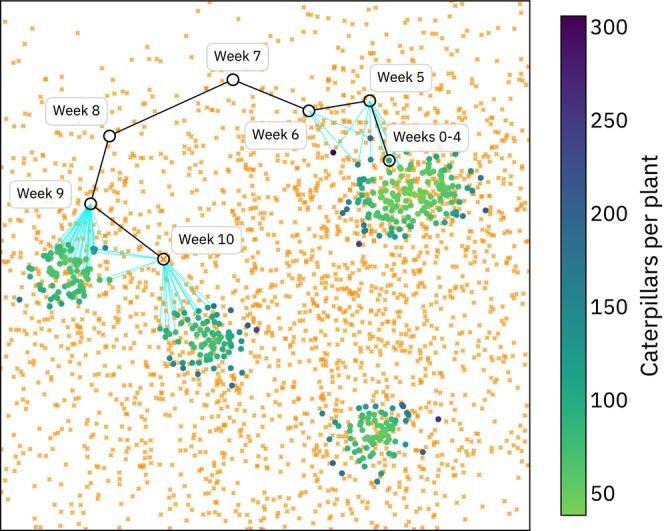
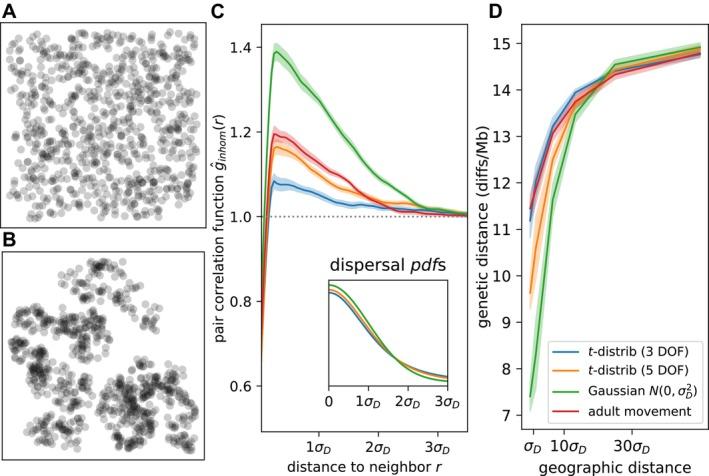
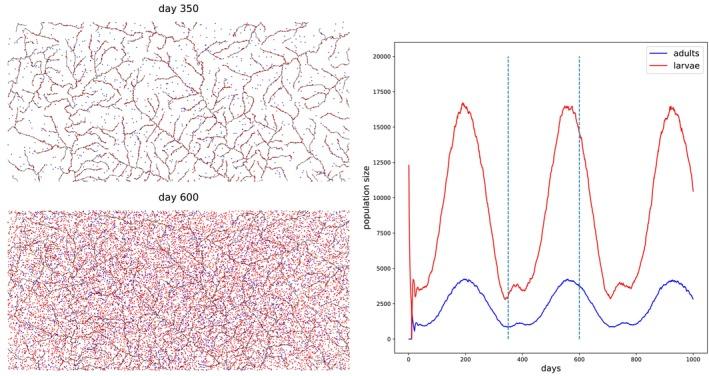
Individual-based simulation has become an increasingly crucial tool for many fields of population biology. However, continuous geography is important to many applications, and implementing realistic and stable simulations in continuous space presents a variety of difficulties, from modeling choices to computational efficiency. This paper aims to be a practical guide to spatial simulation, helping researchers to implement individual-based simulations and avoid common pitfalls. To do this, we delve into mechanisms of mating, reproduction, density-dependent feedback, and dispersal, all of which may vary across the landscape, discuss how these affect population dynamics, and describe how to parameterize simulations in convenient ways (for instance, to achieve a desired population density). We also demonstrate how to implement these models using the current version of the individual-based simulator, SLiM. We additionally discuss natural selection-in particular, how genetic variation can affect demographic processes. Finally, we provide four short vignettes: simulations of pikas that shift their range up a mountain as temperatures rise; mosquitoes that live in rivers as juveniles and experience seasonally changing habitat; cane toads that expand across Australia, reaching 120 million individuals; and monarch butterflies whose populations are regulated by an explicitly modeled resource (milkweed).
基于个体的模拟已成为种群生物学许多领域日益重要的工具。然而,连续地理对许多应用很重要,而在连续空间中实现逼真且稳定的模拟存在各种困难,从建模选择到计算效率。本文旨在成为空间模拟的实用指南,帮助研究人员实施基于个体的模拟并避免常见陷阱。为此,我们深入研究交配、繁殖、密度依赖反馈和扩散机制,所有这些在整个景观中可能会有所不同,讨论它们如何影响种群动态,并描述如何以方便的方式对模拟进行参数化(例如,实现所需的种群密度)。我们还展示了如何使用当前版本的基于个体的模拟器SLiM来实现这些模型。我们还讨论自然选择——特别是遗传变异如何影响人口统计学过程。最后,我们提供四个简短的示例:随着温度升高,鼠兔的活动范围向山上转移的模拟;幼体生活在河流中且栖息地随季节变化的蚊子;在澳大利亚扩散、数量达到1.2亿只的蔗蟾蜍;以及种群受明确建模的资源(乳草)调节的帝王蝶。





 Zotero 插件