Brown Jacqueline Marie, Rita Nicholas, Franco-Arellano Beatriz, LeSage Ann, Arcand Joanne
Faculty of Health Sciences, Ontario Tech University, 2000 Simcoe Street North, Oshawa, ON, L1G 0C5, Canada, 1 9057218668.
Mitch and Leslie Frazer Faculty of Education, Ontario Tech University, Oshawa, ON, Canada.
JMIR Form Res. 2025 Apr 16;9:e69242. doi: 10.2196/69242.
Improving children's food literacy through school-based interventions can support developing healthy eating habits. However, teachers lack appropriate resources, time, and training to provide nutrition education in schools. Serious games, which are games designed for a purpose other than entertainment, have been demonstrated to improve children's food literacy and dietary intake and can address the barriers teachers face in providing nutrition education. Foodbot Factory (Arcand Lab) is a nutrition education intervention that is aligned with curricula and uses a serious game to provide nutrition education to students. Further evidence is needed to understand how serious games, including Foodbot Factory, can be researched in schools to support nutrition education.
The objective of this study was to evaluate the feasibility of a research study protocol that implements the curriculum-based nutrition education intervention Foodbot Factory into a real-world classroom setting. The evaluation of the protocol included study processes, resources, and management feasibility outcomes, as well as a preliminary assessment of scientific outcomes relevant to the intervention.
A nonrandomized study determined the feasibility of intervention implementation. Grade 4 and 4/5 classrooms were assigned to have nutrition education lessons for 5 days with either the Foodbot Factory or a control intervention. Outcomes were assessed in 4 feasibility domains of study processes (eg, recruitment and attrition rates), resources (eg, time taken to deliver the intervention), and management (eg, challenges with intervention delivery), and a preliminary assessment of scientific outcomes pertaining to the acceptability and impacts of the interventions. These outcomes were captured in semistructured field notes completed by study staff and a Nutrition Attitudes and Knowledge questionnaire and acceptability questionnaire completed by participants. Data were analyzed descriptively and using a paired t test to assess within-group changes in nutrition knowledge.
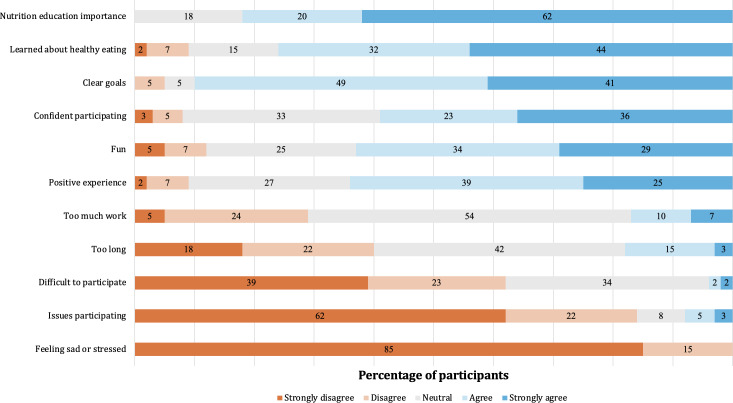
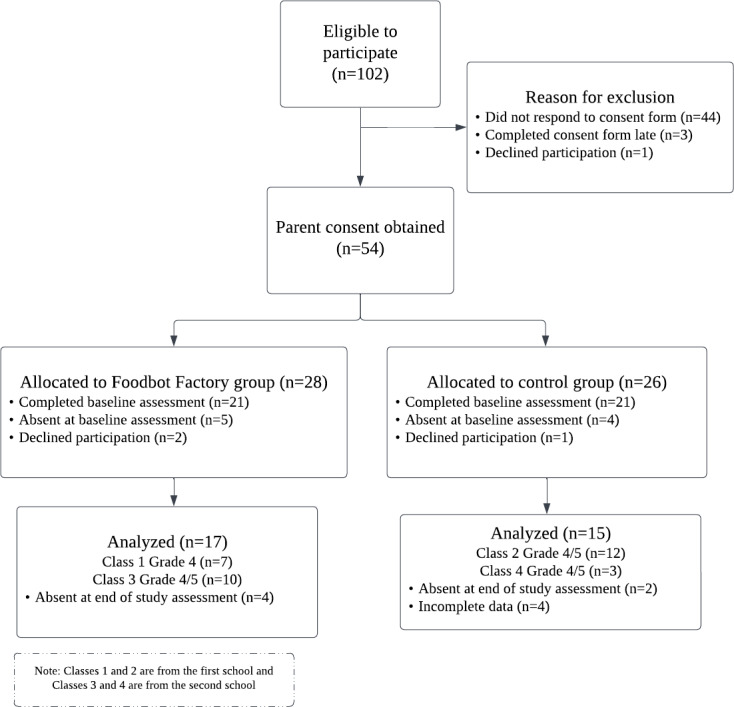
In total, 4 classrooms participated in the feasibility study, with varying recruitment rates for schools (3/20, 15%), classrooms (4/4, 100%), parents (54/102, 53%), and children (49/54, 91%). The time required to implement the research protocol, including data collection and lesson plans, was sufficient and management of the intervention implementation was overall successful. Some challenges were experienced with classroom management during data collection, specifically with electronic data collection. After the intervention, participants reported a positive affective experience (26/41, 63%) and learning something new about healthy eating (31/41, 76%). Participants in both study groups improved their nutrition knowledge, but the changes were not statistically significant. The Foodbot Factory group had a statistically significant improvement in their knowledge of vegetables and fruit (P=.04) and protein foods (P=.03).
These findings indicate that the study protocol is feasible to implement and evaluate Foodbot Factory in a representative sample with select modifications to improve recruitment and data collection procedures.

通过学校干预提高儿童的食品素养有助于培养健康的饮食习惯。然而,教师缺乏适当的资源、时间和培训来在学校开展营养教育。严肃游戏是为非娱乐目的设计的游戏,已被证明可以提高儿童的食品素养和饮食摄入量,并能解决教师在提供营养教育时面临的障碍。Foodbot Factory(Arcand实验室)是一种营养教育干预措施,与课程标准一致,利用一款严肃游戏为学生提供营养教育。需要更多证据来了解如何在学校研究包括Foodbot Factory在内的严肃游戏,以支持营养教育。
本研究的目的是评估一项研究方案的可行性,该方案将基于课程的营养教育干预措施Foodbot Factory应用于实际课堂环境。对该方案的评估包括研究过程、资源和管理可行性结果,以及对与干预相关的科学结果的初步评估。
一项非随机研究确定了干预实施的可行性。四年级和四/五年级教室被分配接受为期5天的营养教育课程,要么采用Foodbot Factory干预,要么采用对照干预。在研究过程(如招募和流失率)、资源(如实施干预所需时间)和管理(如干预实施中的挑战)这4个可行性领域评估结果,并对与干预的可接受性和影响相关的科学结果进行初步评估。这些结果通过研究人员完成的半结构化现场记录以及参与者完成的营养态度和知识问卷和可接受性问卷来获取。对数据进行描述性分析,并使用配对t检验评估营养知识的组内变化。
共有4个教室参与了可行性研究,学校的招募率各不相同(3/20,15%),教室(4/4,100%),家长(54/102,53%)和儿童(49/54,91%)。实施研究方案(包括数据收集和教案)所需的时间是足够的,干预实施的管理总体上是成功的。在数据收集过程中,课堂管理遇到了一些挑战,特别是电子数据收集方面。干预后,参与者报告了积极的情感体验(26/41,63%),并表示学到了一些关于健康饮食的新知识(31/41,76%)。两个研究组的参与者营养知识都有所提高,但变化没有统计学意义。Foodbot Factory组在蔬菜和水果知识(P = 0.04)和蛋白质食物知识(P = 0.03)方面有统计学意义的提高。
这些结果表明,该研究方案在经过一些改进以提高招募和数据收集程序后,可以在具有代表性的样本中实施和评估Foodbot Factory。