Chen Wei, Wang Peng, Meng Fanran, Pehlken Alexandra, Wang Qiao-Chu, Chen Wei-Qiang
Department of Environmental Science and Engineering, University of Science and Technology of China, Hefei 230026, China.
State Key Laboratory for Ecological Security of Regions and Cities, Institute of Urban Environment, Chinese Academy of Sciences, Xiamen 361021, China.
Fundam Res. 2024 Jan 26;5(2):505-513. doi: 10.1016/j.fmre.2023.11.019. eCollection 2025 Mar.
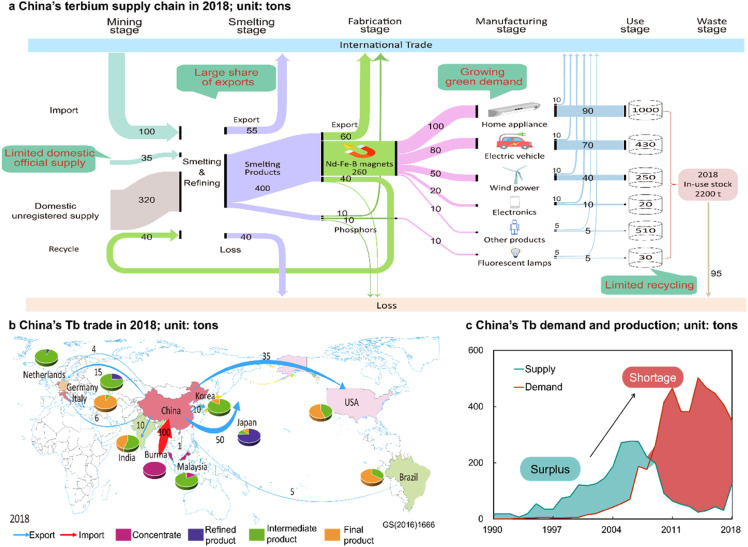
China's official heavy rare earths (HREs) supply, vital to the global sustainable transition, has declined by 90% over the past 20 years. Global concerns have mounted regarding China's production quota policies, yet the real-world bottlenecks remain unclear. This study explores China's terbium (a critical HREs element) supply-demand conflicts and supply chain bottlenecks, and further simulates future potential changes. We identify a growing terbium shortage (a total of 3300 metric tons) in China as its registered production declined by 90% during the period from 2007 to 2018. Contrary to previous views that attribute HREs supply limitations to the production quota policy, we find that only 25% of China's quota related to HREs was utilized in 2018. Such a large quota-supply gap stems primarily from the enforced closures of HREs mines since the current mining techniques failed to reach strict environmental regulations. Furthermore, our simulations predict a 2-5-fold increase in terbium shortage by 2060 under the burgeoning ambitions in electric vehicles and wind power. However, this looming shortage could potentially be mitigated by 27%-70% under the scenario of breakthroughs in green mining techniques. This study highlights the urgency of seeking and promoting HREs green mining technologies, with implications for shifting global attention from geopolitical competition to green supply of rare earth and other minerals.
中国的官方重稀土供应对全球可持续转型至关重要,在过去20年中已下降了90%。全球对中国的生产配额政策愈发担忧,但其实际瓶颈仍不明朗。本研究探讨了中国铽(一种关键的重稀土元素)的供需冲突和供应链瓶颈,并进一步模拟了未来的潜在变化。我们发现,由于2007年至2018年期间中国铽的注册产量下降了90%,铽短缺问题日益严重(总计3300公吨)。与以往将重稀土供应限制归因于生产配额政策的观点相反,我们发现2018年中国与重稀土相关的配额仅使用了25%。如此大的配额供应差距主要源于自当前采矿技术未能达到严格的环境法规以来,重稀土矿的强制关闭。此外,我们的模拟预测,在电动汽车和风力发电蓬勃发展的情况下,到2060年铽短缺将增加2至5倍。然而,在绿色采矿技术取得突破的情况下,这种迫在眉睫的短缺可能会减少27%至70%。本研究强调了寻求和推广重稀土绿色采矿技术的紧迫性,这对于将全球注意力从地缘政治竞争转向稀土及其他矿产的绿色供应具有重要意义。