Pan Weijun, Han Boyuan, Jiang Peiyuan
Civil Aviation Flight University of China, Chengdu, China.
University of Electronic Science and Technology of China, Chengdu, China.
Front Neurorobot. 2025 Apr 2;19:1482327. doi: 10.3389/fnbot.2025.1482327. eCollection 2025.
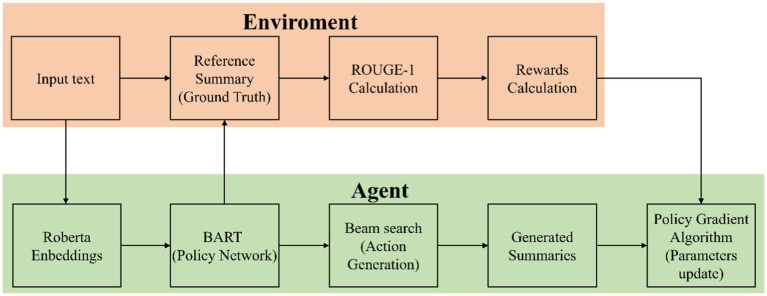
The development of air traffic control (ATC) automation has been constrained by the scarcity and low quality of communication data, particularly in low-altitude complex airspace, where non-standardized instructions frequently hinder training efficiency and operational safety. This paper proposes the BART-Reinforcement Learning (BRL) model, a deep reinforcement learning model based on the BART pre-trained language model, optimized through transfer learning and reinforcement learning techniques. The model was evaluated on multiple ATC datasets, including training flight data, civil aviation operational data, and standardized datasets generated from Radiotelephony Communications for Air Traffic Services. Evaluation metrics included ROUGE and semantic intent-based indicators, with comparative analysis against several baseline models. Experimental results demonstrate that BRL achieves a 10.5% improvement in overall accuracy on the training dataset with the highest degree of non-standardization, significantly outperforming the baseline models. Furthermore, comprehensive evaluations validate the model's effectiveness in standardizing various types of instructions. The findings suggest that reinforcement learning-based approaches have the potential to significantly enhance ATC automation, reducing communication inconsistencies, and improving training efficiency and operational safety. Future research may further optimize standardization by incorporating additional contextual factors into the model.
空中交通管制(ATC)自动化的发展受到通信数据稀缺和质量低下的限制,特别是在低空复杂空域,非标准化指令经常阻碍训练效率和运行安全。本文提出了BART强化学习(BRL)模型,这是一种基于BART预训练语言模型的深度强化学习模型,通过迁移学习和强化学习技术进行了优化。该模型在多个ATC数据集上进行了评估,包括训练飞行数据、民航运行数据以及从空中交通服务无线电话通信生成的标准化数据集。评估指标包括ROUGE和基于语义意图的指标,并与几个基线模型进行了对比分析。实验结果表明,在非标准化程度最高的训练数据集上,BRL的整体准确率提高了10.5%,显著优于基线模型。此外,综合评估验证了该模型在标准化各类指令方面的有效性。研究结果表明,基于强化学习的方法有潜力显著增强空中交通管制自动化,减少通信不一致性,并提高训练效率和运行安全。未来的研究可以通过将额外的上下文因素纳入模型来进一步优化标准化。