Masri Ahmad, Bhattacharya Priyanka, Medoff Brent, Ejaz Ain U, Elman Miriam R, Chandrashekar Pranav, Ives Lauren, Santos Alfonsina Mirabal, Teruya Sergio L, Zhao Yuanzi, Huang Shuaiqi, Wang Xiaofeng, Sperry Brett W, Maurer Mathew S, Soman Prem, Hanna Mazen
Amyloidosis Center, Knight Cardiovascular Institute, Oregon Health & Science University, Portland, Oregon, USA.
Cardiac Amyloidosis Program, Columbia University Irving Medical Center, New York, New York, USA.
JACC CardioOncol. 2025 Apr;7(3):282-293. doi: 10.1016/j.jaccao.2024.12.005. Epub 2025 Feb 11.
Tafamidis improved survival and decreased cardiovascular hospitalizations in the ATTR-ACT trial. Due to improved recognition and earlier diagnosis, the epidemiology of transthyretin amyloid cardiomyopathy (ATTR-CM) is rapidly evolving.
The authors sought to evaluate the contemporary long-term outcomes of patients with ATTR-CM treated with tafamidis.
Patients with ATTR-CM who received at least 1 dose of tafamidis between 2018 and 2021 at 5 amyloidosis centers in the United States were enrolled. Primary outcome was all-cause mortality.
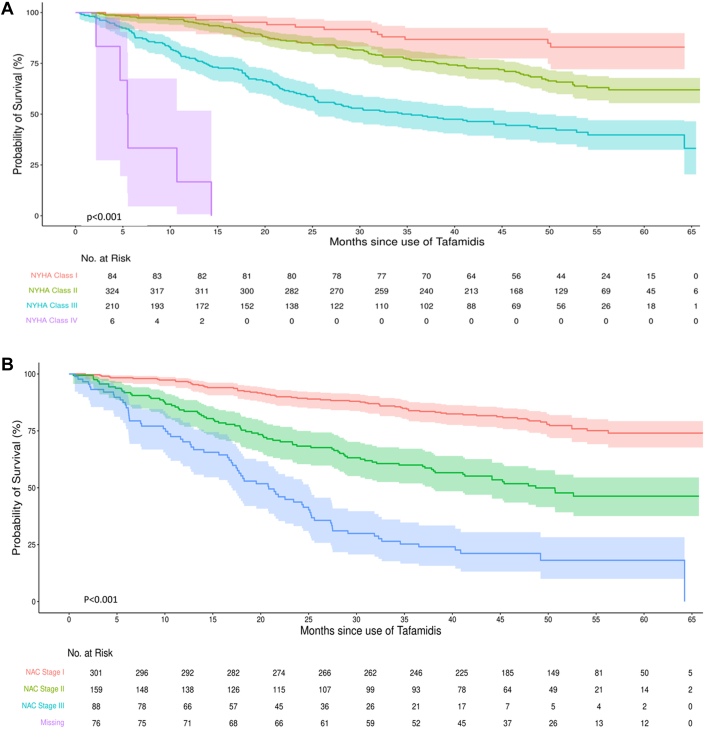
Among 624 patients, mean age was 76.9 ± 8.4 years, 12.5% were female, 17.5% were Black, and 17.5% had variant ATTR-CM. At the time of tafamidis start, 52% had NYHA functional class II, 34% had NYHA functional class III, 40% were in National Amyloidosis Center (NAC) Stage ≥II, 38% were in Columbia Stage ≥II, and the median NT-proBNP level was 1,914 (Q1-Q3: 957-3914) pg/mL. Over a median follow-up of 43.2 months (Q1-Q3: 25.2-52.8 months), 241 patients (38.6%) died. The probability of freedom from death at 65 months was 54.1% (95% CI: 47.4%-60.4%). Similarly, restricting the cohort to patients who received tafamidis within 6 months of their ATTR-CM diagnosis (n = 397, 63.6%) showed similar results, with a survival probability of 49.6% (95% CI: 37.6%-60.5%) at 65 months.
In a contemporary cohort of tafamidis-treated patients with ATTR-CM, 39% of patients died over a median of 43 months. Further work is needed to improve our understanding of ATTR-CM, its natural history, and how to further improve survival and prevent progression of heart failure.
在转甲状腺素蛋白淀粉样变心肌病(ATTR-CM)临床试验(ATTR-ACT)中,塔非酰胺可改善生存率并减少心血管住院率。由于识别能力提高和诊断提前,转甲状腺素蛋白淀粉样变心肌病(ATTR-CM)的流行病学正在迅速演变。
作者试图评估接受塔非酰胺治疗的ATTR-CM患者的当代长期预后。
纳入2018年至2021年间在美国5个淀粉样变性中心接受至少1剂塔非酰胺治疗的ATTR-CM患者。主要结局是全因死亡率。
624例患者中,平均年龄为76.9±8.4岁,12.5%为女性,17.5%为黑人,17.5%患有变异型ATTR-CM。开始使用塔非酰胺时,52%的患者纽约心脏协会(NYHA)心功能分级为II级,34%为III级,40%处于国家淀粉样变性中心(NAC)≥II期,38%处于哥伦比亚≥II期,NT-proBNP水平中位数为1914(四分位间距:957-3914)pg/mL。中位随访43.2个月(四分位间距:25.2-52.8个月),241例患者(38.6%)死亡。65个月时无死亡的概率为54.1%(95%置信区间:47.4%-60.4%)。同样,将队列限制为在ATTR-CM诊断后6个月内接受塔非酰胺治疗的患者(n = 397,63.6%),结果相似,65个月时生存率为49.6%(95%置信区间:37.6%-60.5%)。
在当代接受塔非酰胺治疗的ATTR-CM患者队列中,39%的患者在中位43个月内死亡。需要进一步开展工作,以增进我们对ATTR-CM及其自然病史的了解,以及如何进一步提高生存率和预防心力衰竭进展。