Akhtar Evana, Kuddusi Rakib Ullah, Talukder Md Tanvir, Jakarea Md, Haq Md Ahsanul, Hossain Md Shamim, Vandenent Maya, Islam Mohammad Zahirul, Zaman Rashid U, Razzaque Abdur, Sarker Protim, Raqib Rubhana
icddr,b, 68 Shaheed Tajuddin Ahmed Sarani, Mohakhali, Dhaka, 1212, Bangladesh.
UNICEF, Dhaka, 1207, Bangladesh.
Sci Rep. 2025 Apr 17;15(1):13341. doi: 10.1038/s41598-025-95870-6.
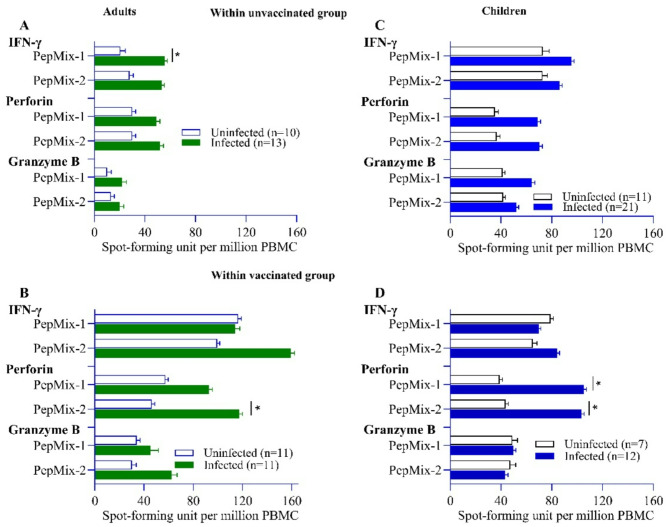
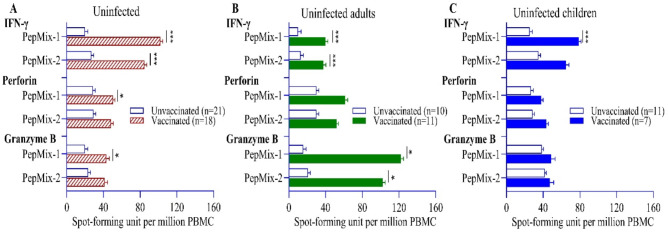
Severe COVID-19 is rare in children suggesting differences in immune response between children and adults. Limited information is available on how cellular immunity is modulated by COVID-19 vaccination and prior infection, and whether it is differentially modulated in children compared to adults. Here, we aimed to compare COVID-19 vaccine-induced functional T cell response between adults and children with and without previous SARS-CoV-2 infection. Adults (18-45 years; n = 45) and children (5-10 years; n = 51;), who received Pfizer-BioNTech COVID-19 vaccine or remained unvaccinated, and previously infected or not with SARS-CoV-2 were selected from two cross-sectional SARS-CoV-2 serosurveillance studies conducted in Bangladesh. Plasma nucleocapsid (N)-specific antibodies were measured by electrochemiluminescence immunoassay; IFN-γ, perforin and granzyme B secreting T cells were assessed using ELISpot assay. Vaccination in adults without previous infection, induced higher frequencies of IFN-γ and granzyme B secreting T lymphocytes compared to unvaccinated adults, while it increased only IFN-γ expression in vaccinated children. Previous infection increased IFN-γ response in unvaccinated adults only. Unvaccinated children showed higher granzyme B expression compared to adults irrespective of infection status. In vaccinated individuals, prior infection induced perforin expression in both adults and children. Children showed slightly different functional T cell response than adults in response to COVID-19 vaccination and infection. mRNA vaccination provided higher IFN-γ response in both adults and children, but induced cytotoxic T lymphocyte (CTL) response in adults only. Future studies may evaluate the impact of other types of COVID-19 vaccines on functional T cell immunity in children to confirm the findings.
重症新冠病毒病(COVID-19)在儿童中较为罕见,这表明儿童与成人的免疫反应存在差异。关于COVID-19疫苗接种和既往感染如何调节细胞免疫,以及与成人相比儿童是否受到不同调节,目前可用信息有限。在此,我们旨在比较有或无既往SARS-CoV-2感染的成人和儿童中COVID-19疫苗诱导的功能性T细胞反应。从在孟加拉国进行的两项横断面SARS-CoV-2血清学监测研究中,选取了接种辉瑞-生物科技公司COVID-19疫苗或未接种疫苗、既往感染或未感染SARS-CoV-2的成人(18 - 45岁;n = 45)和儿童(5 - 10岁;n = 51)。通过电化学发光免疫测定法测量血浆核衣壳(N)特异性抗体;使用酶联免疫斑点试验评估分泌干扰素-γ(IFN-γ)、穿孔素和颗粒酶B的T细胞。与未接种疫苗的成人相比,既往未感染的成人接种疫苗后,分泌IFN-γ和颗粒酶B的T淋巴细胞频率更高,而在接种疫苗的儿童中仅增加了IFN-γ表达。既往感染仅增加了未接种疫苗成人的IFN-γ反应。无论感染状态如何,未接种疫苗的儿童与成人相比,颗粒酶B表达更高。在接种疫苗的个体中,既往感染在成人和儿童中均诱导了穿孔素表达。在对COVID-19疫苗接种和感染的反应中,儿童表现出与成人略有不同的功能性T细胞反应。mRNA疫苗在成人和儿童中均提供了更高的IFN-γ反应,但仅在成人中诱导了细胞毒性T淋巴细胞(CTL)反应。未来的研究可能会评估其他类型的COVID-19疫苗对儿童功能性T细胞免疫的影响,以证实这些发现。